.svg)

.svg)


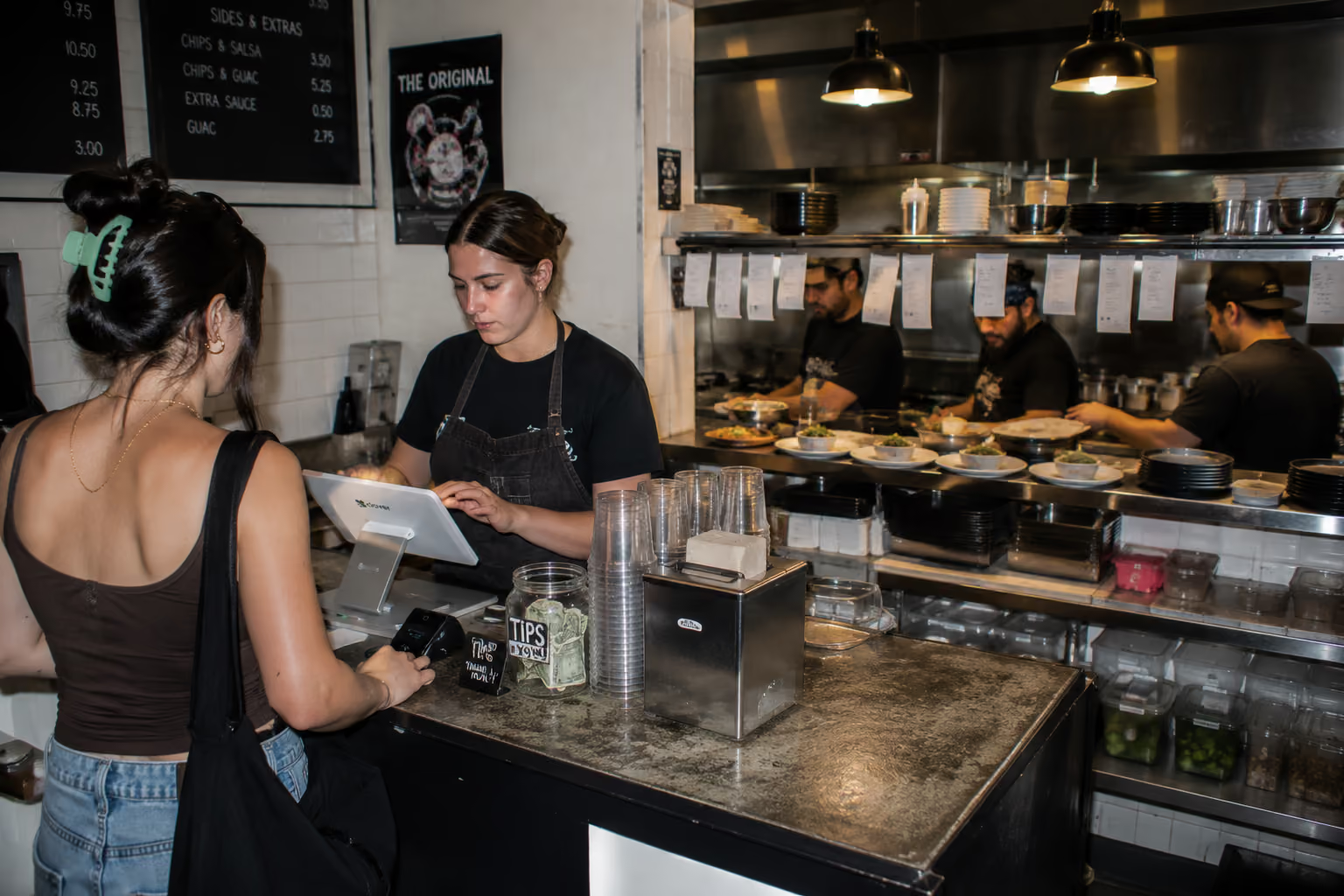
Clover vs Toast for restaurants: Counter-service POS vs restaurant-built POS
I grew up taking phone orders at my family's restaurants starting at age nine. By 16, I was managing front-of-house operations across 11 locations. I've seen every type of POS system you can imagine, and here's what I learned: the biggest mistake operators make is picking a system that was never designed for their type of business in the first place.
When you're comparing Clover and Toast, you're comparing two fundamentally different philosophies. Clover started as a general-purpose point-of-sale system for any business and later adapted for food service. Toast was built from day one exclusively for restaurants. That origin story shapes everything.
The difference between restaurant-built and general-purpose POS
The core argument of this article is simple: a POS system's origin story defines its strengths and weaknesses. Toast was born in a restaurant environment to solve restaurant problems. Clover was born in a retail environment to solve general business problems. Understanding this difference is the key to choosing the right system and avoiding years of operational headaches.
Read our comparison of the best POSs.
Why you should trust my perspective on POS systems
I'm Gurveer Singh, Co-Founder and CEO of Certus AI - an AI answering service for restaurants. Before building restaurant technology, I lived restaurant operations. I started taking orders at nine years old, worked every station by 12, and was managing the front of house for 11 of my family's restaurants by 16. I've personally used or evaluated dozens of POS systems, and this comparison comes from that operator-first perspective, not from a tech reviewer's demo.
Toast vs. Clover POS Comparison at a glance
For operators who need a quick answer, here is the bottom line. Toast is the superior choice for businesses where the kitchen is the heart of the operation. Clover is a better fit for simpler, counter-service businesses or those with a mix of food and retail. Both systems, however, fail to solve the costly problem of missed phone calls during peak hours.
| Feature | Clover | Toast |
|---|---|---|
| Built for | General business adapted for restaurants. Best for counter-service, cafes, and mixed retail/food concepts. | Exclusively for restaurants. Best for full-service, quick-service, bars, and multi-location groups. |
| Distribution | Sold through banks and resellers, leading to varied pricing and support. | Sold directly, providing consistent sales and support processes. |
| Kitchen workflow | Basic order management. Advanced KDS features often require third-party apps. | Deep, native restaurant features including advanced KDS routing, coursing, and fire times. |
| Hardware | Sleek, modular options. Not specifically rated for harsh kitchen environments. | Proprietary hardware is durable, spill-proof, and built for demanding kitchen environments. |
| Payment processing | Rates and terms depend on your reseller, creating significant pricing variations. | Requires use of their in-house payment processing with predictable rates. |
| Contract terms | Often requires multi-year commitments with fees that vary by reseller. | Typically requires a long-term contract (2–3 years) with an early termination fee. |
| Delivery integrations | Integrates with third-party services through its app marketplace. | Direct, robust integrations with major platforms like DoorDash, Grubhub, and Uber Eats. |
| Multi-location | Can support multiple locations, but management features are less comprehensive. | Strong multi-location management with centralized menu updates and reporting. |
Understanding the core differences: Toast and Clover side-by-side
Toast and Clover differ fundamentally in their design philosophy, which affects everything from daily operations to long-term scalability. Toast was engineered specifically for restaurant workflows, with features like coursing and kitchen routing built into the core system. Clover was designed as a versatile business platform that can handle restaurants but also retail stores, service businesses, and hybrid concepts.
Origin stories: Built for restaurants vs. general business
Toast launched in 2013 to solve the unique problems restaurant operators face. The founders spent months in kitchens observing order flows and bottlenecks. Every feature was designed around restaurant-specific workflows, from the front of house to the back. This focus is why restaurants use AI to automate orders and other complex tasks through systems built with their needs in mind.
Clover, launched by First Data (now Fiserv) in 2012, took a different path. It was built as a modern, flexible POS for any small business, from boutiques to salons. Its versatility is a strength for mixed-use businesses but a limitation for complex restaurants that need specialized tools, not general ones.
Pricing models and potential hidden costs
Toast's pricing is direct but can be steep. Hardware starts around $799, and software plans range from $69 to over $425 per month. You are also locked into their payment processing, which is typically around 2.49% + 15 cents per transaction. The main benefit is predictability; your costs are clear from the start.
Clover's pricing is a minefield. Because it's sold through thousands of different resellers (like banks), your costs for hardware, software, and processing can vary wildly. One reseller might offer a great rate, while another locks you into an expensive, multi-year lease with high termination fees. You must scrutinize the contract and ask for the total cost of ownership before signing.
Hardware options and durability for restaurant environments
Toast's hardware is built like a tank. Their terminals are spill-resistant, and their Toast Go 2 handheld is IP54-rated to withstand the drops, splashes, and grease of a busy kitchen. This durability comes at a higher price, and the hardware is proprietary, meaning you can only get it from Toast.
Clover offers a wider, more modern-looking range of hardware, like the portable Clover Flex and compact Clover Mini. These devices are perfect for counter-service environments, food trucks, or retail shops. However, they are not specifically hardened for the harsh reality of a high-volume kitchen, making them more susceptible to damage.
Payment processing and contract terms
With Toast, you use Toast Payments, period. This lack of flexibility is a drawback for high-volume restaurants that want to negotiate processing rates. However, it simplifies support, as you only have one company to call for both your POS and payment issues. Contracts are typically 2-3 years.
Clover's processing is a mixed bag. You have the flexibility to find a reseller offering competitive interchange-plus pricing, but you also risk getting stuck with inflated rates and a non-cancellable, three-year contract. It is critical to understand who your processor is and what the terms are before committing.
Also read our comparison of Clover vs Square! I've also published a full Clover POS review and Toast POS review covering pricing and contracts in more depth.
When is Toast the best POS?
Toast excels when your kitchen is the heart of your operation. Its features are designed to streamline complex workflows, provide deep operational insights, and grow with your business. For full-service dining, high-volume takeout, and expanding restaurant groups, Toast is purpose-built for success.
Advanced kitchen workflow and order management
Toast's Kitchen Display System (KDS) is a game-changer for busy kitchens. It automatically routes orders to the correct prep station, tracks ticket times, and allows for native coursing (e.g., firing appetizers before entrees). This level of control is essential for managing complex orders and ensuring a smooth service, a key lesson from how Domino's built a pizza empire.
Comprehensive reporting and analytics for restaurant owners
Toast provides restaurant-specific analytics that go far beyond simple sales reports. You can track menu item profitability, labor costs as a percentage of sales, and inventory depletion down to the ingredient level. This data is crucial for optimizing your menu, controlling costs, and making informed business decisions, much like the strategies Domino's uses to track everything.
Integrated online ordering, delivery, and loyalty programs
Toast offers a seamless, all-in-one solution for digital guest engagement. Its native online ordering platform (Toast Takeout), direct integrations with major delivery services (DoorDash, Grubhub), and a built-in loyalty program all work together. This eliminates the need for multiple third-party tablets and ensures that all order and customer data flows into one system.
Scalability for multi-location growth
For restaurant groups, Toast's cloud-based architecture is a major advantage. You can manage menus, pricing, and employees across all locations from a single dashboard while still allowing for location-specific adjustments. The system is designed to scale, ensuring you won't outgrow your POS as you expand from one location to ten.
Also check out Toast vs Square POS!
Where Clover finds its niche: Flexibility for counter and mixed businesses
Clover's strength lies in its versatility and lower barrier to entry. It's an excellent choice for businesses where food is just one part of the equation or where operational needs are straightforward. Cafes, bakeries, food trucks, and quick-service spots with simple menus can thrive with Clover's flexible and affordable system.
POS with low entry cost and hardware versatility
For a new business or one on a tight budget, Clover's lower upfront hardware costs are appealing. You can get started with a simple card reader or a portable Clover Flex for a fraction of the cost of a full Toast system. This affordability makes it a popular choice for pop-ups, food trucks, and small counter-service shops.
Extensive app marketplace for diverse business needs
Clover's app marketplace is its biggest differentiator. You can add functionality for everything from payroll and accounting to specialized loyalty programs and weight scale integrations. This allows businesses to build a custom POS solution tailored to their unique needs, whether it's a bakery needing a scale or a small shop wanting to manage appointments.
Ideal for simple menus and retail crossover
Clover shines in environments like cafes that sell coffee and pastries alongside bags of beans and branded mugs. The system handles both restaurant-style items (with modifiers) and standard retail products (with barcodes and SKUs) with ease. If your menu is simple and your business has a retail component, Clover is often a more natural fit than a restaurant-only system like Toast.
Navigating Clover's varied processing rates and reseller ecosystem
A key "watch-out" for Clover is the reseller model. While it offers flexibility, it also creates risk. You must do your homework to find a reputable reseller that offers transparent pricing and fair contract terms. Always get a written proposal detailing all fees, the contract length, and any early termination penalties before you sign.
Can I switch from Clover to Toast easily?
Switching is possible but can be challenging. You'll need to migrate menus, customer data, and employee information. The biggest hurdle is often getting out of your Clover contract, which may have a steep early termination fee. Plan for a transition period of several weeks to ensure a smooth changeover.
The gut-check: Are you a restaurant or a counter business?
Choosing the right POS comes down to understanding your business's operational DNA. Don't get distracted by flashy features; focus on what you need to run your specific operation smoothly and profitably. The best system is the one that feels like it was designed just for you.
When your kitchen is the heart of the operation
If you run a full-service restaurant, a high-volume takeout spot with a complex menu, or any business where kitchen efficiency is paramount, you need a restaurant-first POS. Your system must handle intricate order modifications, coursing, and routing without extra workarounds. In this scenario, a system like Toast is built to support your core business.
When food is part of a broader retail experience
If you run a coffee shop that also sells merchandise, a bakery with a retail shelf, or a small market with a deli counter, your needs are different. You require a POS that can seamlessly handle both food service and retail transactions. A flexible, general-purpose system like Clover is often the better choice here.
Avoiding the wrong POS: Fighting your system daily
Choosing the wrong system leads to daily frustration and lost revenue. It means servers using confusing workarounds, kitchen staff misreading tickets, and managers spending hours trying to get the data they need. A POS should solve problems, not create them. A mismatch between your operations and your POS is a tax on your efficiency, morale, and bottom line.
The one problem neither POS solves: Your phone at peak hours
Even with the perfect POS, there's a massive revenue leak that most restaurants ignore: the ringing phone. During a dinner rush, your staff is focused on serving in-house guests, and every unanswered call is a lost takeout order, a missed reservation, and a frustrated customer who may never call back.
Why you need restaurant Voice AI
Think about it. If your average phone order is $30 and you miss just 10 calls during a busy Friday night, that's $300 in lost revenue in a single shift. Over a year, that adds up to over $15,000. Even the best POS system can't help you if your team is too busy to answer the phone, which is why you must never miss a call with an AI phone agent.
How Certus AI bridges the gap for any POS
This is where Certus AI comes in. Our autonomous restaurant voice AI acts as your restaurant's best employee, answering 100% of your calls, 24/7. It takes complex orders in English and Spanish, answers common questions, and places the order directly into your POS system, whether it's Toast, Clover, or Square. Learn more about Voice AI for restaurants with POS integration.
We offer a flat monthly price, same-day setup, and a 30-day money-back guarantee. Just ask Boardwalk Pizza, which captured over $70,000 in orders they would have missed (read the full case study).
The POS-checklist for your restaurant's future
Use these questions to guide your decision. Be honest about your current operations and your future goals to ensure you choose a system that will support you for years to come.
Question 1: Restaurant-first or retail-first?
What is the core of your business? Is it a complex kitchen operation or a simpler counter-service model, possibly with retail? Your answer to this question is the most important factor in your decision.
Question 2: How complex is your menu and kitchen workflow?
Do you need advanced features like coursing, complex modifier management, and integrated KDS routing? If so, a restaurant-native system is non-negotiable.
Question 3: Who handles your payment processing and what are the terms?
Are you comfortable being locked into a single processor (Toast), or do you want the flexibility to shop for rates (Clover)? Make sure you understand the total cost, including all fees and contract terms.
Question 4: What's your hardware budget and durability needs?
How much can you invest upfront, and how much abuse will your hardware take? Balance the sleek, affordable options from Clover against the rugged, purpose-built hardware from Toast.
Question 5: What's your phone order volume and how much are you losing?
Finally, look beyond the POS. How many calls are you missing each day? Acknowledging this often-overlooked revenue leak is the first step to plugging it, often with one of the best AI phone ordering systems.
Author Bio and Conclusion
Gurveer Singh is the Co-Founder and CEO of Certus AI, a Y Combinator-backed company that won the Innovation Award 2025 for its revolutionary voice AI technology. After growing up in his family's restaurant business, Gurveer dedicated his career to solving the biggest operational challenges for restaurant owners.
Your POS can manage orders, but it can't answer the phone. Certus AI ensures you never miss an order again. Learn how an AI phone agent can handle complex orders and see how much revenue you could be recovering.
We are happy to give you personal consulting

.svg)
.svg)
.svg)
.svg)