.svg)

.svg)


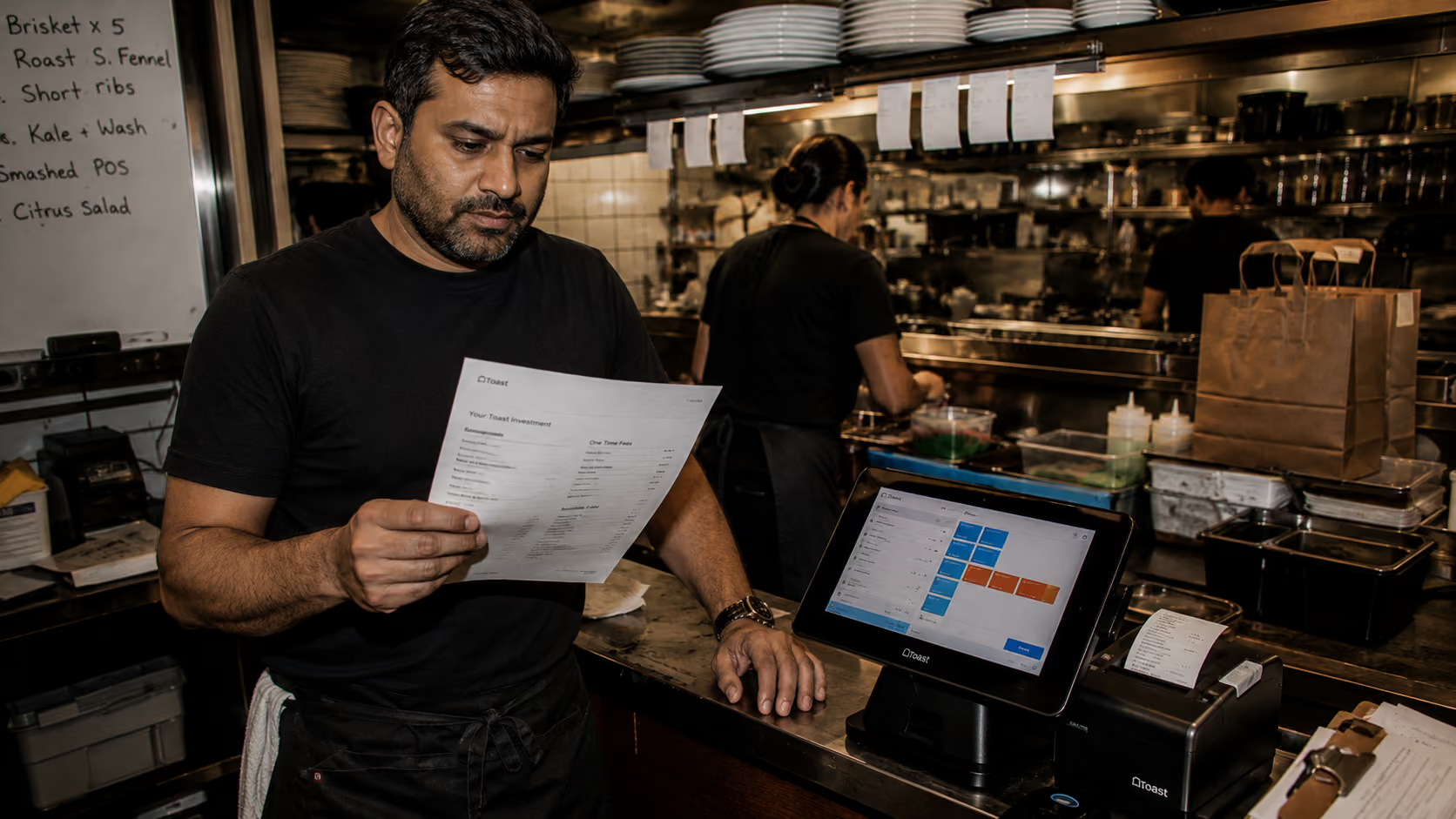
Operators in my network ask me about Toast more than any other POS, and I get why. It's the fastest-growing restaurant POS in the country, and at first glance the entry price is zero dollars a month. I ran front-of-house across 11 of my family's restaurants growing up, and I've learned the hard way that "free" and "cheap" are different things in this industry.
One thing up front: Certus integrates with Toast, and plenty of the restaurants we serve run on it. I see Toast working in real kitchens every week. This review is what I'd tell a friend evaluating it for their own restaurant: where it earns its reputation, where the bill actually lands, and the one revenue channel it leaves for you to solve.
What Toast POS is
Toast is a restaurant-only POS: purpose-built hardware, kitchen display screens, handhelds, online ordering, payroll, and marketing, all in one ecosystem. It isn't adapted retail software. That focus is why it's grown to about 171,000 restaurant locations, adding roughly 7,000 in the first quarter of 2026 alone, up 22% year over year.
For scale: industry analysis puts Toast at around 16% of US restaurant payment volume, level with NCR and behind only Oracle's Micros. When a platform is that widespread, the staff you hire have often already used it. That matters more than most feature checklists.
Toast POS pricing, what you'll actually pay
Toast's published software tiers look simple. The real math lives in processing rates, hardware, and add-ons, so let's take them in order.
| Plan | Software cost | What you get |
|---|---|---|
| Starter Kit | $0/month | Up to 2 terminals, core POS |
| Point of Sale | $69/month | Core POS, cloud reporting, 24/7 support |
| Build Your Own | Custom quote | Core plus your pick of add-on modules |
The $0 plan tradeoff
Nothing at Toast is free; the Starter Kit just moves the cost into your processing rate. Pay-as-you-go pricing runs 3.09% to 3.69% plus 15 cents per transaction, and Toast requires you to process payments through Toast, so you can't shop that rate around. Pay for your hardware upfront and card-present processing drops to 2.49% plus 15 cents.
Run the math on your own volume before the $0 sticker decides for you. On $60,000 a month in card sales, the gap between 3.69% and 2.49% is about $720 a month, which is a lot more than the $69 software fee you were avoiding.
Hardware and the add-on stack
Starter hardware bundles run from about $449 for a handheld setup to roughly $1,024 for a countertop terminal, or $0 upfront if you accept the higher processing rate. Extra handhelds, kitchen displays, and kiosks each carry their own hardware and monthly software costs.
The bigger budget surprise is the module stack. Online ordering runs about $75 a month, loyalty $50, gift cards $50, email marketing $75, payroll $90 plus $9 per employee, and kitchen display software $25. A $69 plan quietly becomes $200 to $400 a month once you add the modules most independents actually want, so price the stack you need, not the tier.
Contracts
Toast contracts typically run one to three years, most commonly two, with auto-renewal and early termination fees that operators report can run well into four figures. Combined with proprietary hardware that doesn't move to another system, switching costs are real. Go in assuming you're committing for the term.
What operators like about Toast
On Capterra, Toast holds 4.1 out of 5 across 550+ reviews, and the ease-of-use sub-score is 4.5. The navigation and order entry get singled out constantly, with 92% of reviewers positive on navigation. In practice that means new staff get productive fast, which during a staffing crunch is worth real money.
The kitchen display integration and reporting also earn their keep. Order-to-kitchen flow without paper tickets, menu-level sales data, and labor reporting in one place is genuinely the standard the rest of the category chases.
Where operators get frustrated
The same Capterra reviews put value-for-money at 3.8 and support at 3.7, and fees are the single most common complaint theme. That tracks with everything above: the software is well-liked, the bill is not.
The trust wobble worth knowing about: in June 2023 Toast added a mandatory 99-cent fee charged to your customers on online orders over $10. Operators revolted, and within weeks Toast reversed it, with the CEO publicly saying "we made the wrong decision." I give them credit for the reversal. But it's a reminder that on a closed platform, pricing decisions get made for you, so read every fee notice they send.
Toast's AI moves in 2026
Toast has been shipping AI fast, and it's worth understanding what that does and doesn't cover. ToastIQ and the Toast IQ assistant help operators work the platform itself, and its Sous Chef upsell tool lifted average order value about 6% in pilots. In April 2026 Toast launched a drive-thru product that supports voice ordering through integrations.
Notice the shape of that: Toast's AI investment points at the operator and the in-store experience. Your restaurant's phone line isn't the target, and Toast itself routes phone-ordering AI through its partner ecosystem. That's the gap the next section covers, because it's where independents bleed the most.
The gap Toast leaves: your phone line
However good your POS is, it doesn't answer the phone. DoorDash's research, reported by Restaurant Dive, found 50% of calls to restaurants go unanswered. Those calls are orders, reservations, and catering jobs, and they land hardest during the rush when nobody can step away from a table.
This is where an AI phone agent completes the stack, and it's exactly what we built Certus to do. It answers every call, takes the full order in English or Spanish, both included as standard, and fires the ticket straight into Toast through the integration, so nobody re-types anything. Manhattan Deli and Grill in Tupelo, Mississippi runs this exact setup, Toast plus Certus, and added $30,000 a month in phone orders it used to miss.
Certus works with all major POS systems including Toast, Square, Clover, Skytab, and Aloha NCR, on flat monthly pricing with a 30-day rolling contract, same-day setup, and a 30-day money-back guarantee. If you're already sold on Toast, this is the piece that makes sure the demand it helps you build actually gets captured. You can see the full setup on our Toast integration page.
Verdict: who should choose Toast
Toast fits you if you want restaurant-specific software your staff learn in a day, you're comfortable committing for a contract term, and you'd rather have one accountable ecosystem than stitch together five vendors. It's the fastest-growing major POS for a reason, and NerdWallet currently rates it their top restaurant POS at 4.4 out of 5.
Think harder if you're rate-sensitive on processing, since you can't shop it around. Same if you want month-to-month flexibility, or your real total is the $69 tier plus four add-on modules. Price your actual stack, read the contract term, and compare against Square for Restaurants and Clover before signing; I've broken down Toast vs Square separately if that's your shortlist. I've also reviewed Skytab in full if it's on your radar.
Frequently asked questions about Toast POS
Is Toast a good POS system for independent restaurants?
For most independents, yes, with eyes open on cost. It's purpose-built for restaurants, easy to train staff on, and holds a 4.1 on Capterra. The tradeoffs are mandatory Toast payment processing, multi-year contracts, and add-on modules that raise the real monthly cost well past the sticker price.
How much does Toast POS really cost per month?
Software runs $0 to $69 a month for the standard tiers, but the realistic total for an independent using online ordering, loyalty, and a kitchen display lands around $200 to $400 a month, plus processing at 2.49% to 3.69% and 15 cents per transaction depending on how you buy your hardware.
What are the biggest complaints about Toast POS?
Fees top the list in operator reviews: processing rates on the $0 plan, add-on module costs, and contract termination fees. Support responsiveness is the second recurring theme, scoring 3.7 on Capterra against a 4.5 for ease of use.
Does Toast answer restaurant phone calls?
Not natively. Toast's AI products focus on operator workflows, in-store upselling, and drive-thru. Phone answering and phone ordering are handled through Toast's partner integrations, which is how an AI phone agent like Certus connects: it answers the call, takes the order, and sends the ticket into Toast automatically.
Can I leave Toast before my contract ends?
Toast contracts typically run one to three years with auto-renewal, and operators report early termination fees that can reach into the thousands. Assume you're committed for the term and negotiate the term length before you sign.
Ready to make sure the phone side of your Toast setup captures every order? Book a demo and we'll show you Certus running on Toast, live.
References
Sources referenced in this article:
- NerdWallet, "Toast POS Review 2026" (updated January 13, 2026) - nerdwallet.com
- Merchant Maverick, "Toast POS Pricing Guide" (June 10, 2025) - merchantmaverick.com
- POSUSA, "Toast POS Pricing" (June 23, 2026) - posusa.com
- UpMenu, "Toast Pricing" (May 12, 2026) - upmenu.com
- Capterra, Toast POS reviews - capterra.com
- Restaurant Business, "Toast to remove 99-cent fee after widespread backlash" (July 2023) - restaurantbusinessonline.com
- PYMNTS, "Toast reverses course on $0.99 consumer fee" (July 2023) - pymnts.com
- Toast Q1 2026 financial results (May 7, 2026) - stocktitan.net
- Payments Dive, "Toast, Clover battle for restaurant customers" (April 29, 2025) - paymentsdive.com
- Nasdaq/Toast PR, "Toast launches ToastIQ" (May 1, 2025) - nasdaq.com
- PYMNTS, "Toast AI-powered menu upsell tool boosts AOV 6%" (May 9, 2025) - pymnts.com
- Restaurant Technology News, "Toast launches conversational AI assistant" (October 29, 2025) - restauranttechnologynews.com
- Toast support docs, Incept AI phone-ordering integration - support.toasttab.com
- Restaurant Dive, "DoorDash adds automated AI phone ordering" (August 28, 2023) - restaurantdive.com

.svg)
.svg)
.svg)
.svg)