.svg)

.svg)


Key takeaways
- Generic AI answering systems fail restaurants because they don't understand the unique demands of taking complex food orders.
- A true restaurant AI must handle end-to-end ordering, integrate with your POS, manage payments, and speak English and Spanish.
- Missed calls are costing your restaurant thousands every month; calculating your lost revenue reveals the real impact.
- Choose an AI built specifically for restaurants that offers clear ROI, quick setup, and robust support.
The phone line problem I know too well
I was nine years old the first time I answered a phone order at my family's restaurant. After managing 11 of those restaurants, I can tell you the phone line is still the most stressful part of running a food business. The difference now is that we don't have to rely on a nine-year-old anymore haha.
AI answering systems have exploded across industries, but a generic AI that works for a law office will fail spectacularly in a restaurant.
This article breaks down how AI phone agents for restaurants work, why most "AI answering services" miss the mark, and how to calculate what missed calls are costing you right now. If you're getting 30+ calls a day, the math gets brutal fast.
What AI answering means for your restaurant
Restaurant AI phone answering means having an autonomous system that handles phone conversations from start to finish. It's not about routing calls or reading scripted responses. It uses conversational AI to understand natural speech, make decisions, and complete transactions without human help. For your restaurant, this means taking a full order, processing payment, and sending it directly to your kitchen while your staff focuses on in-house guests.
The technology has moved far beyond the frustrating traditional IVR systems of the past. A system designed for a dentist's office has no idea how to handle "large pepperoni, half with mushrooms, no olives, and can you make sure it's well done?" Restaurants need purpose-built solutions.
Why generic AI falls short for food orders
Generic AI systems are built for simple, predictable conversations. They work fine when someone asks "What are your hours?" but they fall apart when a regular calls and says, "Give me the usual but swap the fries for onion rings."
Think of it like asking a general assistant to cook a gourmet meal. They might know ingredients, but they don't understand technique or timing. Restaurant orders require understanding context, handling modifications, and managing the chaos of a Friday night rush. I tried a generic IVR in my family's restaurants. The phone would ring, a robot would read options, and customers hung up. We were better off just missing the call.
The shift from routing calls to taking action
Old-school phone systems just answered and transferred calls. Modern restaurant AI completes transactions. Your goal isn't just to pick up the phone, it's to capture revenue. Traditional systems might say "Press 1 for takeout," then put the caller on hold. This frustrates customers and still interrupts your staff.
A true restaurant AI takes the order, confirms it, processes payment, and pushes it to your POS. It doesn't hand off work to your staff, it completes the work. That's the fundamental shift from answering to acting, achievable with the best conversational IVR solutions.
The four jobs a restaurant AI must master
A true restaurant AI phone system handles four critical jobs that generic answering services can't touch.
Smart restaurant voice AI can take orders end-to-end
The AI must understand and process complete orders through natural conversation. This means handling complex requests, navigating large menus, managing modifiers, and answering allergy questions. Imagine a customer says, "I want a large pepperoni pizza, half with mushrooms, no olives, and a side of ranch." The AI needs to parse that sentence, understand the half-and-half request, and add the side.
This is where most systems break. They can handle "large pepperoni pizza" but choke on modifications. Or they get the order right but then say "Visit our website to complete your order," which defeats the purpose. A purpose-built AI needs to know how to handle complex restaurant orders from start to finish.
Pushing orders directly to your POS ticket with AI
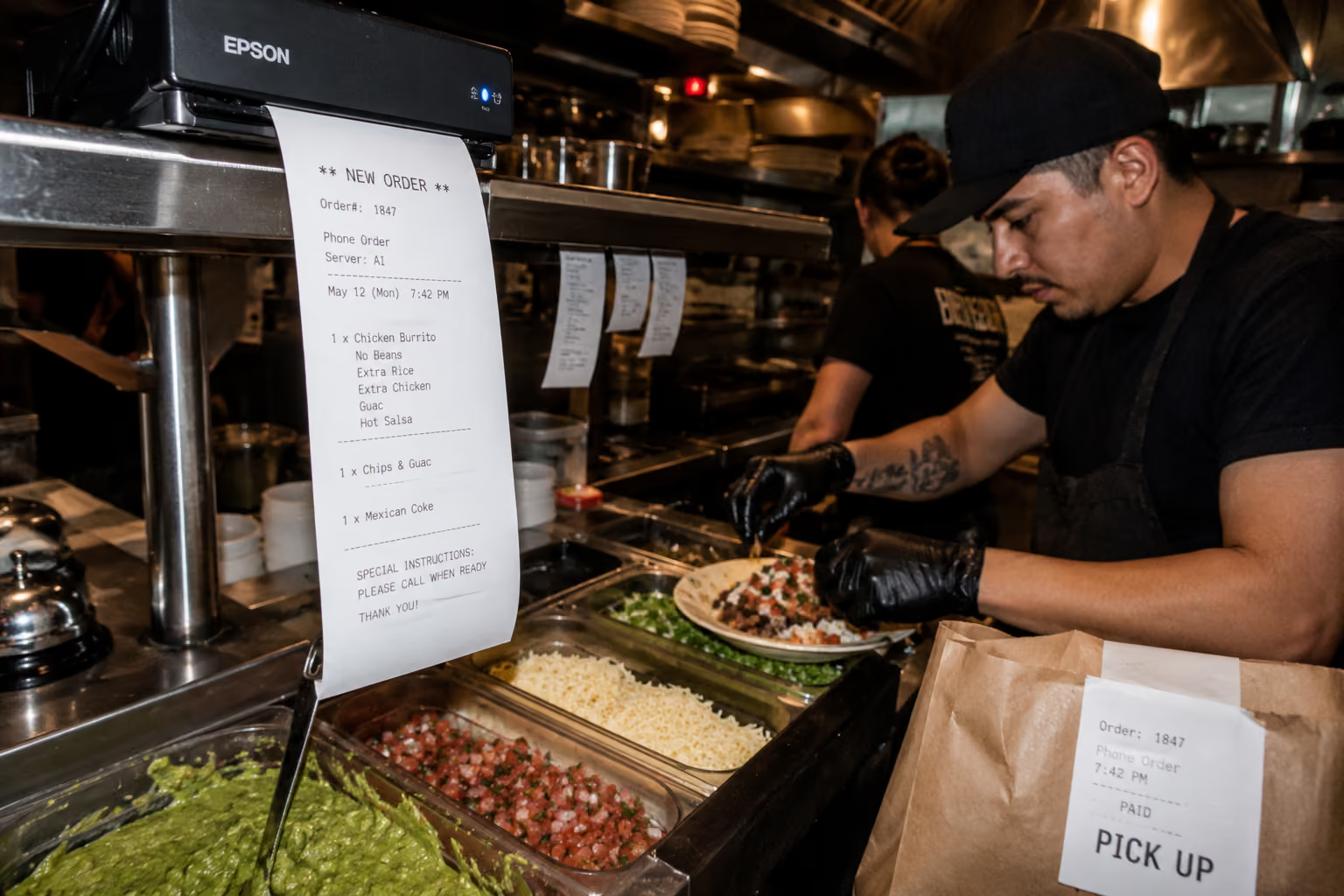
An order isn't complete until the ticket prints in your kitchen. The AI must integrate directly with major POS systems like Toast, Square, Clover, Skytab, and Flipdish (--> Read our comparison of Toast vs Sqaure POS). The order should appear exactly as if a staff member entered it, printing at the bar and kitchen with full accuracy.
If orders come through with errors, your staff will lose trust in the system.
Handling payments and multilingual conversations
The AI must process payments securely, whether by capturing card details on the call, sending an SMS payment link, or marking orders for payment at pickup. It also needs to handle both English and Spanish conversations without upcharges, understanding distinct accents and regional variations.
Multilingual support matters more than most operators realize. Sunset Point Wood Fired Pizzeria serves a largely Spanish-speaking customer base. Before implementing a bilingual AI phone agent, they were losing orders from customers who called, heard English, and hung up. After adding Spanish support, they started capturing the Spanish-speaking orders they were losing.
Freeing up staff for in-house hospitality
The real job of restaurant AI is to remove the impossible choice between answering the phone and serving the guest in front of you. When your host isn't running to grab the phone, they can greet customers and manage the waitlist. Phone duty burns out staff faster than almost anything else.
Why most AI phone services miss the mark for restaurants
The AI answering market is crowded, but most services will waste your money because they aren't built for the specific chaos of restaurant operations. Here’s how to spot the ones that don't work.
The "send a link" trap: why rerouting calls fails
Some services, like Slang AI, answer your phone and immediately text the caller a link to your online ordering page. This isn't a solution, it's just adding friction. People call for a reason: they're driving, they have a complex order, or they simply prefer talking to someone.
Sending them a link tells them "We can't help you, go figure it out yourself." Most will hang up and call your competitor. This is why many restaurants are looking for a Slang alternative. True restaurant order automation means Certus AI takes the order on the phone, it doesn't just text a link to your menu.
Hidden costs and limited language support
Pricing models reveal whether a company understands restaurant economics.
Loman AI, for example, charges $399 per month plus $0.50 per minute. For a busy restaurant getting 50 calls a day at an average of 3 minutes, that's an extra $2,250 in usage fees per month. Your total bill would be over $2,600.
Compare that to a flat monthly price with no per-minute charges. The difference is huge. Many systems also charge extra for Spanish support, which is unacceptable in today's market.
Add-on modules and fragmented solutions
Some tech platforms, like Maple, treat phone ordering as an expensive add-on. The problem is that these modules are rarely the company's focus. This means slower updates, less sophisticated AI, and clunky integrations. You need a purpose-built solution that does one thing exceptionally well: answer your phone and take orders flawlessly.
The real cost of missed calls: doing the math
Most operators know they're missing calls, but few have calculated the cost. Let's fix that. A typical busy restaurant gets 30-75 calls per day. During rush hours, roughly 25% of those calls go unanswered. With an average order value (AOV) of $35-$50, the losses add up fast.
Let's use conservative numbers: 50 calls a day, 25% missed during rush (12 calls), and a $40 AOV. That's $480 in lost revenue per day. Over a month, that's over $14,000 walking out the door. And this is what you can recover with automated phone order taking.
Calculating your restaurant's lost revenue
Use this simple formula to estimate your own missed revenue: (Daily Calls × Miss Rate %) × Average Order Value = Daily Lost Revenue
Example: (60 calls × 25%) × $45 AOV = 15 missed calls × $45 = $675 per day. That's $20,250 per month, or $243,000 per year.
The cost goes beyond a single lost order. A customer who can't reach you will call your competitor, and you may lose them for good. There's also the cost of staff burnout. When your team is constantly stressed by a ringing phone, they give worse service to in-house guests and are more likely to quit. The real cost is the compounding effect of frustrated customers, burned-out staff, and degraded service.
What a truly effective restaurant AI phone agent looks like
A truly effective AI phone agent for restaurants is built specifically for this industry. It combines advanced technology with a deep understanding of hospitality. It's your most reliable employee, one that never calls in sick and always sounds happy to be there.
This kind of system is validated by the industry. It's backed by groups like Y Combinator and wins awards like the Restaurant Tech Innovation Award (Certus AI). Operators across the US trust it because it delivers measurable results, turning a major pain point into a reliable revenue stream. When you're looking for a solution, ask yourself if it's just a generic bot or one of the best AI phone ordering systems for small restaurants.
The right AI partner makes adoption easy. Certus AI can go live in 48 hours with less than an hour of your time. The best providers offer a flat monthly price with no hidden per-minute charges, so your bill is always predictable. A 30-day money-back guarantee is also a critical sign that the company stands behind its product and is confident it will deliver value.
Built for complexity, proven by operators
An effective AI is proven by its ability to handle the messy reality of restaurant orders. It should easily manage custom requests, navigate menus with over 100 items, and support both English and Spanish speakers at no extra cost. This isn't a theoretical capability, it's a requirement proven by real-world restaurant operators who rely on it every day.
Getting started with AI for restaurants
Many operators hear "new tech" and think "new headache." A good AI partner understands this and has designed the process to be as painless as possible. The goal is to get you capturing more revenue immediately, not to add another project to your plate.
A quick setup, not a headache
The onboarding process should be simple and fast. A restaurant phone software provider can get you set up in about 45 minutes. You provide your menu and a few details about your operation, and they handle the rest.
Within the same day, your AI can be live and taking orders, with no new hardware required.
Support that understands your business
When you need help, you should be able to reach a real person who understands the restaurant business. Avoid companies that hide behind chatbots or long support queues. Look for providers that offer direct access to their team, including developers, through a private chat. This ensures that any issues are resolved quickly by people who know the system inside and out.
Time to reclaim your restaurant's potential
The phone line doesn't have to be a source of stress and lost revenue. It can be your most reliable, always-on employee, turning every call into profit. By automating the repetitive task of taking phone orders, you empower your staff to focus on what they do best: providing amazing hospitality to the guests in your dining room.
This isn't just about plugging a leak, it's about re-engineering your front of house for a new era. It's a strategic move, much like how Domino's built an empire without having the best pizza, by focusing on technology and operational excellence.
About the author
Gurveer Singh is the Co-Founder & CEO of Certus AI, a Y Combinator-backed company re-engineering the restaurant front of house. Growing up in his family's 11-location restaurant group, Gurveer started taking phone orders at age 9 and was managing the front of house by 17. He built Certus AI to solve the pervasive problem of missed calls and lost revenue, drawing on decades of firsthand restaurant experience.
Ready to turn every phone call into revenue? See how a restaurant-specific AI phone agent can transform your operations. [Book a Demo Today]

.svg)
.svg)
.svg)
.svg)