.svg)

.svg)


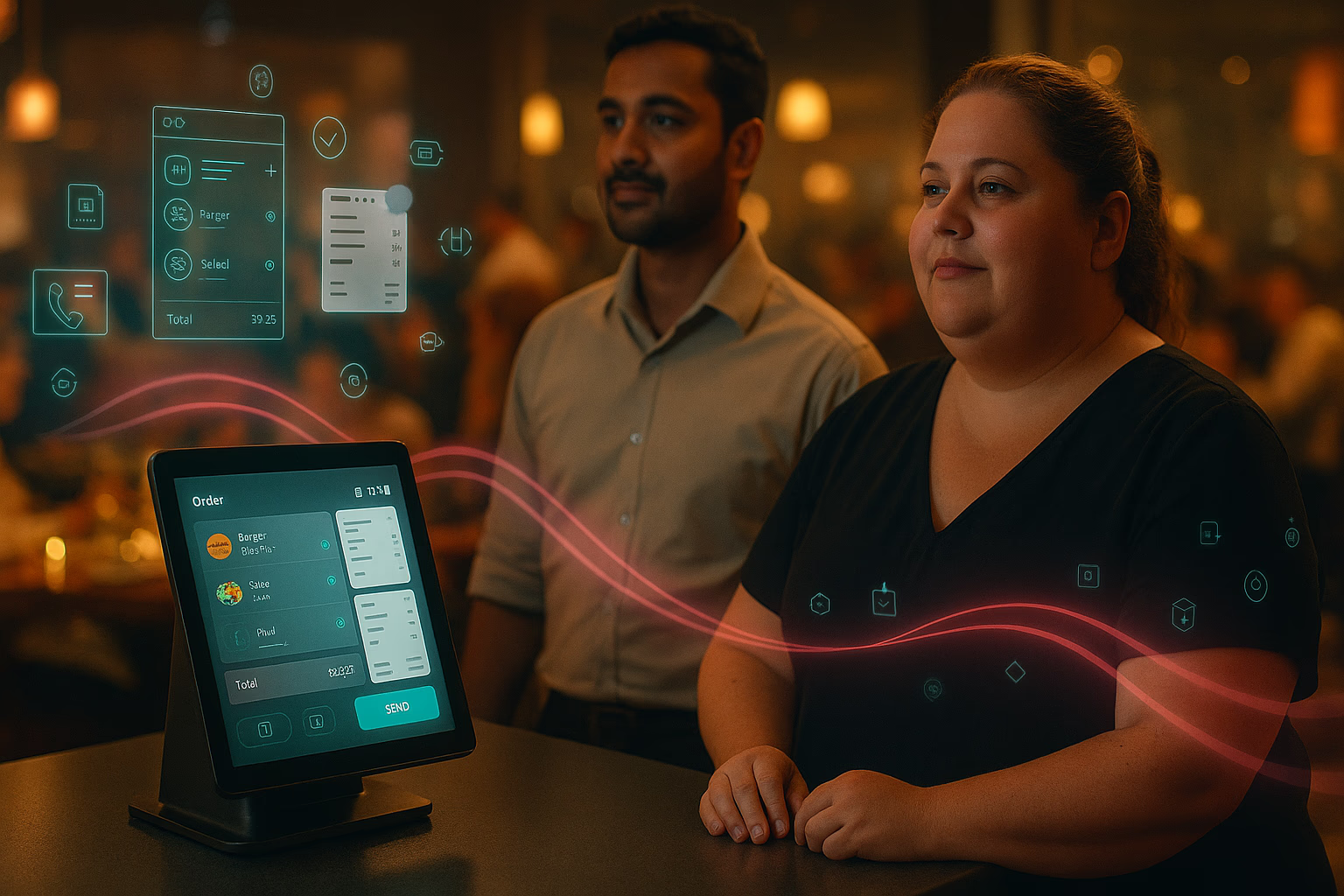
Your host is seating a party of eight, servers are running food, and the kitchen is in full swing. Someone needs to answer that call, take the order correctly, and somehow get it into your POS system without mistakes.
This daily juggling act costs restaurants time, money, and customers. But what if every phone order could flow directly into your kitchen display system? That's the power of proper POS integration with voice AI.
When your phone system talks directly to your point of sale, orders move automatically from customer call to kitchen screen. No manual entry, no transcription errors, no lost tickets. Let's explore how this integration works and why it matters for your restaurant.
Certus AI's Restaurant Voice AI Integration
Certus AI's restaurant voice AI integrates directly with major POS systems including Square, Toast, Clover, and others, sending phone orders straight to your kitchen. This integration eliminates order errors, speeds up service, and ensures every phone order is captured accurately in your system.
The AI answers calls, takes orders through natural conversation, and transmits everything to your existing POS in the correct format. Setup takes five days without disrupting operations. Restaurants using integrated voice AI save $9,051 monthly on average while tripling delivery revenue. The integration handles complex orders, modifications, and special requests while maintaining perfect accuracy.
How restaurant voice AI connects with your existing POS system
Restaurant voice AI doesn't operate in isolation. The real value comes when it seamlessly connects with your existing technology stack. AI call centers for restaurants work by creating a direct pipeline from customer phone calls to your kitchen display system.
When a customer calls, the AI answers instantly and takes their order through natural conversation. As the order builds, the system formats everything according to your POS requirements. Once confirmed, the order transmits directly to your POS, appearing on kitchen screens exactly as if staff had entered it manually.
This integration happens through APIs (application programming interfaces) that allow different software systems to communicate. Major POS providers like Square offer robust APIs that enable this kind of seamless connection. The AI speaks your POS system's language, ensuring orders appear correctly formatted with all necessary information.
The integration handles complex scenarios automatically:
- Menu synchronization: Your POS menu becomes the AI's knowledge base
- Modifier management: Special requests and modifications appear correctly
- Pricing accuracy: Current prices, including specials, stay synchronized
- Order routing: Different items route to appropriate kitchen stations
- Payment records: Transaction details link properly for reporting
This direct connection eliminates the weak points where errors can occur. No more reading handwritten notes, no more entering orders while customers wait, no more lost tickets between phone and kitchen.
The technical setup for POS integration
Setting up POS integration might sound complex, but modern systems make it straightforward. Certus AI handles the technical configuration, requiring minimal involvement from restaurant operators.
The process starts with authentication, where your POS system grants secure access to the AI platform. This uses industry standard security protocols like OAuth 2.0 to ensure your data remains protected. The AI never stores sensitive payment information or customer data beyond what's necessary for order processing.
Next comes menu mapping. Your existing POS menu items, categories, modifiers, and prices sync with the AI system. This includes:
- Core menu items: Every dish, drink, and dessert in your system
- Modifiers and options: Size variations, add-ons, substitutions
- Special instructions: How your kitchen prefers to receive custom requests
- Pricing tiers: Different prices for lunch, dinner, or special occasions
- Availability rules: Items only available certain days or times
The integration then establishes order flow protocols. This determines how orders move from the AI to your POS and into your kitchen workflow. Orders can route to different printers or screens based on type, time, or preparation requirements.
Testing ensures everything works perfectly before going live. The team processes sample orders, verifies they appear correctly in your POS, and confirms kitchen staff sees them properly formatted. Any adjustments happen before actual customer orders flow through the system.
Why direct Restaurant Voice AI POS integration works
Manual order entry creates multiple failure points. Staff mishear orders over noise. Handwriting becomes illegible during rushes. Tickets get lost between phone and POS. Each transfer point introduces potential errors that cost money and frustrate customers.
Restaurant order automation through direct POS integration eliminates these problems entirely. Orders flow digitally from customer to kitchen without human interpretation or transcription. This delivers measurable benefits:
Error reduction: No more misheard orders or illegible handwriting. What the customer says is exactly what appears in the kitchen. This eliminates remake costs and customer complaints from wrong orders.
Speed improvement: Orders appear instantly in your POS without entry time. Your staff focuses on food preparation and customer service instead of data entry. Service speeds up while stress decreases.
Complete order capture with restaurant order automation: Every detail makes it to the kitchen. Special dietary requirements, timing requests, and modifications all transfer accurately. Nothing gets forgotten in the rush of service.
Accurate reporting: All phone orders properly record in your POS for reporting. You can track phone versus in-person sales, analyze ordering patterns, and make data-driven decisions about menu and staffing.
Inventory accuracy: Integrated orders automatically update inventory counts. Your POS knows exactly what was sold through every channel, maintaining accurate stock levels and food cost calculations.
The specific POS systems that work with AI call centers for restaurants
AI call centers for restaurants need to work with the POS systems restaurants actually use. Certus AI integrates with major platforms that power thousands of restaurants.
- Square for Restaurants offers comprehensive integration capabilities. Orders flow directly into Square's system, appearing on KDS (kitchen display systems) or printing to appropriate stations. Square's API supports complex menu structures, making it ideal for restaurants with extensive modifier options.
- Toast provides robust integration features designed specifically for restaurants. The platform's API handles high-volume order flow, supports detailed modifiers, and maintains real-time menu synchronization. Toast's marketplace approach to integrations makes connection straightforward.
- Clover enables seamless order integration through its flexible API structure. The system handles everything from quick service to full-service restaurant needs, with orders appearing instantly in the Clover dashboard and kitchen systems.
- Additional platforms including NCR Aloha, Lightspeed, and others also support integration. Each system has unique strengths, but all enable the core functionality of direct order transmission from AI to kitchen.
The key is ensuring compatibility before implementation. Certus AI's team verifies POS compatibility during initial consultation, ensuring smooth integration with your specific system version and configuration.
Common integration challenges and how they're solved
While POS integration is generally smooth, certain challenges can arise. Understanding these helps set realistic expectations and ensures successful implementation.
Menu complexity in some restaurants requires careful mapping. Restaurants with hundreds of items, extensive modifiers, or complex pricing rules need thorough initial setup. The solution involves detailed menu audits and systematic configuration to ensure every possible combination works correctly.
Legacy POS systems might have limited integration capabilities. Older systems without modern APIs require workaround solutions. These might include middleware platforms or alternative integration methods that still eliminate manual entry.
Multi-location variations add complexity when different locations have different menus or prices. The AI call center for restaurants must recognize which location is receiving the call and apply appropriate menu rules. This requires location-specific configuration but enables chain-wide implementation.
Special promotional items need regular updates. Limited time offers, daily specials, and seasonal menus require synchronization between POS and AI. Establishing clear update protocols ensures specials are available when active and removed when expired.
Network reliability affects real-time integration. Internet outages or POS system downtime can interrupt order flow. Backup protocols, including order queuing and automatic retry mechanisms, ensure no orders are lost even during technical issues.
How restaurant voice AI integration impacts your daily operations
Once integrated, restaurant voice AI fundamentally changes daily operations. The constant stress of managing phone orders disappears, replaced by smooth, automated order flow.
Morning prep becomes more predictable. The AI can take pre-orders for lunch while your team preps, storing them in the POS for timed release. Catering orders placed the night before appear in your system, ready for morning preparation.
During service, the change is dramatic. Your host focuses entirely on the dining room without phone interruptions. Servers stay on the floor instead of running to answer calls. The kitchen receives orders in consistent format, whether they originated from phones, online, or in-person.
AI phone agent for restaurants handles the phone complexity while your team handles what requires human touch. The integration means orders flow naturally into existing workflows without creating new processes or confusion.
End-of-day reconciliation simplifies too. All phone orders are already in your POS, properly categorized and recorded. Sales reports include phone revenue automatically. There's no separate system to check or manual tallies to reconcile.
Staff appreciation for the system grows quickly. Instead of viewing it as new technology to learn, they see it as removal of their least favorite task. The POS integration means they work with familiar systems while the AI handles the stressful phone component.
Measuring the impact of integrated voice AI on your business
The benefits of POS-integrated voice AI are measurable and significant. Restaurants using Certus AI report average monthly savings of $9,051, with much of this coming from operational efficiencies enabled by integration.
Key metrics to track include:
- Order accuracy rates: Measure errors before and after integration
- Service times: Track how quickly orders move from phone to kitchen
- Revenue per call: Monitor average order values and upselling success
- Labor efficiency: Calculate time saved on phone handling and order entry
- Customer satisfaction: Track reviews mentioning phone ordering experience
The integration provides rich data for analysis. Every phone interaction records in your POS, enabling detailed reporting on phone order patterns, peak calling times, and customer preferences. This data guides decisions about staffing, menu optimization, and marketing.
Restaurants saving money with voice AI find that POS integration amplifies their savings. The efficiency gains compound when orders flow seamlessly from phone to kitchen without manual intervention.
Setting up your restaurant for successful POS integration
Preparing for POS integration ensures smooth implementation and maximum benefit. While Certus AI handles technical aspects, restaurants can take steps to optimize success.
Start by auditing your current menu in the POS. Ensure items are properly categorized, modifiers are correctly configured, and prices are current. Clean data in your POS means clean data in the AI system.
Document any special handling requirements. Does your kitchen prefer modifications written in specific ways? Are there common customer requests that need special routing? Sharing these details during setup ensures the integration matches your operational needs.
Verify your POS system is updated to the latest version. Modern APIs work best with current software versions. Updates often include improved integration capabilities and security features that benefit the connection.
Establish clear protocols for menu updates. Decide who can modify menu items, when updates happen, and how changes communicate to staff. Consistent processes ensure the restaurant voice AI always has accurate information.
Train your team on what changes and what stays the same. Staff needs to know that phone orders will now appear automatically in the POS, but they should understand how to identify these orders and handle any special situations that arise.
The competitive advantage of integrated restaurant voice AI
Restaurants with fully integrated voice AI systems gain significant advantages over competitors still handling phones manually. Every call answered perfectly while competitors send customers to voicemail. Every order captured accurately while others struggle with mistakes.
The integration enables capabilities impossible with manual processes:
- Unlimited capacity: Handle any call volume without additional staff
- Perfect consistency: Every order follows exact same process
- 24/7 availability: Take orders for next day even when closed
- Multi-language support: Serve diverse communities without language barriers
- Instant scaling: Handle unexpected rushes without preparation
These advantages compound over time. Customers learn they can always reach you, always get great service, and never deal with hold times or busy signals. They choose you over competitors who make ordering difficult.
The data advantage grows too. Integrated systems provide insights into customer behavior, ordering patterns, and menu performance that manual processes never could. This intelligence guides strategic decisions that further separate you from competition.
Your path to Restaurant Voice AI with POS integration
The phone that's ringing right now while your staff handles other tasks represents immediate revenue waiting to be captured. With proper POS integration, that call transforms from a stressful interruption into automatic revenue flowing directly into your kitchen. No manual entry, no errors, no missed opportunities.
Integrating Certus AI's restaurant order automation system with your POS system takes just five days to implement. Your phone number stays the same, your POS continues working normally, and your staff doesn't need extensive training. The only thing that changes is that every call gets answered, every order gets captured accurately, and everything flows seamlessly into your existing operations.
The restaurants succeeding tomorrow are implementing integrated voice AI today. They're capturing every call, eliminating order errors, and building systematic advantages that compound daily.
Ready to join them? Book a demo with Certus AI and discover how POS-integrated voice AI can transform your restaurant's phone operations starting next week.

.svg)
.svg)
.svg)
.svg)