.svg)

.svg)


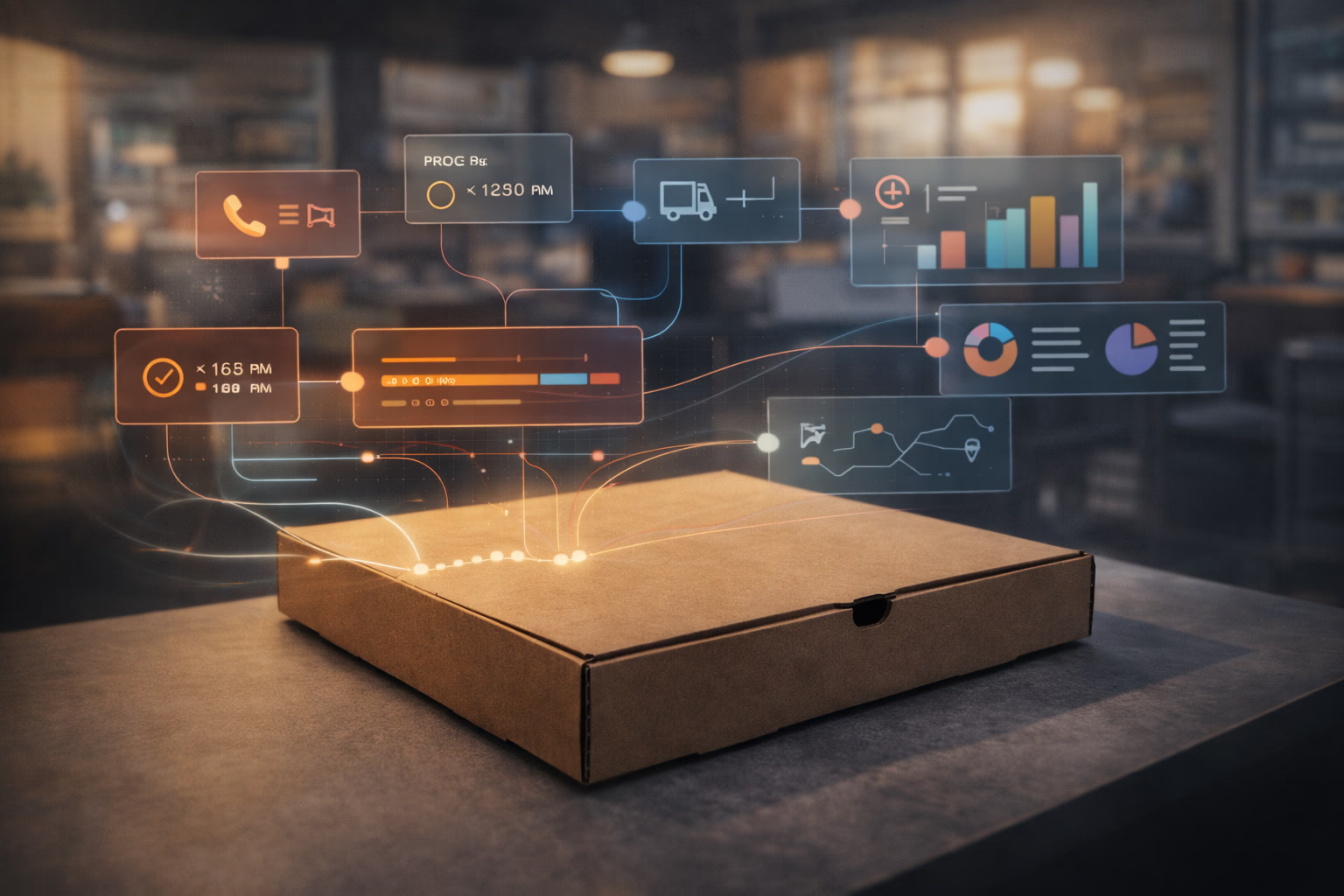
Domino’s Pizza did not become a global powerhouse by relying on intuition. It scaled by tracking every critical part of the operation, from how orders came in to how fast they reached customers.
By investing early in restaurant tracking technology, Domino’s gained real-time insights into stores, channels, and delivery workflows. Their data-first approach reduced errors, improved speed, and replaced guessing with measurable performance.
What follows is a closer look at the strategies and technologies Domino’s uses to track everything, and how similar systems can drive growth, consistency, and control for modern restaurants.
Why tracking mattered more than growth itself
Domino’s growth did not come from expanding faster than everyone else. It came from knowing what was happening inside the business at all times.
As the brand scaled across thousands of locations, complexity increased. More stores meant more variables: inconsistent prep times, missed calls, late deliveries, staffing gaps, and uneven customer experience. Without visibility, scale would have amplified these problems instead of profits.
This is where Domino’s took a different path. Instead of reacting to issues after sales dipped or complaints spiked, the company built systems that surfaced problems early. Every order, call, delivery, and delay became traceable. Decisions were made using operational data.
The systems Domino’s used to make everything visible
With this in place, the strategies and technologies Domino’s uses become clearer. They were designed to answer one question repeatedly: what is happening right now inside the operation, and what needs to be fixed?
Below are the core strategies and technologies Domino’s has been using to track everything at scale.
1. Every order became structured data, not just a transaction
Domino’s designed its ordering systems so that no order entered the business unstructured. Whether an order came from the app, website, phone, or store counter, it flowed into the same system with the same data logic.
That meant:
- Order time, prep time, bake time, and delivery time were all recorded automatically.
- Modifiers and customizations were logged.
- Drop-offs in order completion could be traced to a specific step.
This approach allowed Domino’s to see patterns most restaurants never notice. If orders slowed at a specific hour, they knew whether the issue was staffing, oven capacity, phone congestion, or delivery routing.
This was a major reason Domino’s could scale digital ordering without losing accuracy or speed.
2. Delivery was tracked as a live system, not a promise
Domino’s treated delivery as an operational pipeline, not a black box. GPS tracking, driver check-ins, and route data turned delivery into a measurable workflow.
Instead of asking “Was the delivery late?”, Domino’s could see:
- When did the order leave the oven?
- How long had it sat before dispatch?
- Which routes consistently caused delays?
- How did driver availability affect speed?
This visibility allowed Domino’s to adjust store placement, delivery zones, and staffing models over time. The fortressing strategy, where stores were placed closer together, only worked because delivery data proved where delays were happening.
3. No missed calls thanks to modern restaurant phone technology
While Domino’s pushed digital hard, it never ignored the phone. They knew missed calls were silent revenue leaks.
Domino’s addressed this by:
- Routing calls intelligently during peak hours.
- Adding overflow handling so calls did not die on hold.
- Standardizing call flows to reduce errors.
Later, voice automation and AI-based ordering became a natural extension of this philosophy. The goal was not novelty. It was visibility. If a call came in, it was either answered, routed, or logged. Nothing disappeared. Domino’s moved away from relying solely on experience and intuition early on.
Today, about 70% of restaurant chains have added digital ordering options in the past two years, showing how the industry has shifted toward systems that provide real-time tracking and operational visibility.
This reflects how modern restaurant management software and restaurant voice AI serve complementary roles; one tracks operations broadly, and the other ensures every order is captured.
4. Store-level dashboards replaced gut feeling
One of Domino’s quiet advantages was how much information store managers could see in real time.
Instead of waiting for end-of-day reports, managers had access to:
- Current order volume versus forecast.
- Prep and delivery speed benchmarks.
- Error rates and remake indicators.
- Staffing pressure points.
This shifted decision-making from reactive to preventive. Managers could fix bottlenecks mid-shift instead of discovering them after customer complaints rolled in.
Many of the top restaurant technologies in 2026 adopt similar principles, helping multi-location restaurants track performance and optimize operations across sites.
5. Technology decisions followed operational questions
Domino’s did not adopt technology because it was trending. It adopted tools only after identifying specific operational gaps.
A simple pattern repeated:
- Identify where friction or delay occurred.
- Measure it consistently.
- Apply technology only if it removes that friction.
That is why Domino’s tech stack stayed tightly integrated. Ordering systems talked to the POS. Delivery tools talked to routing. Data flowed upward without manual stitching.
This principle is why many modern restaurants now evaluate AI ordering systems, restaurant voice AI, and automation tools through the lens of visibility and control, not features alone.
For a deeper look at the strategies and technologies Domino’s uses, including AI phone agents and online ordering systems, watch our YouTube breakdown here:
How do these restaurant marketing strategies work together?
To make this clearer, here’s how Domino’s tracking philosophy translated into outcomes:
None of these systems worked in isolation. Together, they created a feedback loop where problems surfaced early and fixes scaled fast.
How restaurants can grow with data
Domino’s success shows that visibility and measurement are the backbone of consistent growth. By tracking orders, kitchens, deliveries, phone calls, and store-level performance in real time, the brand could fix small issues before they became big problems. These systems turned operations into a predictable engine, giving Domino’s control at scale.
For modern restaurants, the takeaway is clear: map your processes, make every step measurable, and let technology reinforce operational clarity. When you track what matters, speed, accuracy, and customer satisfaction follow naturally, turning data into real growth.
One of the most important technologies used by Domino’s is restaurant order automation.
At Certus, we’ve developed a specialized restaurant Voice AI, so you’ll never miss another call. Learn about all the advantages and get personal consulting in a free demo call.

.svg)
.svg)
.svg)
.svg)