.svg)

.svg)


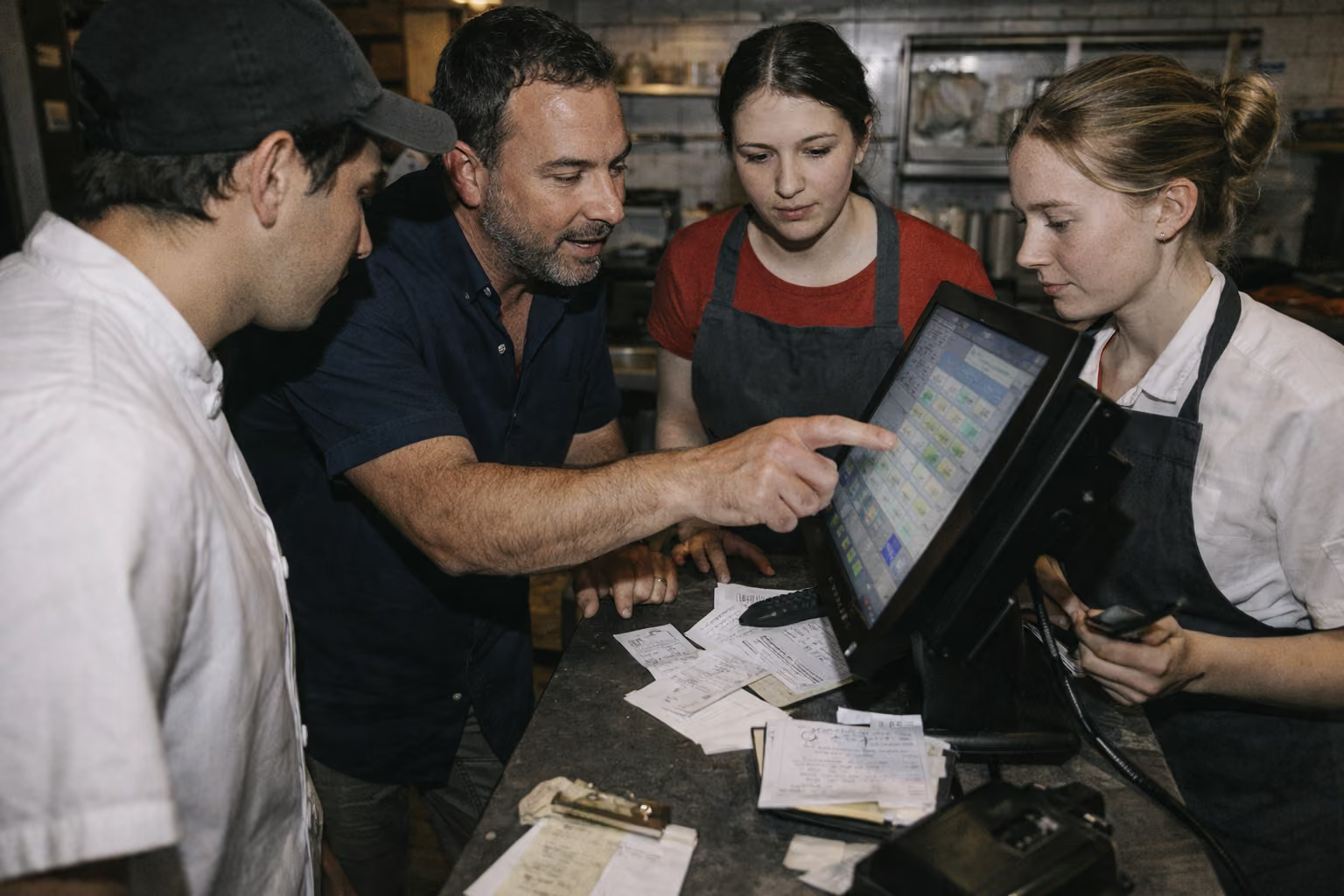
You're staring at three tablets on your counter, a laptop running scheduling software, and a phone that won't stop ringing. Your POS system doesn't talk to your inventory tracker. Your online ordering platform sends tickets to a printer that jams twice a shift. And somewhere in this mess, you're losing money.
The restaurant industry is projected to hit $1.55 trillion in sales this year, but over 90% of operators say rising costs are their biggest challenge. Technology was supposed to fix this. Instead, many restaurants are struggling with disconnected systems that create more work, not less. The restaurants that are winning are are investing smarter, copying strategies from hyper-efficient brands to solve specific problems.
This guide shows you the focused investments that deliver results by consolidating systems, automating repetitive work, and giving you back control over your margins and your time.
The problems with disconnected restaurant technology
The core problem in most restaurants isn't a lack of technology, but a lack of connection between tools. The average restaurant uses over a dozen different software systems that don't communicate, forcing your team to manually re-enter orders, reconcile data, and troubleshoot when things break. This fragmented approach creates friction and directly costs you money in wasted labor and lost sales.
Consolidating these systems can save five to ten admin hours per week, which translates to $15,000 to $30,000 in annual labor savings for a typical operation. The goal is to move away from a patchwork of apps and toward a unified platform where data flows automatically. When your systems don't talk, you're forced back into spreadsheets and manual tracking, defeating the purpose of your investment in restaurant automation software.
Why more tech doesn't always mean better business
We've watched restaurants spend $50,000 on new technology in a year only to see their profit margins shrink. The issue is overhead. Every new platform requires training, maintenance, and monthly fees. Every disconnected system creates friction points where orders get lost, data gets corrupted, or staff gets frustrated.
But the restaurants thriving in 2026 ask a different question. Instead of "What new tool can we add?" they ask, "What problem costs us the most money, and what is the simplest technology that solves it?" This shift from accumulation to consolidation is the key to a profitable strategy using restaurant tech upgrades.
Unifying your operations with a smarter POS system
A modern Point of Sale (POS) system is the central nervous system of your restaurant, connecting front-of-house, back-of-house, inventory, and customer data on one platform. A unified POS captures every transaction, tracks every menu item's performance, and shows you exactly where your money is going in real time. You can't analyze data that's scattered across ten different platforms.
This is crucial because 45% of operators plan to rely more on data analytics this year. A smart POS provides that data automatically, giving you a single source of truth for your entire business.
Your POS should do more than just process payments. The best systems integrate directly with your other tools. When you sell a burger, an integrated POS automatically deducts the bun, patty, and toppings from your inventory count. It connects to your labor scheduler to show labor costs as a percentage of sales in real time. This level of POS integration for voice AI and other tools is what separates a simple cash register from a true operational hub.
What to look for in an integrated POS
When evaluating a new POS, prioritize native integrations. Ask potential vendors if their system connects directly with your existing tools or if it requires clunky, third-party middleware.
Can you access real-time reports from your phone? What happens if the internet goes down? How long does implementation take, and what's included in the training?
The answers will tell you whether you're buying a solution or just another problem.
How to turning every phone call into revenue with smart automation
Restaurant AI automation with Voice AI is a critical investment that solves one of the most expensive problems in hospitality: the phone that goes unanswered during a rush. While only a small fraction of restaurants currently use AI for orders, consumer willingness is high. This gap between adoption and acceptance is a massive opportunity for revenue recovery.
Most restaurants are still forced to choose between serving the guest in front of them and answering a ringing phone. That choice costs you money every single time. An AI phone agent for your restaurant eliminates that choice entirely.
What is the hidden cost of a ringing phone?
A busy restaurant can receive 50 to 100 calls a day. During peak hours, it's common to miss 20-30% of those calls because your staff is slammed. If your average phone order is $35 and you miss just 15 calls a day, that's $525 in lost revenue. Over a year, that adds up to over $180,000.
Beyond lost orders, the ringing phone constantly interrupts your staff, pulling them away from in-house guests. This distraction degrades the service experience for everyone and adds stress to your team, contributing to burnout and turnover.
How AI phone agents recover lost orders and boost average checks
Modern AI phone agents are not the frustrating robots of the past. Today's conversational AI can handle incredibly complex restaurant scenarios. They can navigate menus with over 100 items, answer allergy questions, process custom orders, and understand different accents. They never put a caller on hold, never forget to upsell, and never miss a call.
This technology has become a practical tool that solves a specific, expensive problem. Our comparison of chatbots vs conversational AI for restaurant phone orders show that true conversational AI is far superior. Systems like Certus AI's Restaurant Voice AI integrate directly with major POS platforms, so orders flow straight to your kitchen without any staff intervention.
The ROI is simple: an AI agent that costs a few hundred dollars a month can pay for itself in a single busy night.
What is the data advantage of AI phone agents?
AI phone agents also capture valuable data that most restaurants never see. They track call volume by the hour, identify peak times, record common questions, and measure how often callers ask about specific menu items. This information helps you staff more effectively, adjust your menu, and better understand what your customers want.
For example, one of our clients discovered that 20% of their callers asked about gluten-free options. They added three new GF items, and those now account for 15% of their phone sales.
Watch the video and convince yourself:
Streamlining back-of-house with smart inventory and labor tools
Targeted back-of-house technology directly impacts your margins by reducing waste and optimizing labor. Smart inventory systems can cut food costs by 2-5%, while AI-powered scheduling platforms build more efficient schedules based on sales forecasts. These tools are most powerful when they are integrated with your POS, creating a seamless flow of data from sales to stock to staffing.
How can smart inventory tools cut food waste?
With food costs climbing, waste is a silent killer of profitability. Smart inventory systems sync with your POS to track every ingredient used, compare it to sales, and flag discrepancies in real time. If your POS shows you sold 100 burgers but your inventory system says you used enough beef for 120, you have a variance. This could be due to waste, over-portioning, or theft.
Without an integrated system, you wouldn't catch this until the end of the month. Furthermore, with new regulations like the FDA's FSMA Rule 204 requiring digital traceability, integrated inventory is becoming a matter of compliance, not just cost savings.
Optimizing your team with intelligent labor scheduling
With 98% of operators citing labor costs as a top concern, the focus has shifted from hiring to retention and efficiency. Modern scheduling platforms use AI to forecast demand based on historical sales data, weather, and local events. They build schedules that match labor to expected volume, reducing costly overtime and preventing understaffing that burns out your team. The goal is to automate administrative work so your managers can focus on training and leading their people.
The strategic approach: Audit before you add
Before you invest in any new technology, audit what you already have. List every platform you pay for, what it does, and whether it integrates with your other systems. You'll likely find you're paying for tools no one uses or that multiple platforms are doing the same job poorly. This audit reveals opportunities to consolidate and cut costs.
Your three-question tech filter
Filter every potential tech purchase through these three questions:
- Does it consolidate? Will this tool replace multiple systems or reduce the number of platforms we manage?
- Does it integrate? Will it connect our front-of-house and back-of-house data, or will it create another data silo?
- Does it automate? Will it eliminate a manual, repetitive task that is currently wasting valuable staff time?
If the answer to all three is not a clear "yes," you're likely adding overhead, not solving a problem. The best AI phone ordering systems for small restaurants, for example, check all three boxes by consolidating communications, integrating with the POS, and automating the entire order-taking process.
Building a future-proof tech stack, not just a collection of apps
The most effective restaurant technology in 2026 works quietly behind the scenes, removing friction and giving your team time back to focus on hospitality. This requires a mindset shift from collecting individual tools to building a cohesive ecosystem. Your POS, inventory, scheduling, and phone automation should all work together to give you a complete, real-time picture of your operation.
The restaurants that thrive will be those that resist chasing every trend. They will invest in a small number of high-quality, integrated systems that solve their biggest financial and operational problems. They will measure the ROI of their strategic AI phone answering for restaurants and other tools, cutting anything that doesn't deliver.
Your tech stack should make your restaurant easier to run, not harder. The right investments feel invisible, quietly capturing orders, tracking inventory, and surfacing insights. That's the standard for 2026: technology that works so well you forget it's there.
Ready to build your own? The first step is learning how to implement voice AI in restaurants and other core systems.
And we're here to help. For a demo and personal consulting, feel free to book a restaurant AI assistant demo call with our team.
Frequently asked questions
How do I convince my staff to adopt new technology when they're already overwhelmed?
Focus on the "what's in it for them." Show your team the specific pain point the technology solves. For an AI phone agent, demonstrate how it eliminates the stress of a constantly ringing phone during a rush. For inventory management, show them how much time they'll save on manual counts. When staff see technology as a tool that reduces their workload, resistance fades. Involve them in the selection process to give them a sense of ownership.
What's the biggest mistake restaurants make when investing in new tech?
Buying based on a long list of features instead of solving a specific, costly problem. A sales rep might show you a hundred things a platform can do, but if it doesn't solve your biggest operational bottleneck, it's a distraction. Define your problem first, measure its cost, and then find the simplest, most integrated technology that solves it.
Can a small independent restaurant really afford these kinds of investments?
The better question is, can you afford not to? If you're missing 15 phone orders a day at $35 each, that's over $180,000 in lost annual revenue. An AI phone agent that costs $3,000 a year pays for itself in less than a week. The ROI on focused tech investments that solve major pain points is often measured in days or weeks, not years. Start with your single biggest problem and solve that first.
How quickly should I expect to see an ROI from these tech changes?
It depends on the investment. Phone automation shows an ROI almost immediately by capturing revenue you were previously missing. A unified POS system might take three to six months to show returns through improved efficiency and reduced labor costs. The key is to establish a baseline before you start. Track your missed calls, food costs, and labor percentages now, then measure them again 30, 60, and 90 days after implementation.

.svg)
.svg)
.svg)
.svg)