.svg)

.svg)


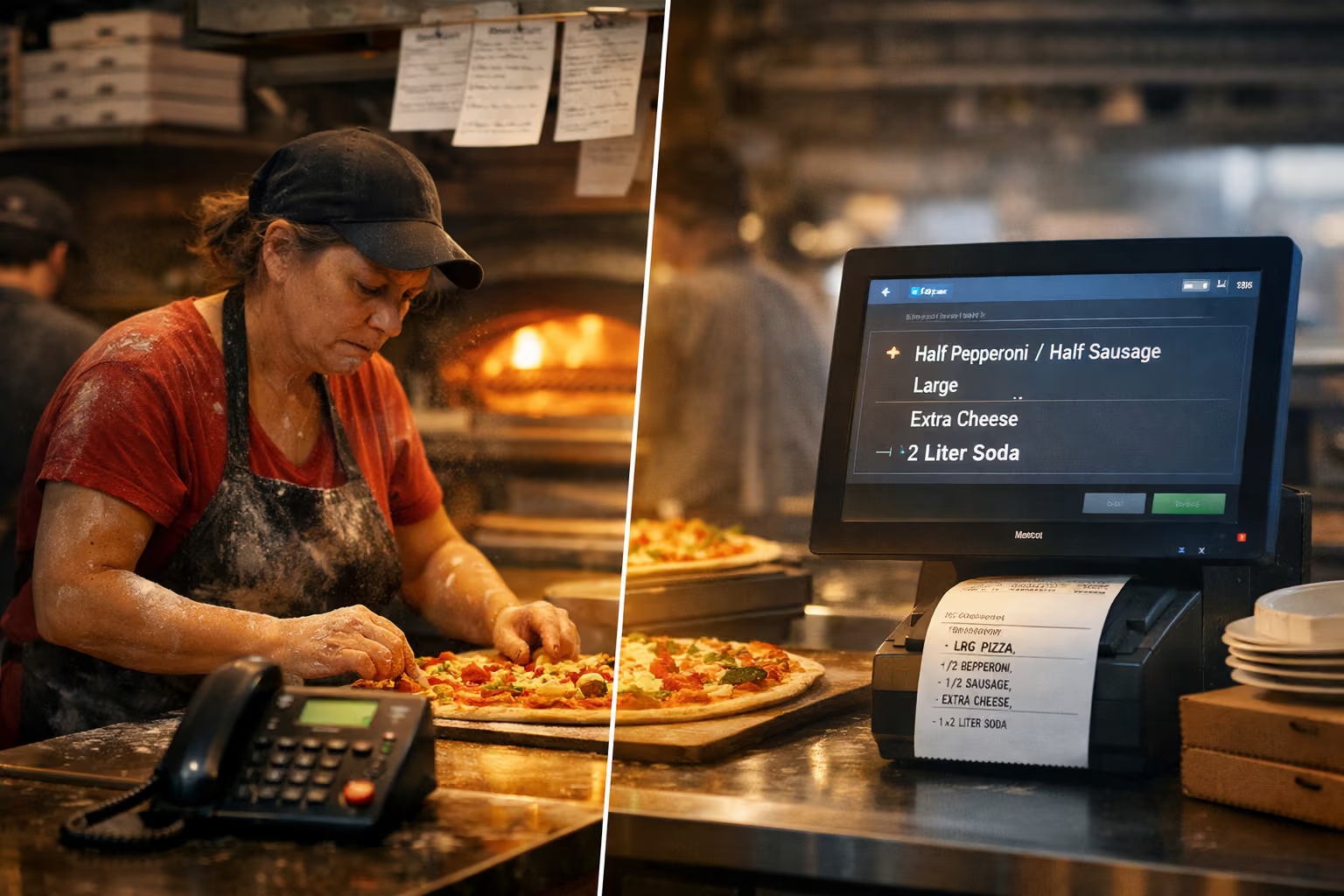
On a Friday night, when your oven is running full tilt, three tickets are up, and the phone is ringing for the third time, you know you just lost that order. The customer who got your voicemail is now calling the place down the street. But today this doesn't need to happen anymore.
This article breaks down how an AI phone agent can help and reviews the best options for a busy pizza shop.
The phone problem in your pizza shop: a familiar story
An AI phone agent for restaurants is a voice system that answers every call instantly, takes orders with perfect accuracy, and sends them directly to your kitchen. The difference is that it never calls in sick, never gets overwhelmed, and costs less than a single part-time employee. For pizza shops, this solves the impossible tradeoff: serve the customers in front of you, or answer the phone and capture new revenue. With AI, you do both.
The feeling of being overwhelmed during a rush is universal. The constant ringing, the staff juggling multiple tasks, and the sinking feeling of knowing orders are being missed is a daily reality for many owners. This isn't a sign of failure, it's a symptom of an outdated system. The traditional phone line was never designed for the volume and complexity of a modern pizza business.
The costs of a ringing phone vs the ROI of restaurant voice AI
An AI phone agent provides immediate ROI by capturing revenue that is currently being lost to unanswered calls and staff overload. Every unanswered call during dinner rush represents $25 to $40 in lost revenue. If you miss just 10 calls a day, that's over $7,500 a month in orders going directly to your competitors.
The financial damage goes deeper. When your staff are constantly interrupted by the phone, order accuracy drops and service slows down. Industry data shows restaurants lose thousands annually from missed calls alone, not including the labor cost of having someone dedicated to phones. Then there's the burnout factor. Your team is there to make great food, not act as receptionists. Taking a strategic approach to AI phone answering for restaurants protects both your revenue and your staff's morale.
How an AI voice assistant helps your pizza shop
An AI ordering system answers your phone on the first ring, greets customers with your restaurant's name, and takes their order using conversational language. It handles the complexity of pizza customization without breaking a sweat. Half pepperoni, half sausage with light cheese on one side? No problem. Gluten-free crust with extra sauce? Done. The technology sounds so natural that most customers don't realize they're talking to an AI.
The system integrates directly with your POS, so orders flow straight to your kitchen. Your staff sees the ticket exactly as if your best server had entered it. Beyond ordering, the AI handles common questions like "What time do you close?" or "Do you have vegan options?" This is the key difference between a simple IVR and true conversational AI. While older systems are rigid, modern AI phone agents can handle complex orders and dynamic conversations that would trip up less advanced tech.
How we ranked the best AI phone agents for pizza shops
To find the best AI voice assistants, we focused on the features that matter most to an independent pizza shop owner. We didn't get distracted by flashy extras. Instead, we evaluated each system based on four core principles: POS integration, order complexity, ease of setup, and real-world performance.
Our ranking prioritizes solutions that offer native integration with Toast, as it's a dominant POS in the pizza industry. We tested each AI's ability to handle tricky pizza-specific orders, like half-and-half toppings and special instructions. Finally, we considered the onboarding process and overall cost, favoring systems that offer quick setup, transparent pricing, and a clear return on investment for a small business.
A review of the top AI voice assistants in 2026
While many companies offer voice AI, only a few are truly built for the chaos of a restaurant's phone line. We reviewed the top contenders to see how they stack up for a typical pizza shop using Toast POS.
| Feature | Certus AI | Loman AI | SoundHound for Restaurants |
|---|---|---|---|
| Best For | Independent pizza shops using Toast | Multi-location chains | QSRs with drive-thrus |
| Toast Integration | Native, 1-Click | API-based | Custom Integration |
| Complex Orders | Excellent (handles modifiers, half-and-half) | Good (standard modifiers) | Fair (best with simpler menus) |
| Setup Time | 48 hours | 1–2 weeks | 2–4 weeks |
| Pricing Model | Flat monthly fee | Per-location fee + usage | Custom quote, enterprise focus |
| Upselling | Automatic & consistent | Configurable | Basic |
Certus AI: best for Toast POS integration and revenue recovery
Certus AI's answering system is designed specifically for high-volume independent restaurants, with a laser focus on pizza shops. Its key strength is its deep, native integration with Toast. Orders are injected directly into the POS and print in the kitchen just like a server entered them.
The AI excels at handling complex pizza orders and has a powerful, consistent upselling engine that can increase average order value by 15% or more. Onboarding is incredibly fast, promising to get a restaurant live in 48 hours with only 45 minutes of the owner's time. With a flat, predictable monthly fee, the ROI is easy to calculate and is often realized within the first week of service by capturing previously missed calls.
Loman AI: a strong contender for multi-location chains
Loman AI is another major player in the restaurant voice AI space. It offers a robust platform that works well for restaurant groups or small chains that need to manage multiple locations from a central dashboard. Its system is capable and handles standard phone orders effectively.
While it integrates with major POS systems, the integration is often API-based rather than native, which can sometimes be less seamless than a direct build. It's a powerful tool, but the setup can be more involved, and the pricing structure may be better suited for businesses with the resources to manage a more complex implementation. It's a great solution for operators who value centralized control over multiple storefronts.
SoundHound for Restaurants: best for voice-enabling drive-thrus
SoundHound is a giant in voice AI technology, and their restaurant solution is a testament to their technical expertise. Their platform is incredibly powerful, particularly in noisy environments like a drive-thru, where it can accurately distinguish a customer's order from engine noise and background chatter.
However, SoundHound's solution is primarily geared toward large, quick-service restaurant (QSR) chains. The implementation is a significant enterprise-level project, and the pricing reflects that. For an independent pizza shop, it's likely overkill. While the technology is impressive, it's not tailored to the specific workflow or budget of a small business owner who needs a simple, effective tool for phone orders.
--> Read our comparison post presenting the best alternatives to SoundHound
Key features to look for in an AI for your pizza shop
Not all AI voice assistants are created equal. Some are just glorified answering services. For a pizza shop running Toast, you need a system built for your specific operational needs. The right system should feel invisible, with orders flowing in and tickets printing, while your staff stays focused on the food.
Voice AI integration with Toast POS
This is non-negotiable. Direct Toast integration means the AI becomes part of your existing workflow. An order for a large pepperoni pizza hits your kitchen display system within seconds, formatted exactly like your other orders. This eliminates manual re-entry errors and keeps your sales data unified. Understanding restaurant voice AI integration with a POS is the difference between a tool that helps and one that creates more work. Ask vendors if their integration is native or a workaround.
Handling complex pizza orders and upsells
Your AI needs to handle a customer wanting four different toppings on specific quarters of the pizza, asking about allergens, and changing their mind mid-order. The AI should navigate this flow naturally without sounding robotic.
The upselling capability is where AI truly shines, as it consistently suggests add-ons on every call. "Would you like to add a 2-liter Coke for $2.99?" These small additions can increase your average order value by 15% to 25%.
AI systems built for small, busy restaurants
You don't have time for a three-week implementation. The best AI phone ordering systems for small restaurants get you live in 48 to 72 hours with minimal owner involvement.
Pricing should be a straightforward monthly fee, typically between $200 to $500 per location. The ROI is simple: if the system captures just five extra $30 orders a day, it generates $4,500 in monthly revenue from a sub-$300 investment. This is especially critical for an understaffed kitchen where AI helps front-of-house operations.
Move to an AI voice assistant for your pizza shop
You didn't open a pizza shop to stress about phones. You did it for the love of the food and the energy of a busy service. An AI restaurant assistant gives you back that focus by solving the one bottleneck that has been draining your revenue and burning out your staff for decades. The technology is a proven tool for revenue recovery.
At Certus AI, we built our system specifically for restaurants like yours. We integrate natively with Toast, handle complex pizza orders with the accuracy of your best employee, and get you live in 48 hours.
Ready to stop missing calls and start capturing every order?
Book a demo with Certus AI and hear the system handle a live call. You'll know in five minutes if this is the solution you've been looking for.
Frequently asked questions about AI for pizza orders
Can an AI really understand my customers' accents or specific pizza requests?
Yes. Modern AI voice systems for restaurants use advanced natural language processing trained on millions of restaurant interactions. They handle regional accents, background noise, and conversational speech, understanding when someone says "large pie" versus "large pizza." When unsure, the system asks clarifying questions, just like a good employee. Most quality systems achieve 95% or higher accuracy, matching or exceeding human performance during a busy shift.
How quickly can I get an AI assistant set up in my shop?
A quality AI phone agent can be set up in 48 to 72 hours. The process typically involves a 45-minute call to provide your menu and preferences. The vendor then handles the technical integration with your phone system and Toast POS. You keep your existing phone number, and there is no new hardware to install. Learning how to implement voice AI in restaurants is surprisingly straightforward with the right partner.
Is this just another tech expense, or does it actually pay for itself?
An AI phone agent pays for itself, often within the first week. If you're missing 15 calls a day at a $30 average order, that's $13,500 in monthly lost revenue. An AI system with flat monthly pricing that captures even a third of those calls generates over $4,000 in recovered revenue, many times its cost. This doesn't even count the added profit from consistent upselling and the labor costs saved. It's one of the few restaurant tech investments that pay off with a direct and immediate financial return.
What's the difference between this and a basic chatbot?
The difference is in the intelligence and flow of conversation. A chatbot or a simple IVR follows a rigid script ("Press 1 for hours, Press 2 for orders"). It can't handle deviations. A true conversational AI understands intent, context, and natural language. It allows a customer to speak normally, interrupt, ask questions, and place a complex order without being forced down a frustrating, linear path. Exploring chatbots vs conversational AI for restaurant phone orders reveals why the latter is essential for a good customer experience.

.svg)
.svg)
.svg)
.svg)