.svg)

.svg)


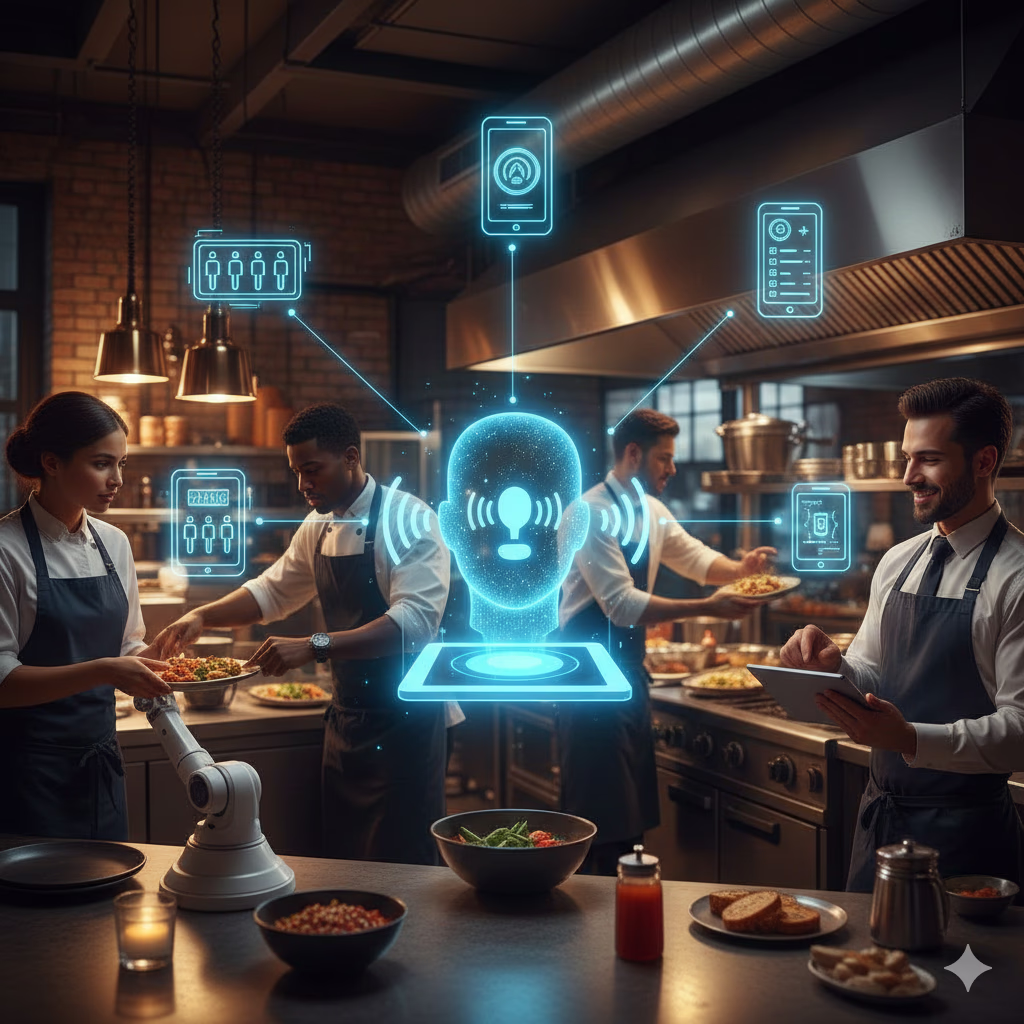
Running a restaurant short-staffed means impossible choices. Answer the phone or serve the table in front of you. Take a takeout order or help the customer who's been waiting.
Most restaurants choose in-house service. Phone calls roll to voicemail. Customers call the next restaurant. Orders go to competitors.
AI voice assistants handle phone orders completely, so your staff can focus on the dining room. They take orders, process payments, and send everything to your POS without requiring anyone to pick up the phone.
How AI voice assistants help with front-of-house operations
- Restaurant understaffing affects nearly half of operators who can't meet customer demand.
- AI voice assistants handle complete phone orders without staff involvement.
- Systems process orders accurately, take payments securely, and integrate with existing POS.
- Understaffed teams focus on in-house service while capturing phone revenue automatically.
- Phone orders increase 30-45% when every call gets answered instantly.
Why are restaurants so understaffed right now?
The restaurant industry added 200,000 jobs in 2024, but it's not enough. Full-service restaurants remain 237,000 jobs below pre-pandemic levels, and 59% of operators report having positions that are hard to fill.
The reasons go deeper than just pandemic recovery:
- Workers left for better opportunities: During shutdowns, restaurant employees found jobs with better hours, higher pay, and more stability. Many aren't coming back.
- High turnover continues: The average restaurant turnover rate sits at 79.6% annually. You're constantly recruiting, hiring, and training just to maintain current levels.
- Demanding work environment: Long hours, weekend shifts, physical demands, and high-stress environments drive burnout. Roughly 90% of food service employees worked overtime or extra shifts in 2022. Of those, 75% did so because of staff shortages.
- Cycle reinforces itself: Understaffing leads to overworked employees. Overworked employees burn out and quit. More people quitting means even worse understaffing.
Research shows 45% of restaurant operators don't have enough employees to support existing customer demand.
What happens when your front of house is understaffed?
Understaffing hits front-of-house operations hardest because customers see and feel the impact immediately.
- Wait times increase: Fewer servers mean longer waits to be seated, take orders, and receive food. Customers get frustrated, leave negative reviews, and don't return.
- Phone calls go unanswered: When staff juggle tables, expo, and hosting duties, the phone becomes the lowest priority. Calls roll to voicemail. Customers wanting takeout orders call competitors instead.
- Service quality drops: Rushed staff make mistakes. Orders get entered wrong. Special requests get missed. Food sits in the window too long. Every mistake compounds customer dissatisfaction.
- Revenue decreases: You're turning away business not because demand is low, but because you physically can't serve everyone who wants to order. Phone orders especially suffer since no one is available to answer.
- Staff burnout accelerates: Existing team members work harder to cover gaps. They get exhausted. They start looking for less stressful jobs. The staffing problem gets worse.
The financial impact is real. Understaffed restaurants see slower table turns, fewer covers per shift, and lost takeout revenue from unanswered calls.
How can AI voice assistants help understaffed restaurants?
An AI phone ordering system operates like a dedicated phone staff member who never needs breaks, never calls out sick, and handles unlimited calls simultaneously.
The process:
- Instant pickup: The AI voice assistant answers within 1-2 rings. No hold music, no waiting, no voicemail. Customers get immediate attention even when your staff is buried.
- Natural conversation: The system understands how people actually order. "Can I get a large pepperoni pizza, extra cheese, and make sure there's no onions?" It captures every detail, including modifications and special requests.
- Complete order taking: The AI asks clarifying questions about drinks, sides, pickup or delivery, and contact information. It gathers all necessary details without rushing customers.
- Secure payment processing: Customers pay over the phone. The AI voice assistant handles credit card information securely, processes the transaction, and confirms payment before ending the call.
- Direct POS integration: Orders flow immediately to your kitchen display system or POS. No manual entry required. Your kitchen sees the order exactly as placed, with all modifications clearly marked.
- SMS confirmation: Customers receive a text confirming order details, pickup time, and total amount. This reduces confusion and callback requests.
Your staff never touches the phone. They focus entirely on the customers in your restaurant, while restaurant order automation captures phone revenue that would otherwise be lost.
Can AI handle complex restaurant orders?
AI voice assistants handle most restaurant orders accurately. About 95% of restaurants now use AI for inventory management, menu optimization, reservations, or other operations.
What works best: Pizzerias with topping combinations, Chinese restaurants with standard dishes and spice levels, sandwich shops with build-your-own options, and wing restaurants with sauce and quantity choices. If your menu has a clear structure and definable options, AI voice assistants handle it smoothly.
What needs consideration: Highly customized dishes without standard frameworks or situations requiring extensive menu education. These situations are rare for most takeout orders.
The system captures standard menu items with common modifications, dietary restrictions, special instructions, payment processing, and upselling relevant items based on order content.
What about integration of Voice AI with existing systems?
Integration separates basic call answering from actual restaurant order automation that saves time and reduces errors.
- POS integration: The Restaurant Voice AI AI connects with your POS system. Toast, Square, Clover, and other major platforms all support integration. Orders appear in your POS exactly as if staff had entered them manually.
- Real-time menu updates: When you 86 an item in your POS, the AI immediately stops offering it to callers. When you add a new menu item, update your POS, and the AI starts taking orders for it.
- Customer data capture: Phone numbers, order history, delivery addresses, and payment methods all get stored in your system. Repeat customers get faster service because their information is already saved.
AI answering machines for restaurants eliminate double-entry, where staff manually transfer phone orders into the POS. This saves time and prevents errors from misreading handwriting or mishearing over the phone.
How much does an AI voice assistant cost?
Pricing for AI phone ordering systems varies based on call volume and features.
Typical pricing: Most restaurant AI voice systems range from $100-$500 monthly, depending on call volume and complexity.
Compare to staffing costs:
- Part-time phone person (20 hours weekly): $15,000-$20,000 annually
- Full-time dedicated phone position: $30,000-$40,000 annually plus benefits
- AI voice assistant: $1,200-$6,000 annually with 24/7 coverage
The ROI calculation is straightforward. If AI captures 15 additional phone orders weekly at $35 average ticket value, that's $27,300 in annual revenue. Most systems pay for themselves within the first month.
What results are understaffed restaurants seeing?
Restaurants implementing AI voice assistants report measurable improvements:
1. Phone revenue increases 30-45%: Every call gets answered. Customers who previously hung up after 3-4 rings now place orders. Weekend and evening calls that staff couldn't handle are now converted to revenue.
2. Staff stress decreases: Teams stop dreading the phone ringing during rush. They focus on tables without constant interruption. Job satisfaction improves when people can actually do their jobs.
3. Order accuracy improves: The Restaurant Voice AI captures modifications correctly every time. Fewer remakes mean less waste and happier customers.
4. Administrative time drops: No more writing down orders then manually entering them into the POS. Everything flows directly from the customer to the kitchen.
5. Peak period capacity increases: During lunch and dinner rush, when phones usually go unanswered, the AI handles all incoming calls. You're not losing phone orders just because the restaurant is busy.
One pizzeria owner reported recovering $18,000-$22,000 annually just from capturing calls that previously went to voicemail during peak hours.
Why AI voice assistants make sense for understaffed restaurants
Staffing challenges aren't going away. While you work to hire and retain quality staff, your phone keeps ringing with orders you can't afford to miss.
AI voice assistants solve the immediate problem. They handle complete phone orders, including payment processing and POS integration, without requiring staff involvement.
Certus AI specializes in restaurant order automation. The system takes complete orders, handles payments securely, integrates with your existing POS, and works for pizzerias, Chinese restaurants, sandwich shops, and any restaurant where phone orders matter.
Ready to stop missing phone orders? Schedule a demo to see how Certus AI captures revenue without adding to your team's workload.

.svg)
.svg)
.svg)
.svg)