.svg)

.svg)


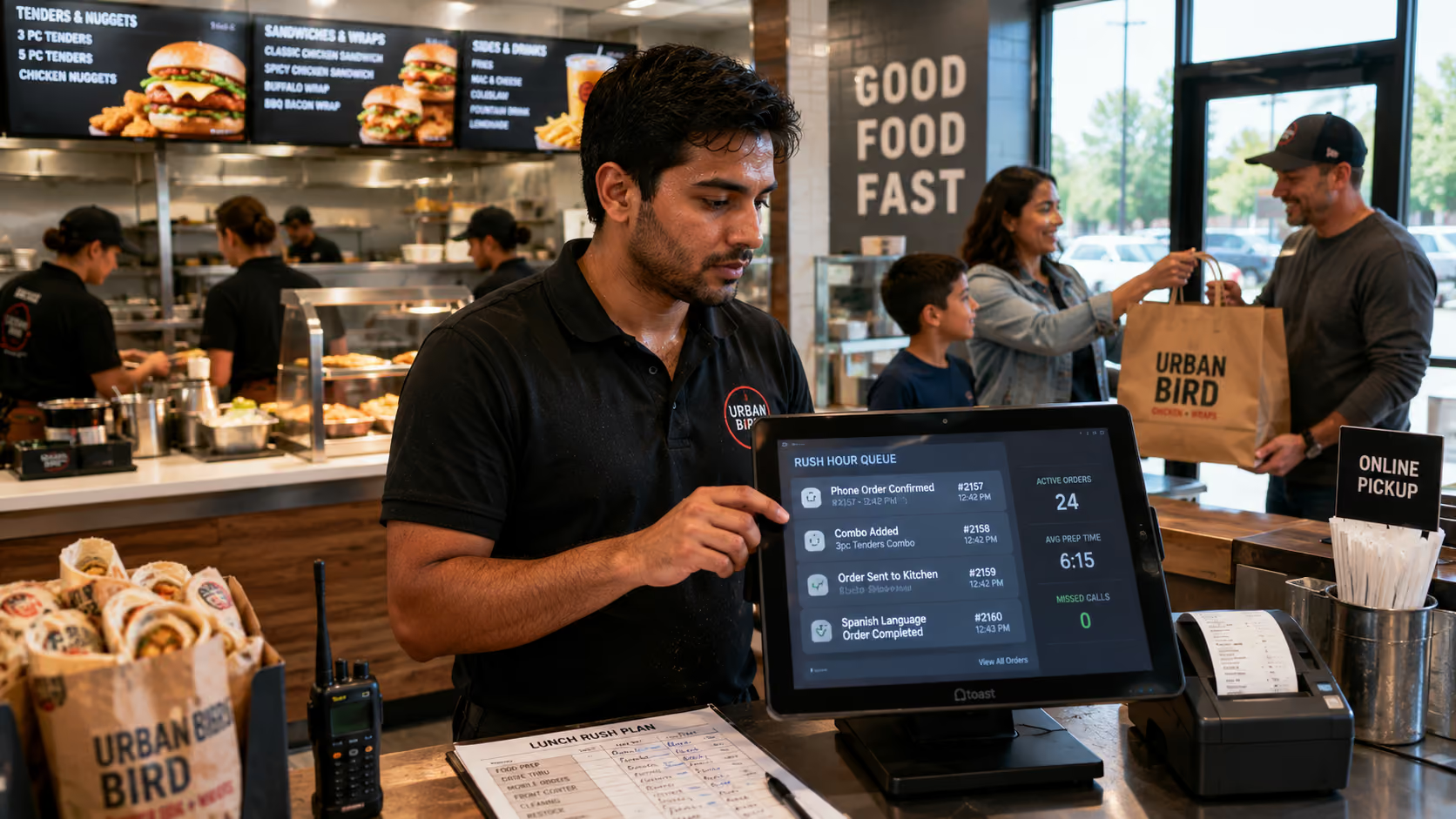
Most QSR operators know their food cost, their labour cost, and their average ticket. Very few know how much revenue walks out the door because nobody picked up the phone.
But nowadays, QSRs can use AI phone agents to answer calls automatically, take orders, reduce missed calls, and manage peak-hour demand.
The best systems integrate directly with POS platforms, handle modifier-heavy orders, and maintain high accuracy during lunch rushes and late-night spikes. This guide covers how to evaluate AI phone agents, how the top platforms compare, and which option fits different QSR operations.
What is an AI phone agent for QSRs?
An AI phone agent is a voice system that answers inbound calls, holds a natural conversation with the customer, takes their order, and pushes it directly into the POS. No hold music. No missed calls. No staff tied up on the phone during a rush.
The technology behind it is conversational AI, which means the system understands natural speech, handles back-and-forth dialogue, and can manage complex requests like substitutions, combo modifications, and allergy questions. It is different from an IVR (interactive voice response) system, which uses rigid menus and keypad inputs. A proper AI phone agent talks like a person.
For QSRs specifically, the use case is straightforward. Calls come in constantly. Staff are busy at the counter and drive-thru. Orders get missed, rushed, or taken down wrong. A restaurant phone answering system that runs all the time and never misses a call is a direct fix to a daily revenue problem.
Do QSRs need AI phone agents?
The operational case is not complicated.
According to Toast's 2024 Restaurant Trends Report, phone orders still account for a significant share of revenue at independent and regional QSR operators, particularly for pizza, wings, Chinese, and similar high-frequency takeout formats. At the same time, labor shortages have made it harder to staff the phones reliably.
The problems QSRs deal with every day:
- Missed calls during peak hours: Staff are at the counter or drive-thru window. The phone rings out.
- Rushed orders: When staff are under pressure, they take orders fast and make mistakes.
- Inconsistency across locations: Franchise operators cannot control how each site handles inbound calls.
- No data on call volume: Most operators have no idea how many calls they are missing or what those orders were worth.
- Multilingual caller friction: Staff who do not speak the caller's language lose the order.
A good voice agent for restaurants solves all of these at once. It answers every call, takes the order accurately, and sends it to the kitchen without involving a single staff member.
How we evaluated AI phone agents for QSRs
Not all restaurant AI phone agents are built the same. Here is the framework we used to compare platforms:
| Criteria | Why It Matters |
|---|---|
| POS integrations | Orders must reach the kitchen automatically |
| Order accuracy | Modifier-heavy QSR menus require precision |
| Modifier handling | Combos, substitutions, and add-ons must work reliably |
| Multilingual support | Many QSR markets have non-English-speaking callers |
| Upselling capability | AI should suggest add-ons and increase average order value |
| Scalability | Must handle concurrent calls across multiple locations |
| Setup complexity | Operators need to go live fast without weeks of onboarding |
| Analytics | Call volume, missed calls, and revenue data must be visible |
| Payment handling | Understand how each system routes payment securely |
| Franchise readiness | Central management and consistent experience across locations |
We applied these criteria across the main platforms QSR operators are currently evaluating.
The best AI phone agents for QSRs in 2026
Certus AI
Certus is a purpose-built AI ordering system for restaurants. It integrates directly with Toast, Square, Clover, and other major POS systems, pushing orders into the kitchen without any manual step. The voice quality is high, it handles complex modifier-heavy menus, and it upsells automatically based on the menu and order context.
Setup is same day. There is no new hardware required. The analytics dashboard shows call volume, orders placed, revenue recovered, and peak hour patterns across all locations.
Certus also handles reservations, delivery queries, and both English- and Spanish-speaking callers. It is well-suited for independent QSRs, pizza operators, and multi-location franchise groups. Read how it compares directly on the Certus vs Slang AI breakdown.
Best for: Independent QSRs, pizza shops, multi-location operators, franchise groups wanting fast deployment and direct POS integration.
Slang AI
Slang AI is a restaurant phone automation platform that has been in the market since the early 2020s. It focuses on call deflection, meaning it handles common queries and routes complex ones elsewhere. One noted limitation is that in some configurations it redirects callers to an online menu rather than completing the order on the call.
For operators who want full order completion over the phone, this is worth examining carefully before committing. Slang AI has grown its POS integrations and has a reasonable track record with multi-location brands.
Best for: Operators primarily looking to reduce call volume rather than capture every order on the phone.
Loman AI
Loman AI focuses on phone ordering for restaurants with a conversational AI approach. It has gained traction with pizza operators in the US market. POS integrations cover several major platforms. Setup timelines and modifier handling depth vary by menu complexity.
Best for: Pizza and takeout operators looking for an established alternative with phone-first ordering focus.
QSR Restaurant Voice AI Platform comparison table
| Platform | Best For | POS Integrations | Direct Order Completion | Multilingual | Upselling | Franchise Ready | Setup Time |
|---|---|---|---|---|---|---|---|
| Certus AI | QSR, pizza, multi-location restaurants | Toast, Square, Clover, and more | Yes | English + Spanish (included) | Yes | Yes | Same day |
| Slang AI | Call deflection and query handling | Multiple | Partial | Limited | Limited | Yes | Variable |
| Loman AI | Pizza and takeout restaurants | Select platforms | Yes | Limited | Yes | Partial | Variable |
Which is the best AI phone agent for pizza QSRs?
Pizza is the highest-volume use case for restaurant AI phone agents. Orders are frequent, modifier-heavy (crust, size, toppings, sauces), and customers often call back to check on status.
A pizza-focused restaurant answering service needs to:
- Handle half-and-half topping requests without confusion
- Manage combo deals and meal upgrades
- Confirm order details before pushing to the POS
- Handle estimated time questions without escalating to staff
For a detailed breakdown of what works in this specific format, see best AI voice assistants for pizza shop orders.
Top AI ordering systems for multi-location franchises
Multi-location operators have different requirements than single-site owners.
The AI system needs to:
- Deliver a consistent caller experience across every site
- Allow central menu management with location-level overrides
- In case of international locations, consider a multilingual AI for restaurants
- Provide analytics by location so operators can spot gaps
- Scale to handle concurrent calls across all sites simultaneously
- Support staff at sites with high non-English-speaking customer bases
Franchise groups that have piloted restaurant AI technology consistently report the biggest wins at high-volume weekend periods, where call volumes spike and staff coverage is stretched thin.
Which are the best AI phone agents for drive-thru heavy brands?
Drive-thru operations generate overflow call volume that the phone system has to absorb. Customers who cannot get through the drive-thru, or who want to call ahead, hit the phone line instead.
An AI phone agent in this context needs low latency (no lag in responses), very high order accuracy on combo and bundle orders, and the ability to handle high concurrent call volumes without degradation.
This is also where multilingual support matters most. Drive-thru markets in urban areas often have diverse customer bases. A system that handles English and Spanish fluently without dropping quality keeps that revenue in-house. For more on this, see why voice AI is mission-critical for independent restaurants.
Voicebot limitations and tradeoffs to know about
No AI phone agent is perfect.
Here is what to expect:
Edge cases on very complex orders: Catering orders with 20-plus line items, large group orders with many individual modifications, or unusual off-menu requests may need human escalation. Good systems handle this gracefully by routing to staff when needed.
Noisy call environments: Callers phoning from loud locations (a car, a street) can affect speech recognition accuracy. Better systems are trained on noisy audio, but it remains a variable.
Menu training time: The AI needs to know your menu. Most platforms ingest this from your POS or a menu file. For very large menus (100-plus items with custom modifiers), expect a short training period before accuracy peaks.
Customer preference for human agents: A small percentage of callers will ask to speak with a person. Every system needs a defined escalation path for this. Understand what happens in that scenario before you go live.
POS sync delays: In rare cases, POS connectivity issues can affect order delivery to the kitchen. Understand the fallback process your vendor has for this.
For operators thinking through security and payment handling alongside these operational questions, read the full guide on AI phone ordering security and PCI compliance.
What QSR operators should ask AI Phone Agent vendors before signing
- Which POS systems do you integrate with natively?
- How do you handle modifier-heavy orders with multiple customizations?
- What languages do you support, and how well?
- What is your average setup time for a single location?
- How do you handle call escalation when the AI cannot complete a request?
- What does the analytics dashboard show, and how often is it updated?
- How do you handle concurrent calls during peak periods?
- How is payment handled, and are you PCI compliant in your flows?
- Can we manage multiple locations from one account?
- What does your support process look like after go-live?
How AI strategy is shifting for independent QSR operators
The gap between large chains and independent operators is closing fast because of tools like restaurant AI technology. Chains have invested in call center infrastructure and digital ordering for years. AI phone agents give independents the same capability at a fraction of the cost.
For a look at how major chains are approaching AI-driven ordering strategy, and what independents can take from it, read the AI strategy lesson independent restaurants should take from Starbucks.
If your restaurant is missing calls, taking orders slowly, or running short-staffed during peak hours, an AI phone agent is a direct operational fix. The best platforms go live the same day, require no new hardware, and start capturing revenue from the first day.
Book a demo with Certus AI to see how the system handles your menu, your call volume, and your POS setup before you commit to anything.
Frequently asked questions
Do customers like ordering with AI?
Acceptance has grown significantly. MIT Technology Review has noted that consumer comfort with AI voice assistants in service contexts has risen steadily since 2023. Customers care more about speed and accuracy than whether a human took the order.
What POS systems work with AI phone agents?
Toast, Square, Clover, and Lightspeed are the most commonly supported. Always confirm native integration versus workaround solutions before committing.
How accurate are AI restaurant phone agents?
Top platforms report order accuracy above 95% on well-trained menus. Accuracy drops on menus with missing or inconsistent item data, which is why clean menu setup matters.
Can AI upsell combo meals?
Yes. Leading systems suggest add-ons and upgrades contextually based on the order. This raises average order value without any staff involvement.
What happens during peak-hour call spikes?
A well-built AI phone agent handles concurrent calls simultaneously, so there is no queue. Every caller gets answered immediately, even during the Friday evening rush.
Can AI phone agents handle multiple calls at once?
Yes. Unlike a single staff member who can only take one call at a time, AI systems handle many calls in parallel. This is one of the most significant operational advantages for high-volume QSRs.
Are AI phone agents good for franchises?
Yes, Voice AI for scaling franchises is a great choice. Every caller at every location gets the same experience, the same upsell logic, and the same order accuracy. Central management of menus and reporting is a key feature to look for.

.svg)
.svg)
.svg)
.svg)