.svg)

.svg)


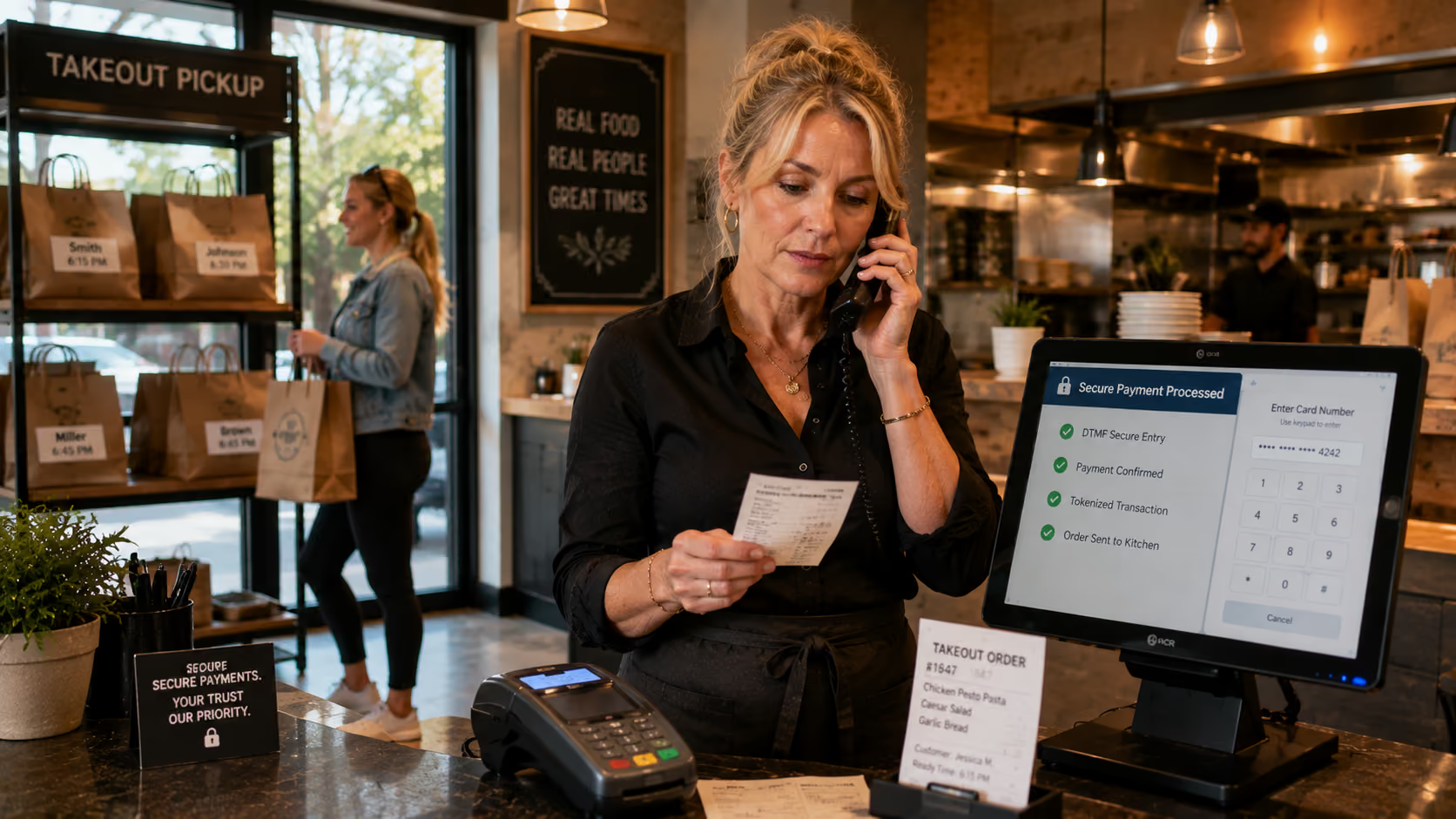
Restaurant operators have started asking harder questions before adopting new phone technology. And rightly so.
Is AI phone ordering secure? Who stores the data? Is the call recorded? What happens if a customer reads a card number out loud?
AI phone ordering systems can support PCI-compliant workflows when payment data is handled through tokenized payment systems, compliant processors, and properly designed call flows. So the short answer: yes, it can be done securely. But how the system is built matters a lot.
This article explains how a voice agent for restaurants can be used securely and answers all of the questions.
What is PCI compliance in restaurant phone ordering?
PCI DSS stands for Payment Card Industry Data Security Standard. It is a set of rules created by major card networks to protect cardholder data during payment transactions.
For restaurants, PCI compliance in phone ordering means:
- Cardholder data (card numbers, CVVs, expiry dates) must never be stored unless absolutely required and encrypted.
- Tokenization replaces raw card data with a secure token that payment processors handle instead.
- Hosted payment flows move card entry away from the restaurant's systems entirely.
- Secure processors like Stripe, Square, and Braintree handle the actual transaction in a PCI-certified environment.
If any of these elements are missing, the restaurant is exposed. According to the PCI Security Standards Council, merchants that fail to meet DSS requirements face fines, higher processing fees, and in serious cases, loss of card payment privileges.
How does AI phone ordering handle payments?
Most well-built AI phone ordering systems do not collect payment over the voice call at all. Instead, they follow one of two secure patterns:
Pattern 1: Pay at pickup or delivery
The AI takes the order and pushes it directly into the POS. Payment happens in person at the point of sale. No card data is ever captured on the call.
Pattern 2: Secure payment handoff via IVR
If payment must happen over the phone, the AI hands the caller off to a DTMF-based (touch-tone) payment flow. The customer enters their card number using their keypad, not their voice. The audio is never recorded during entry. The data goes directly to a PCI-certified processor.
Neither pattern stores raw card numbers in call transcripts, databases, or logs.
What is DTMF masking and why does it matter?
DTMF stands for Dual-Tone Multi-Frequency. When a caller presses a number on their keypad, the system hears a tone rather than a spoken digit.
DTMF masking means the system mutes or replaces those tones in any recording or transcript. So even if a call is recorded for quality purposes, the card number is never captured in the audio file.
This is a standard requirement for any restaurant phone ordering system that handles card payments over the line. If a vendor cannot confirm they use DTMF masking during payment entry, that is a compliance risk.
Is AI phone ordering safer than human staff?
In many ways, yes. Human staff taking phone orders introduce risks that are hard to control:
According to Verizon's 2024 Data Breach Investigations Report, the food service sector consistently appears in breach data linked to point-of-sale and social engineering attacks. A significant portion of those involve insider access.
When they are properly configured, AI systems can remove the human handling of payment data entirely.
Common security mistakes in AI phone ordering
Not every restaurant phone ordering system is built with security in mind.
Watch out for these:
- Card data stored in call transcripts. Some voice AI systems log everything said on a call. If a customer reads their card number aloud and it ends up in a transcript, that is a PCI violation.
- Call recordings that capture payment audio. Recording a call is fine. Recording a call during payment entry without masking is not.
- Non-tokenized processing. If the AI system passes raw card data to the POS or a database, rather than to a PCI-certified processor, the operator is liable.
- Insecure POS integrations. Connecting voice AI to a POS via an unencrypted or undocumented API creates a gap in the payment chain.
- Shared POS credentials. If the AI system logs into the POS using shared staff login credentials, it creates an audit trail problem and a security vulnerability.
To be on the safe side: Before signing with any automated order system, ask the vendor directly how they handle each of these scenarios.
What payment processors work with secure AI phone ordering?
Most major PCI-certified processors integrate with restaurant voice AI systems.
The most common ones used in the QSR space include:
- Square (widely used by independent restaurants; Certus integrates natively with Square POS)
- Toast Payments (built into the Toast ecosystem)
- Stripe (developer-friendly, strong tokenization support)
- Braintree (PayPal-owned, common in franchise environments)
- Clover (popular with mid-size restaurant groups)
If you are running the best AI phone system Square POS integration supports, orders go directly into Square without touching payment data at the AI layer. Payment is processed through Square's own certified environment.
--> Read the comparison of Toast vs Square POS
How to check if your voice AI vendor is PCI compliant
Before going live with any restaurant voice AI platform, run through this checklist:
- Does the system avoid capturing card data over voice?
- Does it use DTMF masking for keypad-based payment entry?
- Does call recording pause or mute during payment entry?
- Is the payment processor PCI DSS certified?
- Does the vendor provide documentation on their data retention policy?
- Are POS integrations handled via secure, encrypted APIs?
- Can the vendor confirm no raw card data is stored in logs or transcripts?
- Do they support audit trails for compliance reviews?
If a vendor cannot answer all of these clearly, that is a red flag. Franchise groups and multi-location operators in particular need this documentation before rolling out across sites.
What happens if a customer reads their card number aloud?
This is a real scenario. Some customers will just say their card number out loud, especially older callers.
A well-configured system handles this in two ways:
- The AI does not attempt to process verbal card data. It is not trained to extract or use spoken card numbers.
- Call recording policies exclude payment conversations, or the transcript is flagged and scrubbed automatically.
The customer should be redirected to key in their card details or pay in person. Most operators using AI phone ordering for takeout and delivery default to pay-at-door or pay-on-pickup to avoid this scenario entirely.
If your restaurant has customers calling in different languages and does need to take payment over the phone, read about how bilingual AI phone systems handle complex call flows, including payment routing, across different customer types.
What data does an AI phone agent store?
Standard data retained by a restaurant voice AI system typically includes:
- Call time and duration
- Order details (items, modifiers, quantities)
- Customer phone number (for order lookup)
- Call outcome (order placed, reservation made, query handled)
What it should never store:
- Raw card numbers
- CVV codes
- Expiry dates
- Full cardholder names linked to card data
Ask your vendor for their data retention policy in writing. Reputable platforms make this available during the sales process.
Is restaurant voice AI ready for enterprise and franchise rollout?
Yes, with the right vendor. Franchise groups and QSR operators have specific requirements:
- Consistent call handling across all locations
- Central analytics and reporting
- Documented vendor compliance posture
- API-based POS integration with no manual workarounds
- Clear escalation paths for security incidents
Larger operators typically want to see SOC 2 documentation or equivalent, plus clarity on where data is stored and who has access.
If you are evaluating voice AI for multiple locations, the future of voice agents for restaurants covers what enterprise-grade deployment actually looks like in practice.
How AI phone ordering fits into your wider restaurant security posture
Payment security is one piece of the puzzle. A good restaurant phone ordering system also needs to handle:
- Access control (who can see call logs and order data)
- POS integration security (encrypted APIs, no shared credentials)
- Staff training on what the AI does and does not handle
- Incident response (what happens if a data issue is flagged)
If you are already using AI to answer calls and push orders into your POS, the security conversation is mostly about what the system does not touch, which is the payment layer. Keep that separation clean and you are in a strong position.
Operators who want to see how AI handles upselling, order accuracy, and POS sync alongside security can read more about automated upselling for restaurants and how it works end to end.
Getting started with secure AI phone ordering
If you want to answer every call, push orders directly into your POS, and keep payment data out of the AI layer entirely, book a demo with Certus AI.
We will walk you through exactly how the system handles calls, orders, and payment routing so you can make a confident decision for your restaurant.
--> Also worth reading: IVR vs voice AI breaks down how older phone systems compare to modern AI agents on call handling and security.

.svg)
.svg)
.svg)
.svg)