.svg)

.svg)


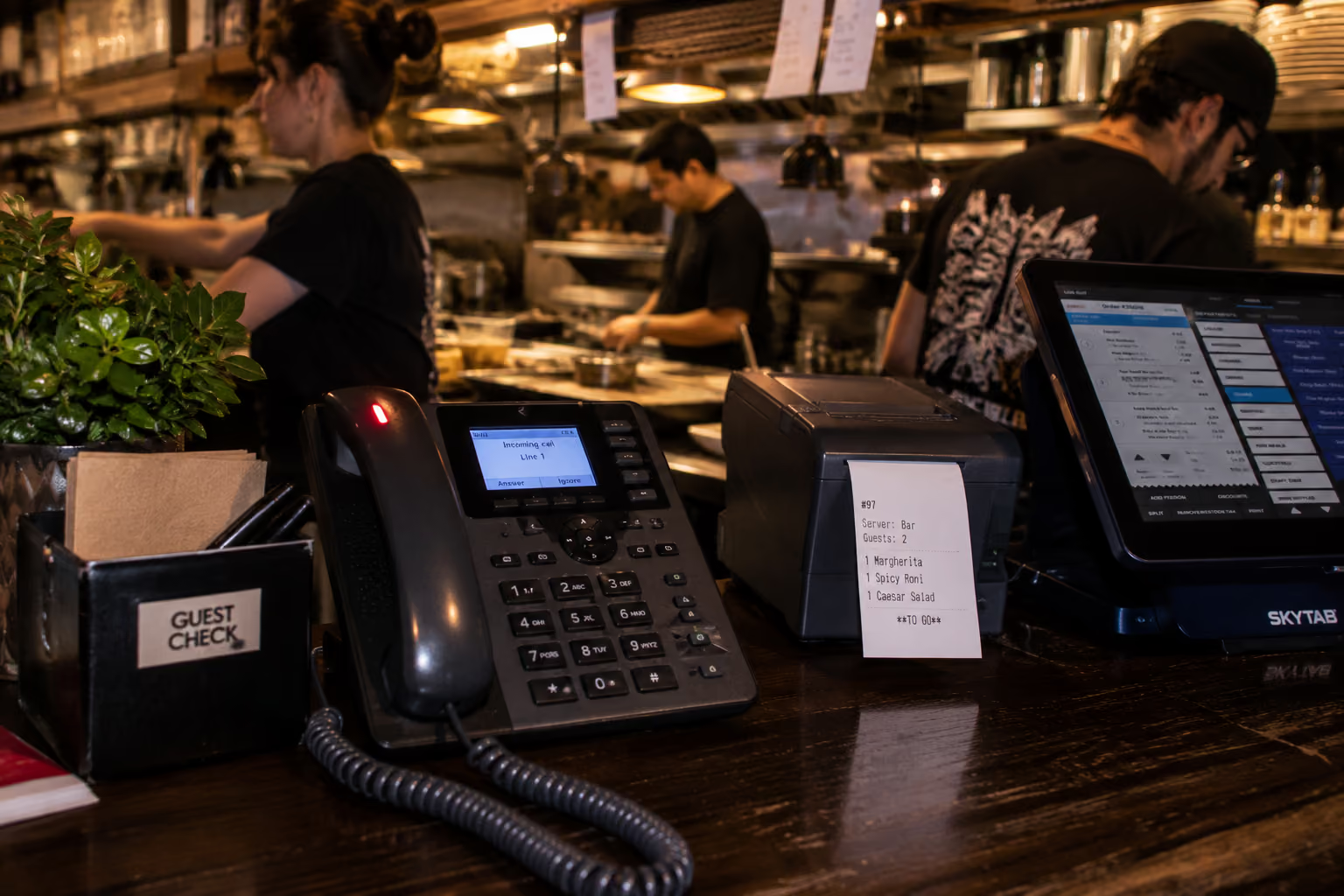
Five years ago, online ordering felt optional. I remember the conversations with many restauranteurs on the topic. "Why would we pay a commission when people can just call?" They said that in 2019. By 2021, they were doing 40% of their revenue through third-party apps.
Voice AI for restaurants is following the same path, but faster. The operators I talk to aren't asking if they should adopt it anymore. They're asking which system to choose and how quickly they can get it live.
I've managed 11 restaurants, from takeaways to breweries, and started taking phone orders at age nine. I've lived the chaos of a Friday dinner rush when the phone won't stop ringing, a server is stuck on a call, and a table of six is waiting to order. That chaos is exactly why phone orders still drive restaurant revenue and why solving this problem is so critical.
That experience is why we built Certus AI. We saw that the technology had finally caught up to the problem. A growing share of restaurant operators now use restaurant AI technology to handle phone operations, and the trend is accelerating. The technology has moved from experimental to essential, particularly for independent restaurants where every missed call is lost revenue.
The new table stakes: Voice AI is following online ordering's path
Restaurant Voice AI is quickly becoming baseline infrastructure for any restaurant that relies on phone orders. This shift mirrors how online ordering became essential between 2018 and 2022, but the adoption is happening much faster. The technology solves immediate, costly operational pain points that independent operators face every single day.
Remembering when online ordering felt optional
In 2018, signing up with DoorDash was a debate. The commission felt steep, regulars knew to call in their orders. Why change what was working? Then the world changed, and online ordering became a survival tool. Restaurants that had resisted for years scrambled to get on every platform. The ones who adopted early had smoother operations because they had already optimized their workflows.
The lesson was clear: when technology solves a fundamental problem, early adoption is a lasting advantage.
The shift in restaurant technology adoption
Restaurant operators are adopting new technology faster than ever. According to industry coverage in FSR Magazine, AI tools are moving from pilot programs to production systems in months, not years. The difference between online ordering's adoption curve and voice AI's is the nature of the problem they solve. Online ordering solved a customer convenience issue. Voice AI solves an operational crisis: understaffing, missed revenue, and burned-out teams.
Why this trend is different, and faster
Three factors are accelerating voice AI adoption. First, the labor shortage is persistent. In 2019, you could hire your way out of phone coverage problems. Today, you can't. An AI voice assistant can help with front of house operations when you are understaffed.
Second, the technology works. Early AI was clunky, but modern voice AI handles complex orders and integrates directly with your POS.
Third, the ROI is immediate. You can track every call answered and every dollar of recovered revenue. When Boardwalk Pizza captured $70,000+ in orders and freed 195 hours of staff time, that was three months of actual data, not a projection.
What does "mission-critical" mean for your restaurant?
In a restaurant, "mission-critical" technology passes three tests: losing it costs you money, it scales faster than hiring staff, and it improves the customer experience during your busiest hours. Voice AI meets all three criteria for takeout-heavy independents, which is why it's rapidly becoming essential infrastructure.
Does losing it cost you money?
The clearest test is simple: what happens if it goes down? If your POS crashes or your walk-in cooler fails, you lose money. The same is true if your phone goes unanswered during a rush. Most operators underestimate how much. If you miss 10 calls a day with a $30 average order, that's $300 in lost daily revenue. Over a year, that's over $100,000. That's why Gold Coast Kitchen recovers $30,000/month in missed revenue by answering every call automatically.
Can a restaurant AI assistant scale faster than hiring staff?
Labor is the biggest constraint on growth for most independent restaurants. You can't hire fast enough for a sudden spike in orders, and training a new employee to handle your menu and upsell effectively takes time. The cost of a dedicated phone person can run over $40,000 annually.
A restaurant AI phone system scales instantly. If your call volume doubles, the system handles it with no hiring, training, or scheduling headaches. It answers every call, takes complex orders, and pushes them directly to major POS systems like Toast, Square, and Clover.
Does Voice AI improve customer experience at your busiest times?
The worst customer experience happens when you're too busy to provide good service. When staff are overwhelmed, calls go unanswered, customers are put on hold, and mistakes happen. A caller hangs up and orders from the competitor who answered on the first ring.
Voice AI for restaurants provides consistent, patient, and accurate service no matter how busy you are. It never puts a customer on hold and confirms every detail, which is how an AI phone agent can handle complex orders without staff intervention.
Why independent restaurants need this more than ever
Independent restaurants face a structural disadvantage in phone operations that voice AI directly solves. Unlike chains with large call centers, independents rely on front-of-house staff who must choose between serving in-person guests and answering the phone. This creates an impossible tradeoff that costs revenue and burns out teams.
The chain advantage and the independent struggle
Large chains solved phone operations years ago with centralized call centers. When you call a major pizza chain, you're often routed to a dedicated agent. Independents can't afford that infrastructure. You rely on your host or server to grab the phone between other tasks.
This is how chains like Domino's built a massive empire on operational efficiency. Voice AI levels the playing field, giving independents the same always-on phone coverage that chains achieve through massive investment, but for a flat monthly price.
How AI technology motivates your restaurant's team
I've watched this scenario play out thousands of times. It's 7 PM on a Friday, the dining room is full, and the phone rings. Your host glances at the phone, then at the waiting customers, and makes a split-second decision: let it ring. The in-person customer wins every time. But that invisible caller represents real revenue. The system is failing your staff by forcing an impossible choice. The best AI phone ordering systems for small restaurants remove that choice entirely, letting staff focus on in-person hospitality while the AI handles phone orders.
When your best server has to stop mid-conversation with a table to answer the phone, both experiences suffer. I've seen turnover drop when restaurants implement voice AI. Staff appreciate not being interrupted constantly. They can focus on creating great experiences for the guests in the dining room. Voice AI preserves your team's energy for where it creates the most value: face-to-face hospitality.
What to look for in a reliable restaurant voice AI
An effective restaurant voice AI must be restaurant-specific, integrate seamlessly with your POS, support multiple languages, and offer rapid deployment. These features separate production-ready systems that solve problems from experimental tools that create new ones. A reliable system should feel like your best employee, not another piece of tech to manage.
Is it truly restaurant-specific?
Generic AI chatbots fail in restaurants because they don't understand the complexity of food service. A restaurant-specific AI is trained on thousands of real restaurant conversations. It understands custom orders, menu modifications, and allergy questions. It knows how people actually order food, including regional terms and slang, and can answer questions like "Is the marinara sauce vegan?" or "How spicy is the Nashville hot chicken?"
Seamless integration with your existing POS
Integration is where most restaurant technology fails. If your voice AI doesn't push orders directly into your POS, you've just moved the bottleneck, not removed it. True Restaurant Voice AI POS integration means the AI takes the order and sends it to your kitchen printer just like a server entered it.
It works with all major POS systems including Toast, Square, Clover, Skytab POS, and Flipdish. This eliminates manual re-entry, which kills efficiency and introduces errors.
Language support and quick setup
Your customer base speaks multiple languages, and your voice AI should too. English and Spanish support is the baseline for most U.S. restaurants. The AI should detect the language and respond naturally without requiring the customer to press a button.
Quick setup is also critical. The best providers can get you live sam day with minimal time investment from you, because every day you wait is another day of missed revenue.
Understanding the differences between restaurant AI solutions
The voice AI market has several different approaches. Some, like Slang AI, reroute callers to an online ordering page, which creates friction for customers who specifically chose to call. Others, like Loman, may charge per minute and lack key features like Spanish support. The right choice depends on your operation, but the core requirements are consistent.
To ease your decision-making process even more, read our restaurant voice AI buyer's guide.
Choosing an AI provider: Ask the right questions
Before committing to any voice AI, you need to ask the right questions to filter out incomplete solutions and identify systems ready for production use. Focus on four key areas: end-to-end automation, POS integration, language support, and deployment speed. The answers will reveal which providers can actually solve your problem today.
Five essential questions for any vendor
When evaluating providers, cut through the marketing and ask these questions:
- Does it handle end-to-end ordering? The system must take the complete order, including modifications, and send it to the kitchen without staff intervention.
- Does it integrate with my POS? Not "can it," but "does it." Ask for live references using your exact POS system.
- Can it handle my menu? Many AI systems are build to handle simple menus with 1-3 modifiers at most. For many independents this is a no go due to the modifications they require. Certus AI has been built from the ground up to handle menus large and small.
- Does it support English and Spanish? A bilingual AI phone agent should detect the language and respond naturally.
- Can it be set up today? A 48-hour deployment shows the technology is mature. Weeks of setup means the system requires heavy customization.
Real results from fellow operators
Operators seeing the biggest impact share common traits: high phone volume, a takeout-heavy model, and a tight labor market.
- Boardwalk Pizza runs on Toast and captured over $70,000 in orders in three months, freeing up 195+ hours of staff time.
- Gold Coast Kitchen tracked their missed calls and now recovers $30,000 per month in revenue that was previously lost.
- The team at Dirty Bird on Square POS stopped losing phone orders and went from skeptic to superfan after seeing the AI handle their complex menu during a rush.
- The Gatsby Hawaii recovered $8,354/month in missed revenue after struggling with unanswered calls at their high-end establishment.
Mission-critical Voice AI for your restaurant
The phone line has been a chaotic, inefficient, and costly part of restaurant operations for decades. For the first time, technology exists to solve the problem completely. Voice AI is no longer a futuristic concept; it's practical, affordable infrastructure that directly addresses the most pressing challenges in the industry: labor shortages and missed revenue.
Like online ordering before it, voice AI is becoming a fundamental part of the modern restaurant tech stack. The operators who adopt it now are building a more resilient, efficient, and profitable business. They are freeing their teams to focus on hospitality and no customer is ever lost to a busy signal again.
Hundreds of restaurants trust Certus AI to turn every phone call into revenue. If you're ready to see the difference it can make for your restaurant, book a demo to see it in action.

.svg)
.svg)
.svg)
.svg)