.svg)

.svg)


Starbucks' AI strategy: a lesson for independent restaurants
- Understand your core problem: Chains like Starbucks need to inspire new visits. Independents need to capture existing demand.
- Don't copy chain AI strategies: What works for a brand with 30 million loyalty members won't work for your neighborhood spot.
- Focus on zero-friction AI: Your customers shouldn't have to change their behavior to order from you.
- Prioritize revenue capture: Your AI should solve missed calls and lost orders, not just offer new ways to browse.
On April 15, 2026, Starbucks launched a beta app inside ChatGPT that gives customers personalized drink recommendations. The news spread fast, with outlets like Axios and Business Insider calling it the future of restaurant AI.
I grew up taking phone orders at age 9 in my family's restaurants and was managing front-of-house by 16. When I saw this news, my first thought wasn't "this is brilliant." It was "this would kill most independent restaurants."
The press framed this as a blueprint for the industry, but it's not. It's a blueprint for Starbucks. The strategy that makes sense for a global chain is the exact opposite of what works for a neighborhood pizza shop. The difference comes down to one fundamental question: what problem are you actually trying to solve?
What Starbucks launched and why it makes sense for them
Starbucks' new AI tool is a top-of-funnel discovery play designed to create new purchase occasions and drive engagement. Customers open ChatGPT, prompt @Starbucks with a mood or a photo, and the AI suggests a drink. They then click through to the Starbucks app or website to complete the order. This strategy is a logical solution to a specific problem faced by a massive, mature brand.
With over 35 million active loyalty members, Starbucks doesn't have a customer acquisition problem. Their challenge is inspiring existing customers to visit more often or try new things. As their SVP of Digital, Paul Riedel, said, "customers aren't always starting with a menu. They're starting with a feeling."
This AI integration meets customers in moments of inspiration, before they've even decided they want coffee, and plants the idea. For a company that needs to maintain momentum on its 4% same-store sales growth, this makes perfect sense. They have the brand loyalty, technical infrastructure, and marketing budget to make it work. Most importantly, they're solving a discovery problem, not a capacity problem.
Discovery vs. capture: why chain AI is the wrong model for you
Independent restaurants have the opposite problem of chains like Starbucks, which means a different AI strategy is required. While chains focus on discovery to inspire new visits from a known customer base, independents must solve the capture problem, converting customers who are already trying to place an order. Applying a discovery-focused AI strategy to a capture-based business is a recipe for failure.
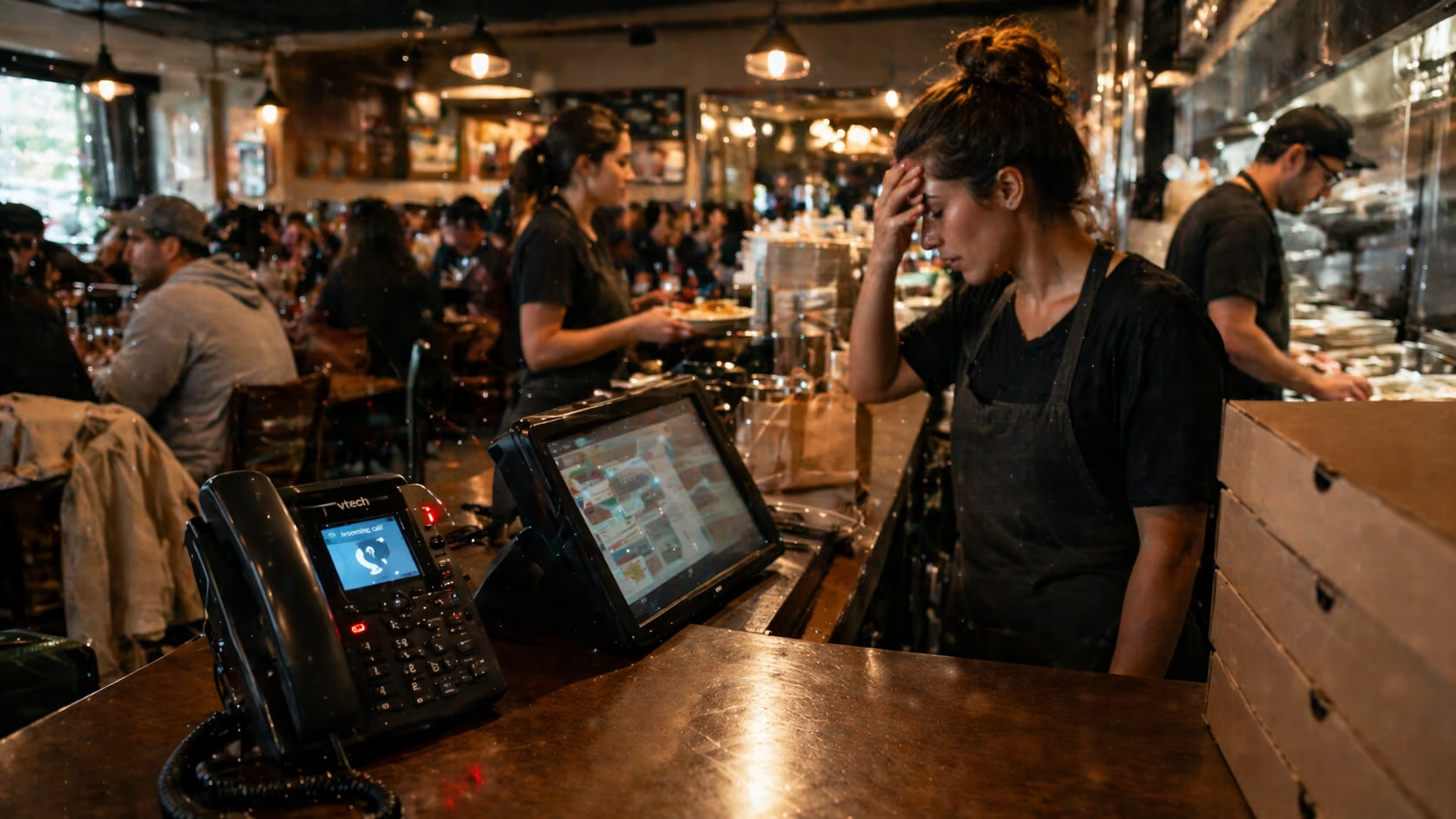
Your problem is converting customers who are trying to reach you right now. Industry data shows that 43% of calls to independent restaurants go unanswered. During the weekend dinner rush, that number climbs even higher. I've seen it firsthand. You're slammed with in-house guests, the phone rings, and you face an impossible choice: answer the call and neglect the table in front of you, or serve the guest you can see and let the call go to voicemail.
Every missed call is a customer who wanted to give you money. They knew what they wanted. When you miss that call, you lose an immediate sale. The math is brutal. Missing just 10 calls a day at a $30 average order value adds up to over $100,000 in lost annual revenue. This is the core issue that shows why old phone systems are failing restaurants.
The Starbucks experience requires customers to download ChatGPT, enable an app, learn a new prompt, and switch to another app to check out. Starbucks can ask this because their 30 million loyalty members will follow them. Your neighborhood restaurant doesn't have that luxury. Asking your customers to change their behavior is how you lose them to the place that just answers the phone. As one expert noted, much of restaurant tech is designed for the "scaled use case" of chains, and copying it actively hurts independents by adding friction.
The independent's AI playbook: solving the capture problem
The right restaurant AI automation for an independent restaurant meets customers where they already are, on the channel they already use: the phone. A voice AI phone system provides a zero-friction solution that directly solves the capture problem by answering every call, taking orders, and freeing up your staff without asking customers to change their behavior.
This type of AI is the universal interface. Every customer knows how to use it. A modern voice AI phone agent answers every call instantly, takes complex orders, handles questions about ingredients, and sends orders directly to your POS. The customer experience is identical to talking to your best employee, except this employee never gets overwhelmed, never puts anyone on hold, and never misses a call.
This isn't theoretical. By implementing a restaurant AI phone system, Boardwalk Pizza captured over $70,000 in orders and freed up 195 hours of staff time. They didn't ask customers to do anything new. They just answered the phone every time. Spyros Marinos, a restaurateur who adopted voice AI, noted that before the system, 95% of calls went unanswered during busy times.
This is the AI strategy that makes sense for independents. It solves your actual problem, requires zero customer education, and pays for itself in recovered revenue within days. The technology complements your team by handling repetitive work, allowing your staff to focus on providing the great hospitality that makes people want to come back.
--> Read about how independent restaurants can compete with MC Donald's
How to build an AI strategy that works for your restaurant
The real lesson from Starbucks is not to copy their AI, but to copy their thinking: identify your single biggest problem and find a tool that solves it. For a global chain, that problem is discovery. For an independent restaurant, that problem is almost always capturing the demand you already have. Your AI strategy should start with your biggest operational pain point, which for most restaurants is the phone.
Missed calls mean missed revenue. Overwhelmed staff means worse service for in-house guests. The solution isn't asking customers to change their behavior. It's meeting them where they already are with a tool that works invisibly in the background.
The right restaurant AI technology from Certus AI answers every call, takes orders, and integrates directly with Toast, Square, and Clover POS systems. Restaurants go live in 48 hours with just 45 minutes of setup time. The system handles complex orders, upsells naturally, and never puts a guest on hold. Most importantly, it solves the capture problem that's costing you real money every single day.
The best restaurant AI solutions don't require your customers to learn new tools or change their habits. They work behind the scenes, capturing revenue you're currently losing and freeing your team to focus on hospitality. That's the AI strategy that works for independent restaurants.
Book a demo to see how voice AI can solve your biggest operational bottleneck and start recovering lost revenue today.
Won't customers prefer talking to a real person over AI?
This question assumes the choice is between AI and a person. In reality, the choice is often between an AI and no answer at all. During a rush, calls go to voicemail and customers call the next restaurant. Voice AI ensures every customer gets an instant answer, which is what they actually want. Modern systems can even handle complex orders with modifications and special requests just like your best employee.
How long does it take to see ROI from a restaurant AI phone system?
For voice AI, the ROI is typically immediate. If you miss 10 calls a day with a $30 average order, that's $300 in daily lost revenue. A system that costs a few hundred dollars a month pays for itself on the first day. The implementation of Certus AI is fast, and most restaurants see recovered revenue in the first week that exceeds the system's annual cost.
About the author: Gurveer Singh is Co-Founder and CEO of Certus AI's voice AI for restaurants, a Y Combinator-backed company. He grew up in his family's 11-location restaurant chain, taking phone orders at age 9 and managing front-of-house operations by 16. Certus AI won the Innovation Award 2025 at the Restaurant & Takeaway Innovation Expo.

.svg)
.svg)
.svg)
.svg)