.svg)

.svg)


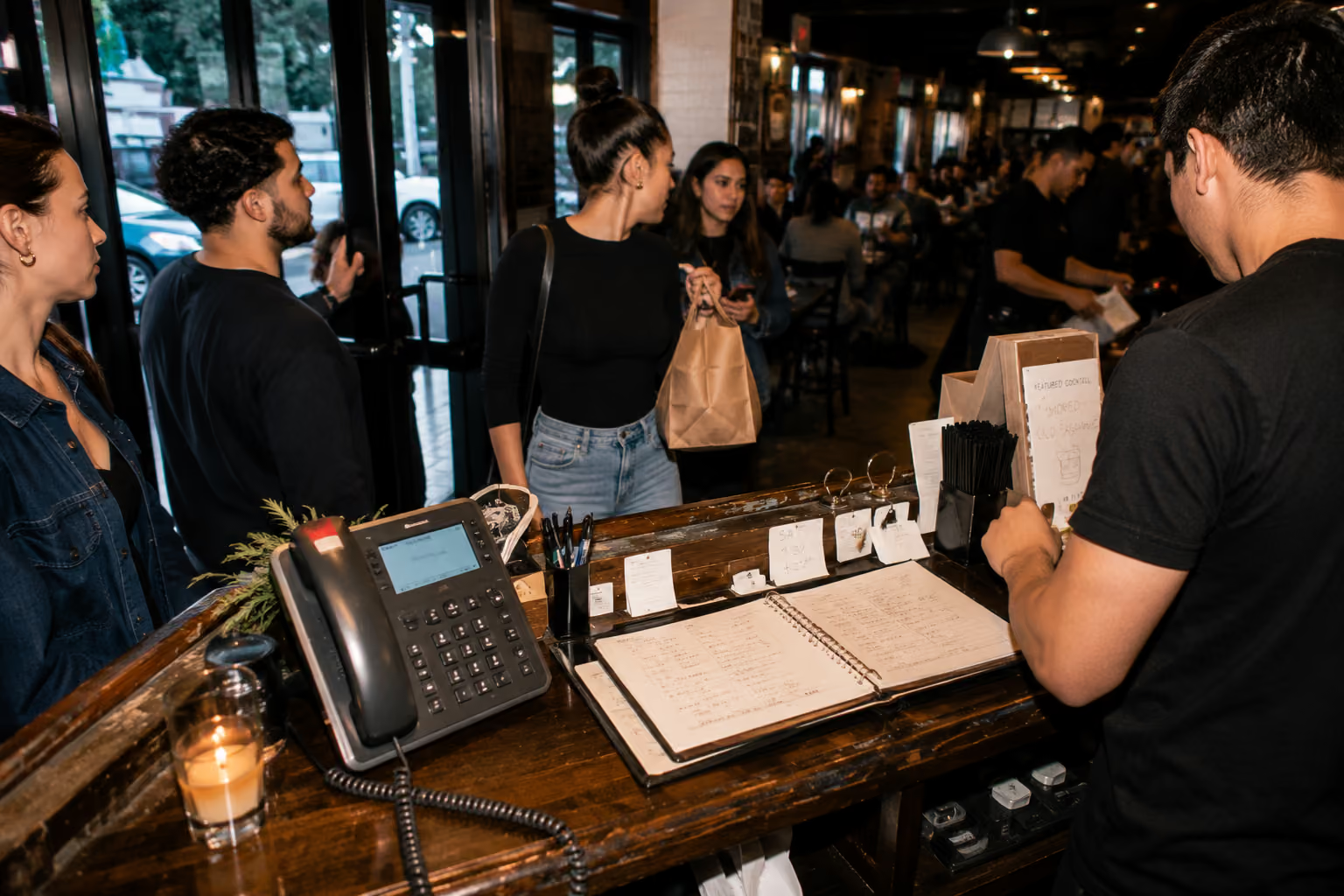
At my family's restaurants, we didn't have a receptionist. We had whoever was closest to the host stand when the phone rang. During a Friday dinner service, that usually meant nobody.
I watched it happen hundreds of times. A server would be mid-order, the phone would ring, and they'd glance toward the host stand in a panic. Do I finish this order or sprint for that call? Most of the time, they stayed with the table. The phone rang out. The caller moved on to the next restaurant.
I didn't realize what those missed calls were worth until I ran the numbers. A single missed reservation for a six-top at $50 per cover is $300 in lost revenue. Miss one of those a week, and you're looking at over $15,000 a year. Miss three, and you've lost the equivalent of a full-time employee's salary.
A restaurant handles more revenue moments over the phone than almost any other piece of equipment, yet we treat it like an afterthought. Hotels have receptionists. Dental offices have receptionists. Restaurants have chaos. This guide explains how an AI receptionist can solve the chaos and turn it into revenue.
Why restaurants should not ignore a ringing phone
The cost of a ringing phone in a restaurant can be measured in lost revenue and staff burnout. While your team focuses on in-house guests, as many as half of all calls go unanswered, representing thousands of dollars in missed reservations and takeout orders each month. This tension between serving present guests and answering potential ones creates a stressful environment and a significant drain on your bottom line.
Picture your busiest Friday night. The phone rings, but your host is busy with walk-ins. It keeps ringing.
This scene plays out in thousands of restaurants every night. According to DoorDash data reported by Restaurant Dive, 50% of calls to restaurants go unanswered. During a rush, when nobody can step away from a table, it only gets worse. These aren't spam calls; they're customers ready to book a table or place an order.
What do missed calls cost restaurants?
A missed call for a four-top reservation at $45 per person is $180 in lost revenue. A six-top is $270. And most people who reach a voicemail won't leave a message. They just call the next restaurant.
If you miss just one six-top reservation per week, that's over $14,000 in annual revenue gone. Miss a few calls like that, and you've lost over $40,000. You're paying the price of a full-time employee by losing revenue you never knew was there. For a deeper look, explore how you can never miss a call with an AI phone agent.
Beyond direct revenue loss, there's the toll on your staff. Every time the phone rings during service, it creates stress. Your team knows they should answer it, but they can't abandon the guest in front of them. This constant tension wears people down. A server taking a phone order can't check on their tables, the in-house guest feels ignored, and the caller feels like an inconvenience. Nobody wins.
What can a restaurant receptionist handle?
A restaurant receptionist handles a wide range of calls critical to daily revenue and operations. Unlike in a typical office, nearly every call to a restaurant is from a high-intent customer who needs immediate action, whether it's booking a table, placing an order, or asking a question that determines if they dine with you. These are real-time revenue opportunities.
When someone calls a restaurant at 6:30 PM on a Saturday, they need an answer now. Despite the rise of online ordering, a majority of reservations and a significant chunk of takeout orders still happen over the phone. Every call represents a decision point.
Managing reservations and waitlists efficiently
Reservation calls require checking availability, confirming party size, and noting special requests. A good receptionist can suggest alternative times or explain your waitlist process, making the caller feel valued.
Answering common questions and special requests
A large portion of calls are from people asking critical questions: What are your hours? Do you have parking? Can you accommodate a gluten allergy?
Answering these questions accurately is often the final step before a customer commits to a booking.
Processing takeout orders and vendor calls
Takeout orders are pure revenue but demand accuracy. A rushed phone order leads to mistakes and lost customers. Even vendor calls are important for operations and need to be routed to the right person without disrupting service. You can learn more about how an AI phone agent handles complex orders.
Why hiring a dedicated receptionist is not worth it for most restaurants
Hiring a dedicated human receptionist seems like the obvious solution. But for most independent restaurants, the high cost, scheduling challenges, and operational realities make it impractical. The financial burden and mismatch between peak call times and staff availability mean this solution often creates more problems than it solves.
Can your restaurant afford a full-time phone answerer?
A dedicated receptionist costs upwards of $40,000 to $50,000 annually when you factor in salary, payroll taxes, and benefits. For an independent restaurant, adding a $50,000 expense for a non-revenue-generating role is a tough pill to swallow, especially when rising labor costs are a top concern for operators.
The impossible timing of peak call volume
The core problem is timing: the phone rings most when your staff is busiest. The bulk of a restaurant's daily calls comes in during the lunch and dinner rush. A human receptionist can only answer one call at a time. If three people call at once, two go to voicemail.
Staff distraction and burnout in restaurants
When servers or hosts answer the phone, it pulls them away from their primary job: serving guests. This creates a ripple effect that slows down service, increases stress, and leads to burnout. Your team starts to see the phone as an annoyance rather than an opportunity.
On top of that, when different staff members answer the phone, you get inconsistent service. One server might be friendly, while another is rushed. A new host might not know the menu. This inconsistency creates a poor experience for callers and erodes trust in your brand.
What can an AI receptionist do for restaurants?
An AI receptionist for restaurants is a specialized voice AI system that answers every call 24/7, acting as your best-trained employee. It autonomously handles reservations, takes complex takeout orders, and answers guest questions in English and Spanish, ensuring you never miss a revenue opportunity. It integrates directly with your existing systems to complete tasks, not just take messages.
The AI receptionist answers every call on the first ring, 24/7. It never takes a break or gets overwhelmed. It can handle unlimited simultaneous calls, so there’s no hold music, no busy signals, and no more sending customers to voicemail.
Booking reservations automatically and managing your waitlist autonomously
The restaurant Voice AI completes bookings by checking your reservation system for availability and adding the party directly to your platform.
It can also manage your waitlist by providing accurate wait times and sending text updates, freeing your host to focus on seating guests.
Taking complex takeout orders with precision
An AI receptionist can navigate large menus, handle modifications, and even upsell by suggesting popular add-ons. The completed order is sent directly to your POS system, and the ticket prints in the kitchen. This is a key part of how restaurants use AI to automate orders.
Bilingual AI receptionists answer every question in English and Spanish
Top AI systems like Certus AI offer multilingual support as a standard feature. An AI receptionist can conduct the entire conversation in English or Spanish, expanding your customer base and improving the guest experience.
This is crucial for restaurants looking to implement bilingual AI phone systems for takeout and for their in-house business.
Can an AI answering service route critical calls and transfer to humans?
Yes, it can.
Not every call should be automated. The AI is trained to recognize when a caller has a complex issue, like a complaint or a detailed catering inquiry, and can route the call to a manager or another designated staff member smoothly.
Real-world example: How Gatsby Hawaii recovered lost revenue
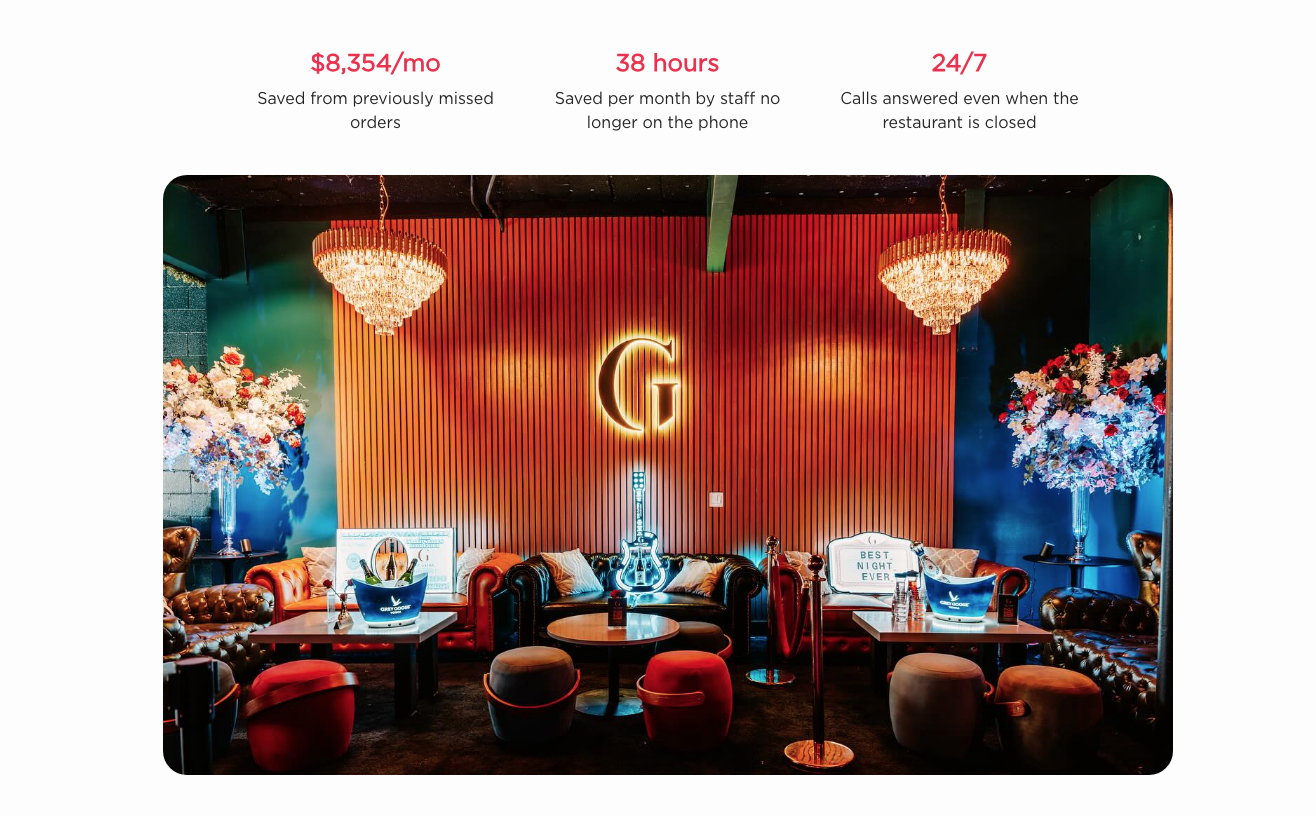
After implementing an AI receptionist, The Gatsby Hawaii, a busy restaurant, began recovering an average of $8,354 a month in previously lost revenue from missed calls. The system paid for itself in the first few days.
Read the whole AI receptionist case study.
AI receptionist versus generic virtual services
A restaurant AI receptionist is fundamentally different from a generic virtual receptionist service. While a generic service simply takes a message for a callback, a specialized restaurant AI completes the call by booking the reservation, placing the order, or answering the question in real time. This distinction is critical for capturing immediate revenue.
The critical difference: completing calls, not just taking messages
A virtual receptionist for a law firm can afford to take a message. A restaurant cannot. When a customer calls at 6 PM, they need a table now, not a callback tomorrow. A restaurant AI is built for action and integrates with your systems to fulfill the caller's request on the spot. This is a major difference between outdated IVR systems vs modern voice AI.
Comparison: generic virtual receptionist vs. restaurant AI receptionist
| Feature | Generic Virtual Receptionist | Restaurant AI Receptionist |
|---|---|---|
| Call Outcome | Takes a message for callback | Completes the task (books, orders) |
| Reservations | Records request | Books directly in your system |
| Takeout Orders | Records request | Places order directly in your POS |
| POS Integration | No | Yes (Toast, Square, Clover, etc.) |
| Bilingual Support | Often an extra fee | Included (e.g., English & Spanish) |
| Pricing Model | Per minute or per call | Flat monthly fee |
| Availability | Business hours or 24/7 | 24/7, unlimited simultaneous calls |
Why specialized AI understands restaurant complexity
A restaurant AI is trained on the specific language and needs of the hospitality industry. It understands menu nuances, dietary restrictions, and the difference between a reservation and a large party inquiry. Generic services lack this context.
The cost-effectiveness of a dedicated AI call center for restaurants
Generic services often charge per minute, which can become expensive and unpredictable. A dedicated AI call center for restaurants like Certus AI offers a flat monthly fee for unlimited calls, providing a predictable, cost-effective solution that delivers a clear return on investment.
Choosing the right AI receptionist for your restaurant
When evaluating an AI receptionist, focus on core functionality that directly impacts your revenue and operations. The right solution should act as a true extension of your team, seamlessly integrating with your existing workflow and delivering a measurable return on investment without a restrictive contract.
Does Voice AI complete the call or just take a message?
This is the most important question. The primary value of an AI receptionist is its ability to perform the action the customer wants. Ensure the system can book reservations, place orders, and answer questions autonomously.
Seamless integration of AI with your existing POS system
For an AI to be effective, it must integrate directly with your core systems. The best solutions work with all major POS systems, including Toast, Square, Clover, Skytab, and Flipdish. This ensures orders are injected accurately and reservations appear without manual entry. When considering options, it's helpful to understand the differences between platforms, such as in a Clover vs. Square for restaurants comparison.
Multilingual support: serving all your guests
Your customer base is diverse, and your phone system should reflect that. Confirm that the AI offers robust multilingual support (like English and Spanish) as a standard feature, not a costly add-on.
Lern more about multilingual AI for restaurants.
What kind of contracts does restaurant Voice AI offer?
The restaurant industry requires flexibility. Look for a provider that offers a simple, flat monthly price with no long-term contracts or hidden setup fees. You should be able to try the service without being locked into a multi-year commitment.
A confident provider will offer a clear return on investment and stand behind their product with a money-back guarantee. The solution should pay for itself within the first month by capturing revenue from calls you were previously missing.
Reclaim your front of house with an AI receptionist
An AI receptionist is a strategic decision to reclaim your revenue, empower your staff, and perfect your guest experience. By automating the task of managing phone calls, you allow your team to focus entirely on the in-house guests who need their attention, turning an operational bottleneck into a seamless, revenue-generating machine.
When the AI handles every call, your human staff is free to deliver exceptional hospitality. Servers can focus on their tables, hosts can manage the floor, and managers can lead their team. The result is a calmer, more efficient front of house.
Turning every phone call into guaranteed revenue
With an AI receptionist, every call is an opportunity captured. No more missed reservations during the dinner rush or lost takeout orders because the line was busy. Every phone call is answered, and every potential dollar is secured. It's one of the most effective ways to understand what type of AI works for independent restaurants versus what's just hype.
Automate the restaurant phone line and start growing
If you're tired of losing revenue to a ringing phone and want to empower your team to focus on hospitality, an AI receptionist for restaurants is the answer. It's the most reliable employee you'll ever hire.
See how it works for yourself. Book a free Demo to hear the AI in action and get a free analysis of how much revenue you could be recovering from the Certus team.

.svg)
.svg)
.svg)
.svg)