.svg)

.svg)


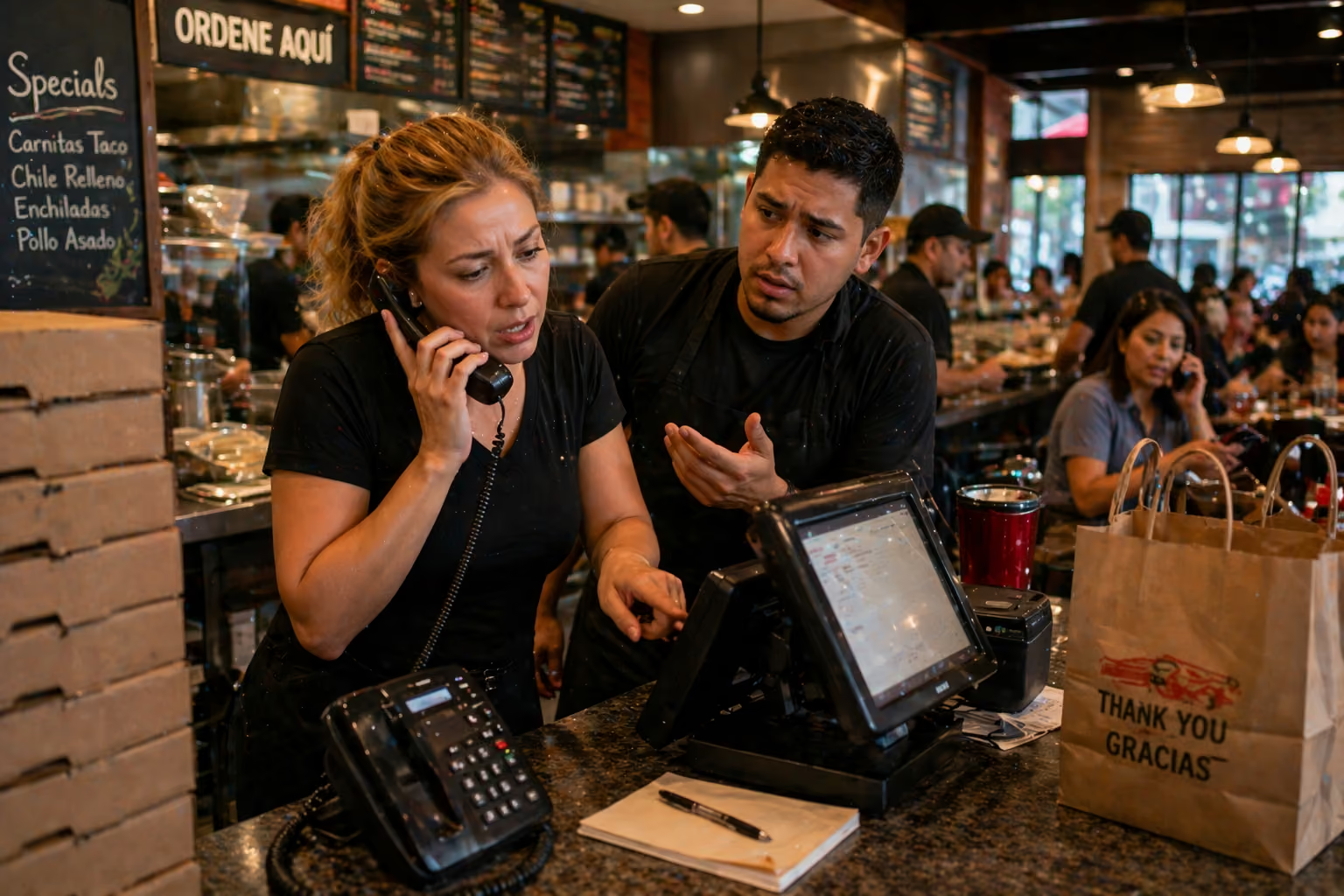
Your phone rings while the dining room is slammed, the kitchen is running behind, and a Spanish-speaking customer is trying to place a large order.
Your host doesn't speak Spanish, puts them on hold, and frantically looks for help.
By the time they get back, the line is dead. That single missed call just cost you real money.
This is a daily reality that costs restaurants real money. In diverse neighborhoods, the problem is even worse. When you can't communicate with a large part of your community, you're missing an entire customer base. This article explains how bilingual AI phone systems solve this problem, turning every call into revenue and freeing your staff to focus on hospitality.
Why language barriers harm your restaurant
The silent cost of a language barrier is the revenue you never see. When a potential guest calls to order takeout, but they can't communicate their order, they hang up and call your competitor. This lost income, combined with the stress it places on your staff, creates a significant drain on your restaurant's financial health and operational efficiency.
And here's a simple truth: It doesn't matter how good your food is if people can't order it.
Are you missing orders from half your neighborhood?
If your restaurant is in a diverse area, you could be losing a significant portion of your potential revenue without even realizing it. Walk outside your restaurant and look around. In many US cities, a large percentage of your neighbors may speak a language other than English. If your phone order data doesn't reflect that diversity, you have found a major revenue leak.
If your average phone order is $35 and you miss just 10 calls a day from language issues or peak-hour chaos, that's $350 in daily lost revenue. Over a month, you're losing over $10,000. Restaurants that implement multilingual AI phone solutions often see huge revenue increases simply by serving customers who already wanted to order from them but couldn't.
How staff stress from communication gaps hurts your business
The financial cost is only part of the story. The human cost to your team is just as damaging. When you force your staff to act as translators, you set them up for failure. They know they're missing details, they can feel the customer's frustration, and they carry that stress through their entire shift. This pressure leads to mistakes, comped meals, and a high-stress environment that drives employee turnover.
Your team members are servers, hosts, and cooks who want to do their jobs well. Taking phone duty off their plate allows them to focus on what they do best: creating great experiences for the guests right in front of them. A system that removes the burden of multilingual communication is an investment in your team's motivation.
How do AI phone agents bridge the language gap?
A bilingual AI phone agent for restaurants acts as a perfectly fluent employee dedicated to your phone line. The system answers every call instantly, detects the caller's language within seconds, and continues the conversation naturally in that language. It provides a seamless experience without the clunky menus or delays of older automated systems.
This technology uses advanced natural language processing to understand conversational speech, regional accents, and food-specific terminology. Think of it as having an employee who speaks both English and Spanish, never gets stressed, and processes orders with 100% accuracy, 24/7. This allows you to serve every member of your community, turning a major point of friction into a competitive advantage.
Understanding every guest with natural language processing
Modern restaurant voice AI achieves a level of understanding that feels almost human. Language detection happens in real time, so a caller who starts with "Hola, quiero ordenar" is immediately met with a fluent Spanish response. The caller doesn't wait, get transferred, or have to repeat themselves. This creates a foundation of trust from the first second of the call.
Can bilingual Voice AI handle accents and dialects?
Leading AI phone systems achieve near-perfect accuracy in understanding various accents and dialects. This means a customer with a thick regional accent gets exactly what they asked for because the AI processes every word correctly. This is a key difference between a simple chatbot and true conversational AI for restaurant phone orders, which is built to handle the nuances of human speech.
The difference between AI and frustrating IVR systems
Unlike the frustrating "press 1 for English" IVR menus you've experienced, a modern AI agent understands intent. Customers talk naturally, ask questions, and make changes without navigating rigid phone trees. The AI makes the experience feel effortless, which is a stark contrast to outdated IVR systems that frustrate callers and lead to abandoned calls.
Can AI really handle complex restaurant orders for takeout?
Yes, a well-designed AI can handle complex orders with the same nuance as a trained server. Taking an order is more than just translation; it's about understanding context, handling modifications, and asking the right follow-up questions. The AI is programmed to manage these details flawlessly in any supported language.
Processing menu modifications and dietary needs
When a customer says they're allergic to shellfish or wants extra cheese on only half the pizza, the system captures that detail accurately. It asks clarifying questions ("Would you like that mild, medium, or spicy?") and confirms changes ("So that's no onions and extra tomatoes, correct?"). This ability to handle detailed restaurant menu modifications with an AI phone system ensures customer satisfaction and reduces order errors.
Upselling and cross-selling to increase order value
An AI system can intelligently upsell without being pushy. When a customer orders a burger, the AI might ask, "Would you like to add fries for $4?" These suggestions are based on your menu's most popular and profitable pairings. Because the AI never forgets to ask, restaurants often see average order values increase by 15% or more.
What are the real benefits for your bottom line?
The return on investment for a bilingual AI phone system is clear and immediate, showing up in both recovered revenue and reduced labor costs. By capturing calls you were previously missing and increasing the value of each order, the system typically pays for itself within the first month.
Calculating the ROI of an AI phone agent
Let's do the math. Say you miss 12 calls a day with an average order value of $32. That's $384 in daily lost revenue, or $11,520 per month. An AI phone system runs on a flat monthly fee. If it recovers even half of those missed calls, you add over $5,700 in monthly revenue for a fraction of that in cost, a return of well over 20x, a key part of a strategic AI phone answering plan for restaurants.
How AI empowers your human staff to focus on hospitality
One of the biggest challenges in the restaurant industry is finding and retaining good staff. By automating the repetitive and stressful task of answering phones, you empower your team to focus on providing excellent service to the guests in your dining room. This shift dramatically improves morale and reduces burnout.
Your servers can give full attention to their tables, your hosts can greet walk-ins warmly, and your kitchen can work without constant interruptions. Staff who feel supported and set up for success stay longer, work harder, and provide better service. The result is a healthier workplace culture and a superior guest experience for everyone.
What does a smart AI phone system deliver?
Beyond bridging language gaps, a truly smart AI phone system integrates deeply with your restaurant's entire operation.
Accurate orders sent directly to your kitchen POS
Seamless integration with POS systems like Toast, Square, and Clover is a game-changer. When a customer finishes their order, the AI sends it directly to your kitchen printer or display system, formatted exactly like an order entered by a server. This eliminates transcription errors, misread handwriting, and lost tickets, ensuring the kitchen gets a perfect order every time. This is one of the core functions of the best AI phone ordering systems for small restaurants.
Answering common questions and handling reservations
The AI can do more than just take orders. It can answer frequently asked questions about your hours, location, and menu items. It can also handle reservation requests, checking your booking system for availability and confirming appointments without any staff intervention.
This frees up your team from handling dozens of routine calls each day.
Making the switch: a simple setup for immediate impact
Getting started with a bilingual AI phone system is surprisingly fast and easy. The best providers have streamlined the process for busy restaurant owners, requiring minimal time and no technical expertise on your part - Certus AI for example only needs one hour of the founder's time for onboarding. You don't need new hardware, and the entire system can be live the same day.
The entire process, from the initial call to taking live orders, typically happens the same day.
What to expect during onboarding with Certus AI
With a solution like Certus AI, the team builds your custom AI agent and connects it to your existing phone line. You get a private chat channel for support, giving you direct access to developers. To see how it works, you can explore the simple implementation process for Certus AI. The goal is to get you recovering lost revenue as quickly as possible, with a system that feels like it was designed just for you.
Get more tips for a successful takeout franchise here:
What if a guest wants to speak to a human?
The system always provides an option for callers to speak with a staff member. If a guest says, "I'd like to speak to a manager," or asks a question the AI can't handle (like a complex catering inquiry), the call is seamlessly transferred to a designated phone number at your restaurant.
It's time to answer every call in your restaurant
Whether your focus lies on takeout or in-house customers: Stop letting language barriers and busy signals dictate your revenue. In today's competitive market, missing a call means losing a customer, possibly for good. A bilingual AI phone system for restaurants is a practical, affordable tool that delivers an immediate return on investment.
By ensuring every call is answered, every customer is understood, and every order is captured, you can unlock thousands in lost revenue each month. You'll also create a less stressful environment for your team, allowing them to focus on delivering the exceptional hospitality your restaurant is known for.
Ready to turn every phone call into revenue? See how Certus AI can transform your restaurant's takeout operations. Book a restaurant voice AI demo today and learn more.

.svg)
.svg)
.svg)
.svg)