.svg)

.svg)


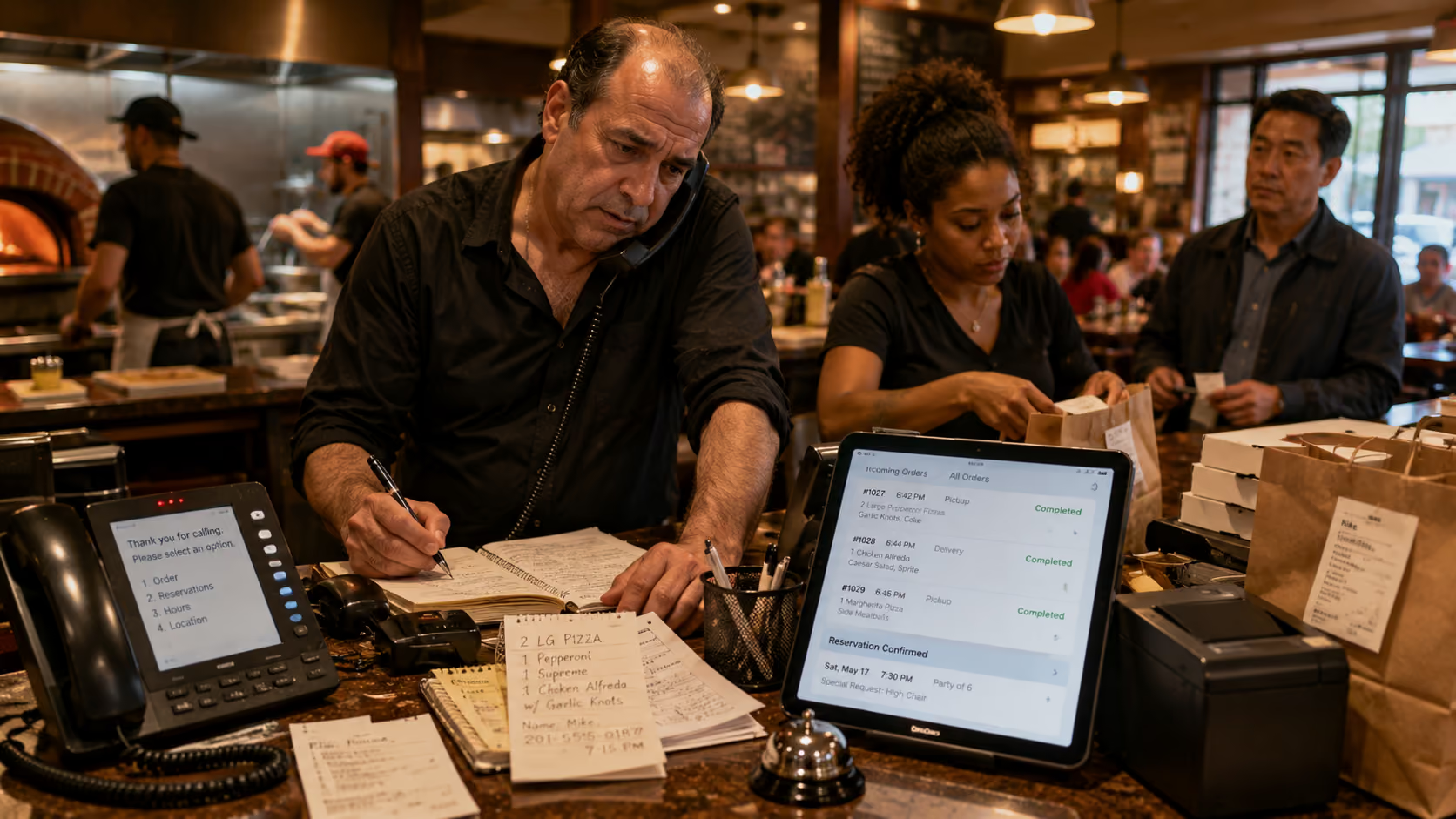
If you have an IVR system on your restaurant's phone line right now, there is a good chance it is costing you more than it saves.
Customers hear "press 1 for orders, press 2 for reservations" and hang up. They call the place down the street instead. Or they don't call back at all.
This article breaks down the real difference between traditional IVR systems for restaurants and modern restaurant voice AI, what each one actually does, where IVR falls short, and why the gap between the two has grown so wide in the last two years.
What is an IVR system for restaurants?
IVR stands for Interactive Voice Response. It's the automated phone system that greets callers with a recorded message and a menu of options. "Press 1 to place an order. Press 2 for reservations. Press 3 for hours and location."
It was designed decades ago for call centers handling thousands of identical requests. It routes people to the right department. That's it.
The problem is that a restaurant is not a call center. A customer calling to order a burger with no pickles, extra sauce, add fries, and ask whether the kitchen can do gluten-free buns is not a routing problem. It's a conversation. And IVR systems cannot have conversations.
Why IVR frustrates restaurant customers
The average IVR abandonment rate sits at around 15% across all industries, and in some sectors it goes as high as 40%. For restaurants, where the caller already knows what they want and just needs someone to take the order, those numbers get worse.
Here is what typically happens on an IVR call to a restaurant:
- Caller hears a menu of 4 to 6 options
- They press the number they think is closest to what they need
- They get put on hold while staff finish with an in-person customer
- They hang up
That caller was ready to give you money. They left because the system got in the way.
A study analyzing over 500,000 restaurant calls between Q4 2024 and Q2 2025 found that AI phone handling cut missed calls by 87% compared to traditional staff-handled lines. That is not a marginal improvement. That is a structural one.
What is restaurant voice AI?
Restaurant voice AI is a different category entirely. It is not a phone menu. It is not a bot that reads out options. It is a system that answers the phone the way a person would, holds a full conversation, understands the menu, takes the order, handles modifications, upsells, and puts the order directly into your POS.
The caller says "I want a large pepperoni pizza but can you swap the mozzarella for vegan cheese, and actually add a garlic bread on the side." The AI handles that. It doesn't transfer. It doesn't ask them to press a number. It just takes the order.
This is what separates restaurant voice technology from legacy IVR. One routes. The other serves.
IVR vs voice AI: a direct comparison
IVR was built to reduce call handling time for large call centers. It was never designed to replace a member of front-of-house staff. Voice AI was built specifically to do that job.
What is conversational IVR, and is it any better?
Conversational IVR is a newer term that describes IVR systems upgraded with some natural language processing. Instead of pressing buttons, callers can speak short phrases. "Reservations," "hours," "order."
It is a step up from traditional IVR, but it is still not a full ordering system. Conversational IVR uses NLP to understand intent and route calls more accurately. It reduces the "press 1" frustration. But it still cannot take a complex order, upsell, handle a menu question, or push an order into a POS.
Think of it as a smarter receptionist compared to a dumb menu. Better at directing the call. Not capable of handling it.
For restaurants where most calls are orders, not routing requests, conversational IVR solves the wrong problem.
What does a missed call cost your restaurant?
A 2025 study by Breez found that 43% of restaurant calls go unanswered during peak hours. Research also shows that only 30% of restaurants have systems capable of effectively answering or routing calls.
Run the math on your own restaurant:
- How many calls do you get per day?
- What percentage go unanswered or get abandoned during hold?
- What is your average order value?
At 25 calls a day with a 25% miss rate and a $45 average order value, that is over $100,000 a year in revenue that never shows up on any report. It doesn't appear as a loss. It just doesn't exist. Which is exactly why most operators have never calculated it.
For a deeper breakdown of this formula and the seven others that affect restaurant profitability, read the 8 best strategies that make restaurants rich.
How does voice AI handle upselling compared to IVR?
IVR cannot upsell. It has no awareness of the order, the customer, or the menu beyond what a script tells it.
Voice AI upsells on every call, consistently. It knows the menu. It knows what pairs well. It suggests sides, drinks, and add-ons at the right moment in the conversation, without sounding forced.
Staff upsell inconsistently. They forget during a rush. They skip it when they're tired. They don't always know the menu well enough to suggest the right pairing. An AI IVR built for restaurants doesn't have those problems.
Restaurants using AI phone ordering see upsell attach rates around 50% on phone orders. If your staff are hitting 20%, that difference on a restaurant doing $10,000 a month in phone revenue adds $4,000 to $5,000 per month. From the same call volume.
Does voice AI work for reservations and event inquiries?
Yes. This is one of the areas where the gap between IVR and voice AI is most visible.
A caller asking about a private dining room for 18 people on a Saturday in two weeks, with dietary requirements, is not a routing request. That call needs a conversation. Traditional IVR cannot handle it. Conversational IVR can maybe confirm that bookings exist as an option. Voice AI can walk through availability, take the details, and confirm the booking.
For restaurants with event revenue, this matters a lot. Every booking that doesn't get answered or gets sent to voicemail is a booking that may go to the venue down the road.
To understand why this type of capability is becoming non-negotiable for independent operators, why voice AI is becoming mission critical for independent restaurants covers the shift in detail.
What about AI IVR, the term you may have seen vendors using?
Some vendors use the term "AI IVR" to describe voice AI systems. This can get confusing.
Traditional IVR is purely rule-based: if the caller presses 2, route to reservations. AI IVR uses machine learning and natural language processing to understand what the caller actually says. For a full breakdown of what changed between the two and why it matters specifically in 2026, AI IVR vs traditional IVR: what changed in 2026 and why it matters explains it clearly.
The short version: if a system still presents a menu of options and routes calls based on what option the caller picks, it is IVR regardless of what it calls itself. True voice AI holds the full conversation from start to finish.
Which restaurants still use IVR, and should they switch?
IVR still makes sense for a narrow set of use cases:
- Large hotel chains routing calls across multiple departments
- Businesses where the only function needed is call routing
- Operations with very low call volume and no phone orders
For any restaurant where phone calls include orders, reservations, or detailed customer questions, IVR is the wrong tool. It frustrates callers. It loses orders. And it does nothing to help the staff who are already stretched during a rush.
35% of restaurant customers still prefer placing orders by phone, according to 2024 research from Lunchbox. That is not a segment you can afford to lose to a menu tree.
How to choose the right restaurant phone ordering system
If you are evaluating options, here are the questions that actually matter:
1. Does it take full orders or just route calls? If the vendor says it "helps with call handling," ask exactly what happens on an order call. Does it take the order? Or does it transfer to staff?
2. Does it connect directly to your POS? An order that has to be manually entered by staff after the call is not automation. Ask which POS systems the voicebot integrates with and how the order appears in your kitchen.
3. How does it handle modifications and edge cases?"Can I get that without the sauce, and can you add extra cheese, and actually is the pasta gluten free?" That is a normal restaurant call. Test it.
4. Does it upsell? Ask for data on average upsell attach rates. A system that doesn't upsell is leaving money on the table every call.
5. What does setup actually involve? Good systems should be live in 48 hours or less. No new hardware. No weeks of staff training. If the onboarding is complicated, it will slow you down.
For a side-by-side comparison of leading options, best conversational IVR solutions for small businesses breaks down the market clearly.
And if you are trying to understand whether it's worth investing in AI answering at all, AI answering for restaurants: how to capture every order lays out the revenue recovery case directly.
Is your restaurant voice technology working for you or against you?
IVR was built for a different era of customer service. It routes calls. It doesn't serve customers.
Restaurant voice AI answers every call, takes complex orders, handles reservations, upsells consistently, and puts everything directly into your POS. It is available 24/7, never puts anyone on hold, and doesn't call in sick on a Saturday night.
If you want to see what a restaurant phone ordering system built on voice AI looks like for your operation, book a demo with Certus and hear the difference for yourself.

.svg)
.svg)
.svg)
.svg)