.svg)

.svg)


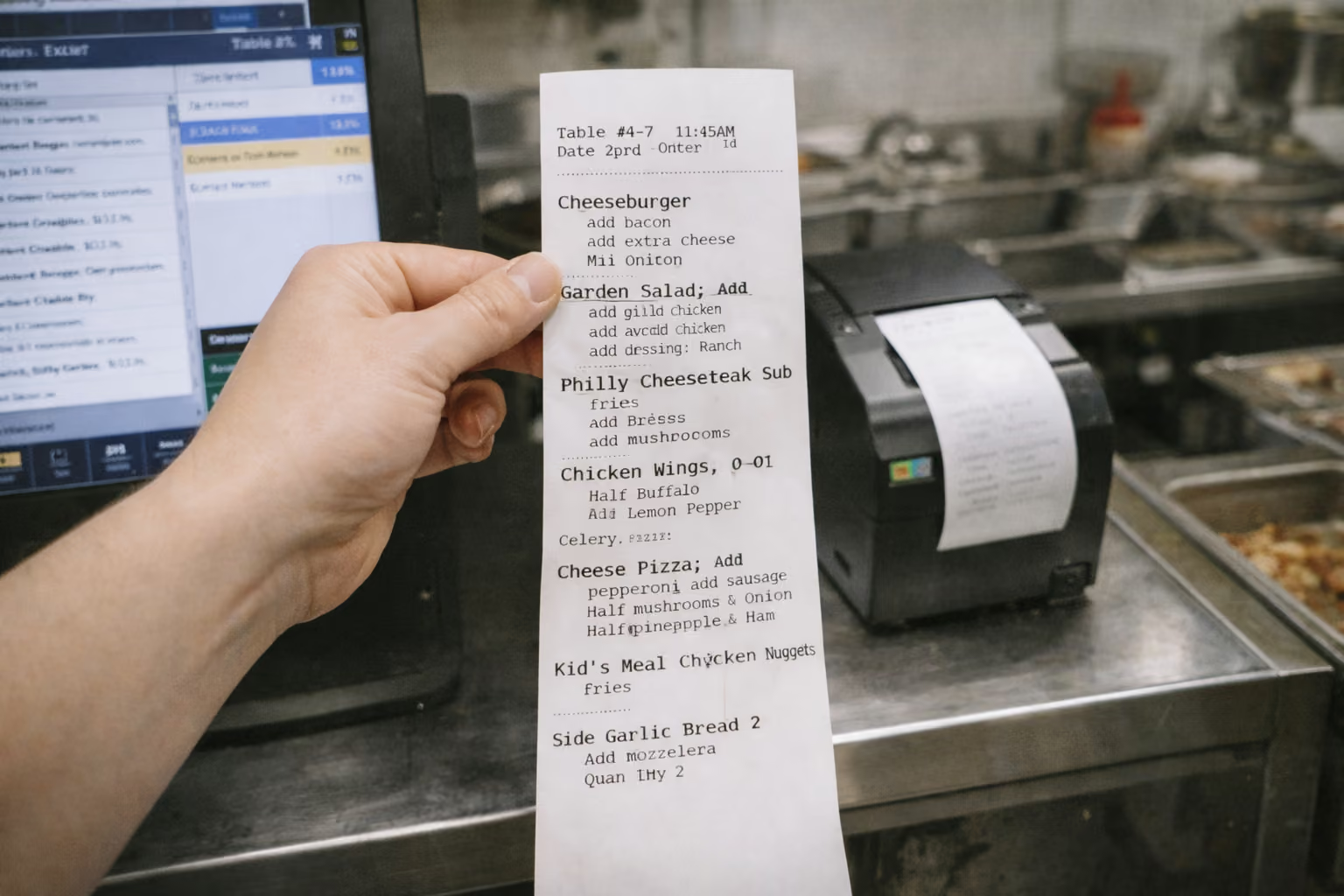
Complex modifications are where order accuracy often falls apart. A customer asks for a burger with no pickles, add bacon, and swap regular fries for sweet potato fries. Your server is scribbling notes while watching table seven signal for their check. Something gets lost in translation.
The kitchen receives an incomplete ticket, the burger arrives with pickles, and the customer is disappointed. Your staff is stressed, and the kitchen has to remake the order, wasting food and time. This is a capacity problem. Human attention has limits, especially when split between multiple urgent tasks.
But there is a solution: Nowadays AI phone systems can handle even complex menu modifications. Learn more:
The restaurant phone line as a hidden source of lost orders
An AI phone agent for restaurants solves the problem of missed calls and order errors by providing a 24/7, automated system that can understand complex requests and integrate directly with your POS. This technology captures revenue that would otherwise be lost during peak hours and frees up staff to focus on in-house guests, reducing stress and improving service.
During a dinner rush, your staff faces an impossible choice: provide attentive service to the guests in front of them or answer the ringing phone. There's no winning. Answer the phone, and your in-house guests feel ig#nored. Let it ring, and you've just handed a sale to your competitor down the street. The numbers tell a brutal story. High-volume restaurants can miss 10 to 20 calls during peak times, which can add up to over $20,000 in lost revenue each month.
What human error and missed details cost restaurants
Order errors cost you far more than just wasted food. Mistakes damage customer trust, generate negative reviews, and create operational chaos during your busiest hours. A single wrong order can cost $15 to $40 in remade food, not to mention the goodwill you've burned with a frustrated customer who might not return.
Missed calls are pure lost opportunity. Unlike a wrong order you can fix, a missed call is revenue that simply evaporates. For restaurants operating on tight 3% to 5% profit margins, this kind of leakage is devastating. The ability of an AI phone agent to handle complex orders is the key to plugging this leak.
How do AI phone agents understand humans?
AI phone agents for restaurants use natural language processing and large language models to interpret customer intent, recognize menu items, and maintain conversational context. Unlike older IVR systems that follow rigid scripts, modern AI adapts to natural speech, handles interruptions, and confirms details conversationally to ensure accuracy before sending orders to the kitchen.
The difference between an old-school IVR and a modern AI phone agent is like comparing a flip phone to a smartphone. IVR systems force customers through painful menu trees: "Press 1 for takeout..." These systems are frustrating and still require a human for anything complex. In fact, outdated IVR systems are dead, and for good reason.
Modern AI phone agents listen to natural speech, understand intent, and respond like a person. When a customer says, "I want a large pizza, but can you do half with meat and half without?" the AI recognizes the core request without needing it phrased in a specific way.
Natural language processing: the AI's secret sauce
Natural language processing (NLP) is how AI converts human speech into structured data. The process starts with transcribing spoken words into text, filtering out background noise. From there, the AI analyzes the text to figure out what the customer actually wants.
The AI performs Named Entity Recognition (NER) to identify key elements: "cheeseburger" is a menu item, "two" is a quantity, and "extra pickles" is a modifier. According to research on food entity recognition, this is challenging due to the vast and ambiguous vocabulary people use for food. The AI then uses slot filling to organize this information, building a complete, structured order.
How AI Phone Systems learn and adapt
Unlike a human employee who might have a bad day, AI systems improve continuously through machine learning. Every call provides new data, helping the system learn common phrases, popular modifications, and confusing questions.
This learning happens in two ways. First, the AI is trained on large datasets of restaurant conversations. Second, it adapts to your specific restaurant through ongoing use. The shift to Large Language Models (LLMs) has been transformative. As explained in comparisons between NLP and LLM approaches, LLMs handle the messy, natural flow of human conversation far better than rigid scripts, allowing them to manage interruptions and adapt when customers change their minds.
Precision in details, complex menus and custom requests
AI phone systems for restaurants achieve accuracy with complex orders through context-aware dialogue management and real-time POS integration. The technology maintains a running record of the conversation, updates order details when customers make changes, and repeats modifications back for verification before finalizing, ensuring multi-part requests are captured correctly every time.
The real test of an AI phone agent is managing the customer who wants a half-and-half pizza with specific toppings on each side, a special crust, and a unique cutting instruction. This is where context awareness becomes critical. Modern AI maintains a running understanding of the entire conversation, so when a customer says, "Actually, make that large fry a small," the system knows exactly which item to update.
How restaurant voice AI deconstructs custom orders
Let's break down how an AI processes a genuinely complex order. A customer says: "I'd like a large pizza, half pepperoni with extra cheese, and the other half with mushrooms and peppers, but no olives on either side, and can you make the crust thin?"
The restaurant AI assistant identifies the base item (large pizza) and creates two separate topping configurations: Side A gets pepperoni plus extra cheese. Side B gets mushrooms and peppers. The "no olives" and "thin crust" instructions are applied to the entire pizza. Each element is captured in its proper slot, maintaining the relationships between modifications and the items they affect. This structured approach reduces mistakes by over 60% compared to human order-taking during busy periods.
Allergy alerts and dietary restrictions
Handling allergies and dietary restrictions is where AI accuracy becomes a matter of safety. When a customer mentions "gluten-free" or "nut allergy," the AI flags this as critical information.
Advanced AI phone agents are programmed to recognize these keywords and respond with verification protocols. For example, if a customer mentions a severe nut allergy, the system can confirm the request and add a clear warning about potential cross-contamination, asking if that's acceptable. This isn't just good service; it's risk management. The AI can even access your menu to identify which items contain common allergens and proactively warn customers.
Seamless POS integration with Voice AI
The magic happens with direct POS integration. The AI injects the order directly into your POS system, exactly as if a trained server had entered it. The ticket prints at the kitchen and bar with all modifications clearly listed in the format your staff already knows. This is a key question to ask: do AI ordering systems work with existing restaurant tech stacks? The best ones do.
This integration eliminates the transcription step where errors typically occur. The order goes from the customer's mouth to the kitchen ticket in seconds. For restaurants using Toast, Square, or Clover, this means the AI speaks the same language as your existing tech. As noted in research on AI context in hospitality, general-purpose AI lacks the specialized precision restaurants need.
The human touch, amplified: benefits beyond accuracy
AI phone agents deliver measurable benefits by answering every call 24/7, capturing revenue during rush periods, and reducing labor costs. Restaurants typically recover thousands monthly in previously missed orders while improving customer satisfaction. This is one of the key benefits of using an AI phone agent for capturing missed revenue.
Accuracy is table stakes. What really matters is the broader operational impact. An AI phone agent doesn't just take orders correctly; it fundamentally changes how your restaurant operates during the most critical hours. It takes away the impossible choice between serving in-house guests and answering the phone.
Never miss a call, never miss a sale, empower your restaurant staff
The most immediate benefit is simple: 24/7 availability with instant answering. No hold times. No voicemail. Every single call gets answered on the first ring, whether it's 2 PM on a Tuesday or 7 PM on a Saturday.
This matters enormously during rush periods when call volume spikes. An AI phone agent captures every one of those calls, converting them into revenue. The math is straightforward. If you're missing 15 calls a day at an average of $40 per order, that's $18,000 in lost revenue per month. An AI agent that costs a few hundred dollars a month pays for itself in a single day.
And let's be honest: phone duty is miserable for staff. It interrupts their flow and prevents them from providing the kind of attentive service that generates tips and repeat customers.
When you remove phone duty from your staff's responsibilities, they can focus entirely on the guests in front of them. Service quality improves, table turns get faster, and staff morale goes up. Certus clients that implement our AI phone answering system for restaurants consistently report that staff satisfaction improves because the constant stress of the ringing phone is gone.
Smart upselling and consistent service
Humans have good days and bad days. They don't always remember to suggest appetizers or drinks. This inconsistency costs you money.
AI phone agents can be programmed to upsell on every call. "Would you like to add a side salad to that?" "Can I interest you in a dessert?" These prompts happen consistently and in a friendly tone. The impact on average order value is measurable, with some restaurants reporting increases of 15% to 27% on phone orders. It's not because the AI is pushy; it's because it's consistent.
How to choose your AI phone agent
When evaluating AI phone agents, prioritize proven accuracy with complex orders, seamless integration with your POS, and responsive human support. Look for systems trained specifically on restaurant conversations, not general-purpose AI, and verify that the solution can handle your menu's complexity before committing.
You need to know how the system performs with real customers who have accents, background noise, and messy requests. Ask for references from restaurants similar to yours and call them yourself to experience the AI as a customer would.
The critical question is: can this AI handle your specific menu? If you run a pizza place with 120 topping combinations, the AI needs to navigate that without getting confused. If your menu changes seasonally, you need a system that allows you to update your menu instantly with AI.
Not all AI phone agents are created equal. The market is flooded with solutions that promise the world but deliver frustrating experiences. Here’s what actually matters when you're looking for the best AI phone ordering systems for small restaurants.
Quick setup, ongoing support, and clear ROI
The best AI solutions are designed for rapid deployment. With Certus AI's voice agent you're able to go live in 24 hours with just one hour of the founder's time needed for onboarding.
Finally, the return on investment should be crystal clear. A good provider like Certus will help you calculate the revenue you'll recover from missed calls and the labor costs you'll save. The right AI phone agent isn't an expense; it's a profit center that pays for itself almost immediately.
The future is calling: time for intelligent restaurant automation
The restaurant phone line has been an operational headache for decades, but that era is over. Intelligent automation is a practical tool that solves one of the industry's most persistent and costly problems. With an AI phone agent, you're not just adopting new technology, you're fundamentally re-engineering your front of house for greater efficiency and profitability.
Turning every phone call into revenue
An advanced AI phone agent ensures you never miss a call, never record an order incorrectly, and never sacrifice in-house service for a takeout order again. It empowers your staff, delights your customers, and captures thousands of dollars in lost revenue every month. The future of your restaurant's profitability is calling. It's time to answer.
Ready to see how it works?
Book a free restaurant voice AI demo call with our Certus experts and get personal consulting.
Frequently asked questions about AI phone agents
Here are answers to some of the most common questions restaurant owners have about AI phone agents.
Can an AI really sound natural?
Yes. Modern voice AI has become incredibly human-like. The best systems use advanced text-to-speech technology that incorporates natural-sounding pauses, intonation, and pacing. Many customers can't tell they're not speaking to a person.
How quickly can it be set up?
Leading providers can get your restaurant's AI phone agent live in as little as 48 hours. The onboarding process is typically streamlined, requiring only about 45 minutes of your time to provide menu details and customize settings.
What about my existing POS system?
Top-tier AI phone agents are built to integrate seamlessly with major POS and KDS systems like Toast, Square, and Clover. The AI injects orders directly into your system, so tickets print at the kitchen just like any other order, requiring no change to your workflow.
Is it expensive compared to a human employee?
No, it's significantly more cost-effective. An AI phone agent typically costs a few hundred dollars per month. Compare that to the $3,000+ monthly salary, benefits, and training costs for a full-time human employee dedicated to answering phones.

.svg)
.svg)
.svg)
.svg)