.svg)

.svg)


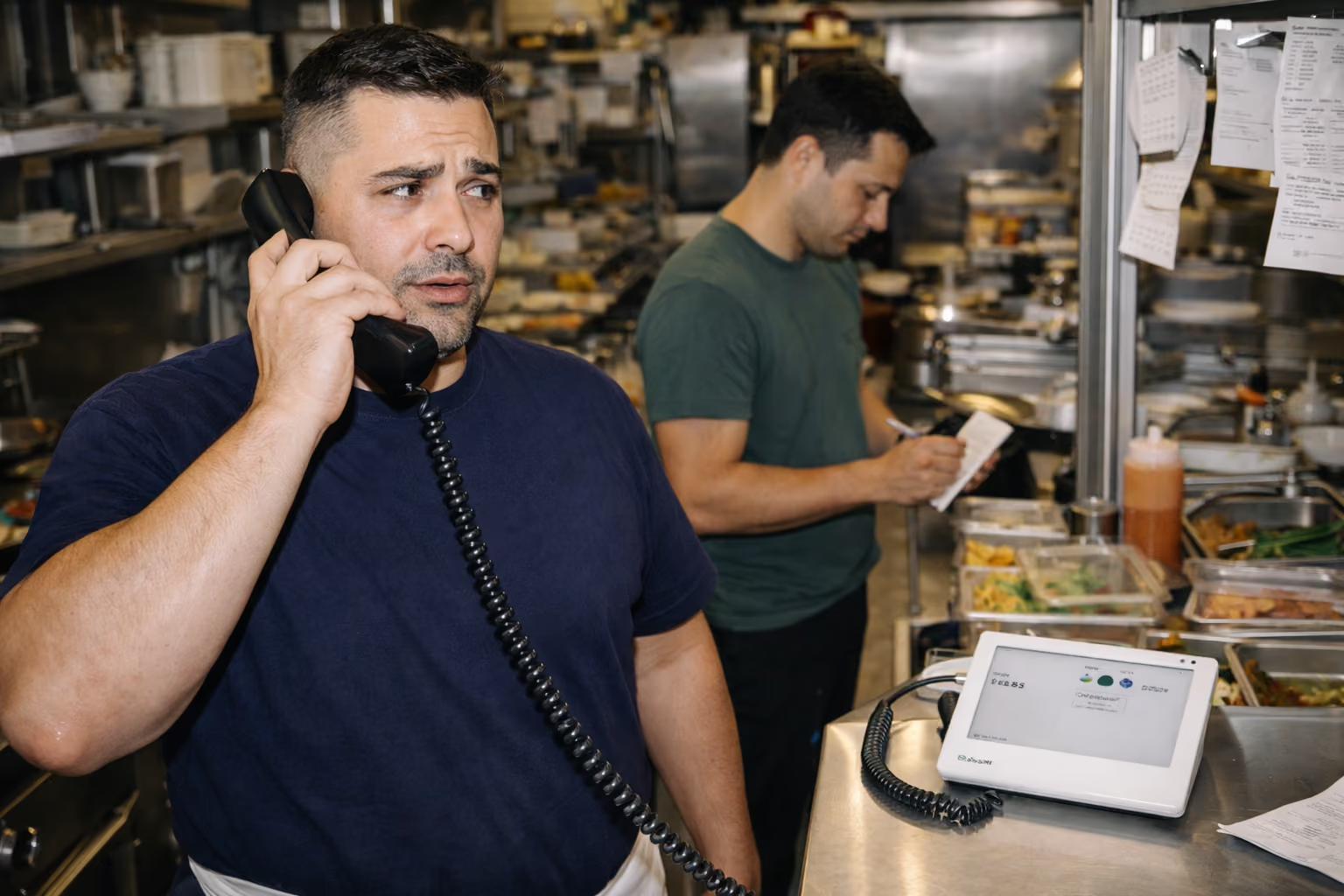
You call a restaurant at 6:30 PM after a long work day. You're hungry, you know what you want, and you just need to place an order. Instead, you get this: "Press 1 for takeout. Press 2 for reservations. Press 3 for catering." You press 1. The line goes silent. Then: "All of our representatives are currently assisting other customers. Your estimated wait time is... seven... minutes."
You hang up. You order from the place down the street that picked up on the second ring.
The phone system most companies rely on was built in the 1970s for massive call centers. It was never designed for a restaurant with three staff members trying to serve a full dining room while the phone rings off the hook.
But something fundamental changed. The technology that powers phone systems finally caught up to how people actually want to communicate.
The old way: why traditional IVR systems frustrate everyone
Traditional IVR (Interactive Voice Response) systems frustrate everyone because they rely on rigid, outdated menu trees that create long wait times and fail to solve customer problems directly. This technology operates on a simple premise: use button presses (DTMF tones) to sort callers into categories, then route them to the right department or put them in a queue. It’s a system built for sorting, not solving, which leads to the high cost of long phone wait times.
Research consistently shows that customers despise these systems. A Vonage study found that 61% of consumers believe IVR creates a poor customer experience, and over half have abandoned a business entirely after a negative interaction. The core issue is that the menus are often irrelevant, forcing callers to listen to options that don't apply to them.
What is a traditional IVR system?
A traditional IVR system is a call routing tool, not a problem-solving one. It presents callers with a menu of options, captures their selection via button press, and either transfers them, plays a pre-recorded message, or places them in a hold queue. The entire system is built on rigid, pre-programmed logic trees that can't adapt to a caller's real needs. This technology became standard in the 1990s for large call centers, but it was never meant for the dynamic environment of a small business.
Traditional IVR was designed for scale, not for service. It assumes you have dedicated staff waiting to take calls once the routing is complete. It assumes your callers are willing to wait. And it assumes the reason for the call fits neatly into one of your menu options. None of those assumptions hold true for a restaurant during dinner rush.
How AI IVR changed the game in 2026
AI IVR, or conversational AI, changed the game by allowing customers to speak naturally to a system that understands their intent and can complete tasks independently. Instead of routing calls to humans, it often replaces the need for a human on the call entirely. The caller speaks, the system understands, and it completes the task: taking an order, booking a reservation, or answering a question. This is the key difference between chatbots and true conversational AI.
The shift happened because speech recognition accuracy crossed the 95% threshold, making the technology reliable enough for real-world business. It's the point where the tech stopped being a novelty and started being a dependable tool for customer interaction.
What is AI IVR and how does it work?
AI IVR uses Natural Language Understanding (NLU) to comprehend the meaning and intent behind what a caller says. Instead of listening for button presses, it analyzes words, tone, and context to figure out what the caller needs. This allows for a free-flowing, natural conversation without the rigid menus of a traditional system. Powered by Large Language Models (LLMs), the AI can process speech in real time, understand complex requests, and trigger actions, like sending an order to your kitchen.
The critical difference: AI IVR replaces, traditional IVR routes
This is the core concept most business owners miss. Traditional IVR routes calls to humans. AI IVR replaces the need for a human on most routine calls. A traditional system says "press 2 for orders" and then puts the caller on hold. An AI IVR is the agent that takes the order, confirms it, processes payment, and sends it to the kitchen. Your staff never touches the phone. This allows a business to handle hundreds of simultaneous calls without ever putting a customer on hold.
Ai ivr vs. traditional ivr: a side-by-side look at what matters
The differences between these systems impact everything from customer happiness to your bottom line. An AI IVR provides a conversational experience that resolves issues instantly, while a traditional IVR forces customers through frustrating menus that lead to long waits. Here’s a direct comparison of what matters for a small business.
Customer experience: frustration versus conversation
With traditional IVR, the customer journey is a maze. Listen to options, press a button, wait, get transferred, and explain the problem again. The system is designed to categorize, not to help. With AI IVR, the customer speaks naturally from the first second. "I'd like to order a large pepperoni pizza for delivery to 123 Main Street." The system understands, confirms, and completes the order. No menus, no hold music, no repeating information.
Operational impact: cost centers versus revenue drivers
A traditional IVR might save a little on a receptionist's salary, but it still requires staff to answer the calls it routes. It's a cost center. An AI IVR, on the other hand, is a revenue driver. If you miss 20 calls a day at an average order of $25, that's $500 in lost revenue daily, or $15,000 a month. An AI phone system captures those calls, takes those orders, and turns missed opportunities into profit.
Who should switch to AI IVR? if phone calls drive your business, listen up
Any business that relies on phone calls for revenue and struggles with staff limitations should switch to AI IVR. This is especially true for businesses where customers call to place orders, book appointments, or ask questions that lead to sales. If your staff can't always pick up the phone, you are leaving money on the table every single day.
Restaurants are the clearest example. Industry data shows that up to 43% of all calls to restaurants go unanswered, translating to billions in missed revenue. The pain points are universal: high call volume during peak hours, staff juggling multiple tasks, and the impossible choice between serving in-house guests and answering the phone.
The restaurant problem: why your phone line is costing you thousands
Restaurants face a unique challenge because phone orders are high-value transactions that come in at the worst possible times. During a dinner rush, your host is seating guests, your servers are taking orders, and your kitchen is slammed. When the phone rings, it often goes unanswered.
That's a $40 order you just lost. Multiply that by 20 missed calls a day, and you're looking at $24,000 a month in lost revenue.
How AI voice ordering solves real restaurant challenges
An AI phone agent for restaurants handles complete phone orders, reservations, and inquiries 24/7. The system integrates directly with your POS, meaning an order taken by the AI flows straight to your kitchen display without any manual input. The AI takes a full, complex order, confirms it, processes payment, and sends it to your kitchen. Your staff sees it print out just like a server entered it.
For example, Boardwalk Pizza captured over $70,000 in orders and freed 195 hours of staff time by using an AI phone system. The technology can even handle menu modifications, allergy questions, and smart upselling. For restaurants that understand why phone orders still drive revenue, the ROI is immediate, especially when you see how voice AI integrates with your POS.
Who should stick with traditional IVR? (it's not who you think)
Traditional IVR still makes sense for a very specific type of organization: massive enterprises with complex, multi-department routing needs and hundreds of agents. These are businesses where the primary goal is to navigate a huge corporate structure, not to complete a simple transaction. If you're a Fortune 500 company with separate departments for sales, support, billing, and technical service, a multi-level IVR helps get callers to the right team.
--> Get to know the best conversational AVR systems
When simple routing is enough
For a massive corporation, the complexity isn't in handling the transaction; it's in navigating the organizational chart. A caller to a large bank might need mortgage lending, credit card services, or fraud prevention. The IVR's job is to ask a few questions and route the call. For these organizations, the challenge in adopting AI is integrating it with dozens of legacy systems. For them, traditional IVR remains a practical, if imperfect, choice. But if you're a small business, you don't need routing. You need someone to answer the phone and do the work.
Choosing the right technology for your restaurant
The choice between traditional IVR and AI IVR comes down to a simple question: what do you need your phone system to do? If you just need to route calls, a traditional system is fine. If you need to actually handle calls, take orders, and complete transactions, AI IVR is the only option that makes sense.
For restaurants, the decision is even clearer. Every missed call is lost revenue. Every minute your staff spends on the phone is a minute they're not serving the guests in front of them. An AI phone system captures those calls, handles those orders, and frees your staff to focus on hospitality.
Want to see the proof? See how Certus AI helps restaurants recover thousands in revenue in a personal restaurant voice AI demo call.

.svg)
.svg)
.svg)
.svg)