.svg)

.svg)


Best conversational IVR solutions for small businesses in 2026 (and why AI is replacing them)
Key takeaways
- Traditional IVR frustrates customers and costs your business revenue. Research shows 61% of customers feel IVR creates a poor experience, leading many to abandon your business.
- Conversational IVR improves experience but still primarily routes calls. While natural language helps, most systems still just transfer callers to a human agent, failing to solve the core staffing issue.
- True AI phone agents complete transactions, boosting revenue and efficiency. They can take orders, book appointments, and handle complex inquiries end-to-end without human help.
- Evaluate solutions based on transaction capability, integration, and clear ROI. The key question is whether a system does the work or just passes it on.
Introduction
I was nine years old the first time I answered a phone order at my family's restaurant. By seventeen, I was managing front-of-house operations across eleven locations. I've spent thousands of hours watching staff juggle plates and phones, seeing orders get missed during rushes, and calculating how much revenue walked out the door because nobody could pick up.
The phone system most small businesses use today, the traditional IVR with its "press 1 for hours, press 2 for orders" routine, was supposed to solve this problem decades ago. It didn't. If anything, it made things worse by adding a layer of frustration between you and your customers.
Today there is a real alternative. Not just a better phone tree, but systems that actually handle the work. The shift from traditional IVR to conversational AI represents the biggest change in how small businesses manage phone operations in thirty years. This article breaks down what's available, what actually works, and how to choose the right solution for your business.
What unanswered calls mean for restaurants
Every unanswered call represents a customer who wanted to give you money, but couldn't. Research shows that 60% of callers hang up when they hit an IVR menu, and a staggering 83% say they'll avoid a company after a bad IVR experience.
For a small restaurant, if just ten calls are missed per day at an average order of $30, that's $300 in lost revenue daily. Over a month, that adds up to $9,000. The worst part? Studies show that 85% of customers whose calls go unanswered will not call back. They'll just order from your competitor.
What is traditional IVR, and why does it fails small businesses?
Traditional IVR (Interactive Voice Response) is the automated phone system that greets callers with a menu of options: press one for hours, press two for orders, press zero to speak to an operator. You know the drill because you've hung up on it yourself. This technology was designed in the 1970s for large corporations to filter calls, but for a small business, it often creates more problems than it solves.
The customer experience bottleneck
From a customer's perspective, traditional IVR feels like a barrier. They call with a simple question and are forced through a rigid menu that doesn't address their need. They get stuck in loops or listen to irrelevant options, creating frustration that leads to hang-ups. A customer trying to place a lunch order doesn't have time for a phone tree, they just want to order food.
The operational drain on your team
IVR doesn't eliminate the need for staff to answer phones, it just delays the conversation. Your team still fields calls from frustrated customers who couldn't find what they needed in the menu. They still answer the same repetitive questions because customers didn't trust the automated information. This system adds steps and stress, especially during peak hours when your team is already overwhelmed.
Conversational IVR: A step forward, but not the finish line
Conversational IVR is an improvement, using natural language processing (NLP) to understand spoken requests instead of requiring button presses. Callers can say "I'd like to make a reservation" in their own words, and the system routes them accordingly. This makes the interaction feel more human and is a significant step up from rigid menus.
How natural language processing changes the game
NLP is the AI technology that allows computers to understand human speech. Instead of listening for button presses, conversational IVR systems analyze the words you say, determine what you're trying to accomplish, and respond. This allows customers to ask questions naturally, like "Do you have outdoor seating?" and get a relevant response, even if it wasn't a pre-programmed menu option.
But here's the limitation: most conversational IVRs still just route your call. If you say, "I'd like to place an order," the system understands and transfers you to the order-taking line, where you still have to wait for a human. It's like a smarter receptionist who still just transfers you instead of solving your problem directly. For a small business with limited staff, this doesn't solve the core issue of not having enough people to handle calls.
The rise of AI phone agents: Completing the conversation
A true AI phone agent for restaurants represents a fundamental shift from routing calls to completing transactions. An AI agent doesn't just understand your request and transfer you. It handles the entire interaction from start to finish, just like a well-trained employee. This is why the global conversational AI market is booming, as businesses realize that simply routing calls isn't enough.
Transactional AI in action
A true AI phone agent can handle the full scope of customer interactions. For restaurants, this means taking complex food orders with customizations and special requests. The AI can ask clarifying questions, suggest add-ons, and confirm the complete order before processing it.
For service businesses and restaurants, it can book appointments by checking real-time availability in your scheduling software. It can also answer detailed FAQs by accessing your knowledge base, ensuring consistent and accurate information 24/7. This is the key difference between a simple IVR and a system that can handle complex restaurant orders.
The power of voice AI with deep integration for restaurants
What makes modern AI phone agents so effective is their ability to integrate directly with your existing business systems. When a customer places an order, the AI injects it directly into your point-of-sale (POS) system, just as if a staff member had entered it.
For restaurants using Toast, Square, or Clover, this means orders from the AI phone agent print at the bar and kitchen just like any other order. This deep POS integration for restaurant voice AI is what transforms an AI agent into a critical business tool.
Top conversational IVR and AI phone agent solutions for small businesses in 2026
The market for phone automation has exploded, with solutions ranging from complex enterprise platforms to plug-and-play options for small businesses. The key is to understand whether you need a general-purpose platform that requires customization or an industry-specific solution built for your business type.
Enterprise-grade phone answering options for complex needs
Solutions like RingCentral and Twilio offer powerful, flexible platforms for building custom IVR and AI solutions. RingCentral is a comprehensive contact center solution, while Twilio provides developer-first APIs. These are great for large companies with IT teams but are often too complex and expensive for a small business.
For those building custom solutions, developer tools from Retell AI, Synthflow, and Bland AI offer advanced capabilities but require significant engineering resources.
Mid-market solutions for growing businesses
Dialpad offers an intelligent, AI-native platform for small and medium businesses. It's more accessible than enterprise tools, with no-code interfaces for building AI agents. It's a strong choice for businesses that have outgrown basic phone systems but aren't ready for enterprise-level complexity. Pricing is typically user-based, and setup can take a few weeks with support from their team.
The best Voice AI for restaurants: Certus AI
For restaurants, a specialized solution is almost always better. Certus AI provides an end-to-end AI phone agent built specifically for the unique challenges of food service. The restaurant phone ordering system handles complete phone orders and reservations, integrating directly with major POS systems like Toast, Square, and Clover. The pricing is a flat monthly fee per location, with a rapid 48-hour setup. The specialization means it understands menu complexity, custom orders, and the chaos of a dinner rush, as seen in how Boardwalk Pizza captured $70,000 in orders using the system.
How to evaluate an AI phone agent for your business
Choosing the right AI solution requires looking beyond flashy features and focusing on measurable outcomes. As a busy owner, your time is precious, so you need a system that delivers real value without creating more work. Here are the four critical questions to ask.
Does it complete transactions or just route calls?
This is the most important distinction. Are you looking for a smarter phone tree, or a new employee that actually gets work done? A system that only routes calls still leaves the primary task on your staff's shoulders. A true transactional AI takes the order, books the appointment, or answers the question itself, freeing up your team completely.
Integration depth: Can the voicebot connect to existing systems?
For an AI agent to be efficient, it must connect seamlessly with the tools you already use. For a restaurant, direct integration with your specific POS (Toast, Square, Clover - here are the best AI phone systems for Clover) is non-negotiable. An AI that sends you an email with an order creates a new, error-prone task for your staff. An AI that injects the order directly into your POS eliminates work and mistakes.
--> Learn more about how AI ordering systems integrate with existing tech.
Setup time and ongoing management
How much of your time will this demand, both upfront and long-term?
Enterprise solutions can take weeks or months to implement and require ongoing technical management. Look for solutions designed for small businesses that promise rapid setup (days, not weeks) and require minimal ongoing effort from you. That's why Certus only needs one hour of the founder's time for onboarding.
The real ROI: What are you recovering?
Don't get lost in technical jargon. Focus on the money. If you miss ten calls a day at an average order value of $25, that's $250 lost daily, or $7,500 a month. What would recovering that mean for your bottom line? A good AI provider should help you calculate this potential revenue recovery and labor cost savings, making the ROI clear and compelling. This is how businesses like The Gatsby Hawaii recovered over $8,000 a month.
The restaurant phone line: A unique challenge, a clear solution
Restaurants are a particularly urgent use case for advanced AI phone agents. The constant tension between in-person guests and a ringing phone is a daily struggle for operators everywhere. This is where the value of a dedicated, transactional AI becomes undeniable, especially when you consider that phone orders still drive significant restaurant revenue.
Serve in-house or answer the phone?
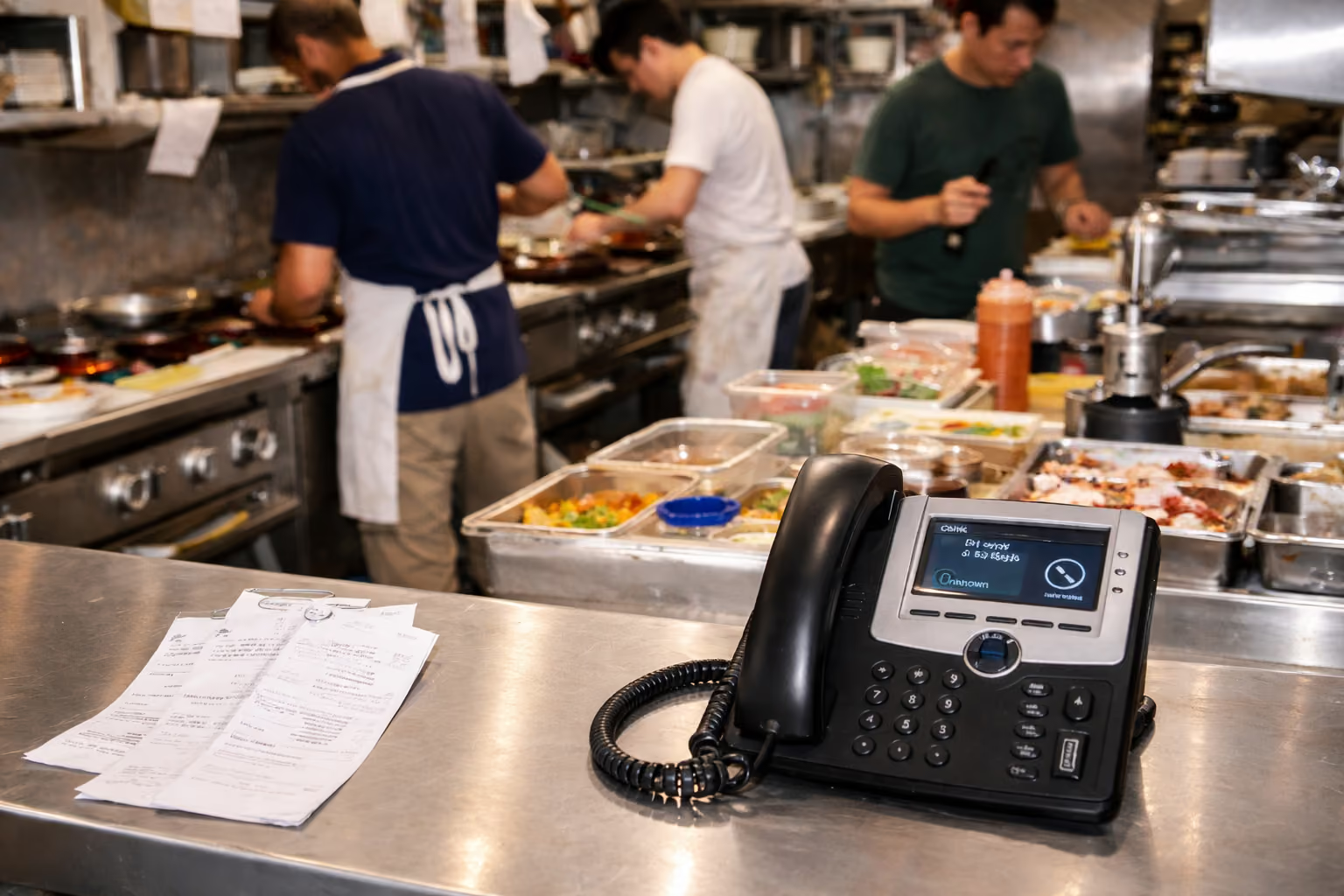
I've seen countless servers juggle plates and phones during a rush, and neither task gets the full attention it deserves. It's a no-win situation. Every moment a server spends on the phone is a moment they aren't attending to a table. Every time they ignore a ringing phone to pour a drink, you're likely losing an order. This operational conflict is the source of immense stress for staff and lost revenue for the business.
Complex orders and distinct accents: The AI advantage
A generic AI can't handle a restaurant's needs. A successful restaurant voice AI must be trained to navigate large menus, understand modifiers ("extra cheese, no onions"), answer allergy questions, and process custom requests with high accuracy. It also needs to comprehend a wide range of accents and speaking styles. This level of specialization is what separates a helpful tool from a frustrating gimmick.
How to turning every call into revenue
An AI phone agent works around the clock. It takes that late-night pizza order after your staff has gone home. It books a reservation for the next day when a customer remembers at midnight. It never calls in sick, never gets stressed during a rush, and never puts a customer on hold. It transforms your phone line from an operational burden into a reliable, 24/7 revenue stream.
What to avoid when choosing your AI partner
The AI space is full of hype, and it's easy for a skeptical business owner to get overwhelmed or, worse, get burned. As you evaluate options, be wary of a few common pitfalls that separate genuine solutions from empty promises.
Don't settle for generic AI
Industry-specific AI is crucial for complex tasks. You wouldn't hire a generalist chef for a specialized sushi restaurant, and the same applies to your AI. A generic chatbot or voice agent won't understand the nuances of your business, whether it's a restaurant order or a medical appointment. Look for a partner that has proven experience in your specific industry.
Beware of hidden costs and complex contracts
Transparent pricing and flexible terms are signs of a confident provider. Look for a simple, flat-rate monthly fee. Avoid solutions with per-call fees, per-minute charges, or long-term contracts that lock you in before you've seen a return. If the value is real, the provider won't need to trap you with a complicated agreement.
Closing reframe: Your phone line can be your best employee
Imagine a phone line that never misses a beat, never gets stressed, and always upsells. Imagine your staff being able to focus entirely on the customers right in front of them, delivering exceptional service without the constant interruption of a ringing phone. This is the reality for smart restaurant owners in 2026. Your phone line doesn't have to be a problem to be managed. It can be your most reliable, profitable employee.
Author bio + CTA
Gurveer Singh is the co-founder and CEO of Certus AI, a Y Combinator-backed company that won the 2025 Innovation Award at the Restaurant & Takeaway Innovation Expo. After growing up in the restaurant industry, he dedicated his career to solving the most persistent operational challenges with intelligent automation.
Ready to turn your missed calls into guaranteed revenue and free up your team?

.svg)
.svg)
.svg)
.svg)