.svg)

.svg)


Key takeaways
- Don't dismiss your phone line; it's a high-value revenue channel, not a relic.
- Understand who calls and why, as these customers are often more loyal and spend more.
- Stop losing money to unanswered calls by investing in smart, automated solutions.
- Integrate phone and online ordering for a complete, profitable direct ordering strategy.
Introduction: The phone still rings, and it's ringing with money
You spent thousands on a new online ordering system. You trained your staff and promoted it on social media. And yet, your phone still rings 40 times a day. Here's what nobody tells you: that's not a problem. That's an opportunity.
Every article about restaurant tech in 2026 pushes the same narrative to go digital and automate everything. But for most independent restaurants, phone orders still make up 30-40% of total off-premise volume, even after launching an online platform.
I grew up taking phone orders at my family's restaurants starting at age 9. By 16, I was managing front-of-house operations across 11 locations. I've seen firsthand what happens when you treat the phone line as an afterthought. You don't just lose orders. You lose your highest-value customers. This guide explains why the phone is still a critical revenue stream and how to capture it without overwhelming your staff.
The enduring power of the restaurant phone call
Phone ordering isn't dying. It's still a premium channel that most restaurants ignore while chasing the latest app integration.
With off-premise dining accounting for a huge slice of restaurant traffic, every channel matters. Despite the push for digital, many customers still prefer to call, and these callers are often your most profitable and loyal patrons.
Who's still calling and why it matters
The customers who call aren't random. They are a valuable segment calling for specific reasons that online systems can't always accommodate.
- Loyal Regulars and Older Guests: Customers over 45 are significantly more likely to order by phone. They value their time, trust your restaurant, and want to get their order right the first time without navigating an app.
- Complex or Large Orders: Customers with dietary restrictions, heavy customizations, or large group orders prefer calling. A direct conversation ensures accuracy where online forms can be clunky. Even major chains recommend calling for large catering orders.
- Convenience-Driven Callers: People driving home from work, planning an office lunch, or who simply know exactly what they want will pick up the phone for speed and simplicity.
These are high-spending, loyal customers who trust you enough to call you directly.
The revenue of a phone order for restaurants
The math behind a phone order is compelling. While the average value of a phone order is comparable to one from a third-party app, the key difference is profit. You keep 100% of the revenue from a direct phone order, with no 15-30% commission paid to a delivery service. A $32 phone order might net you $28 in profit, while the same order through an app could net you as little as $18.
That's a 40-50% difference in actual profit per order. Phone customers have also made a conscious choice to contact you directly, bypassing a dozen competitors on a delivery app. That signals brand loyalty you can't buy.
Priorities in restaurants: Serving in-house or answering the phone
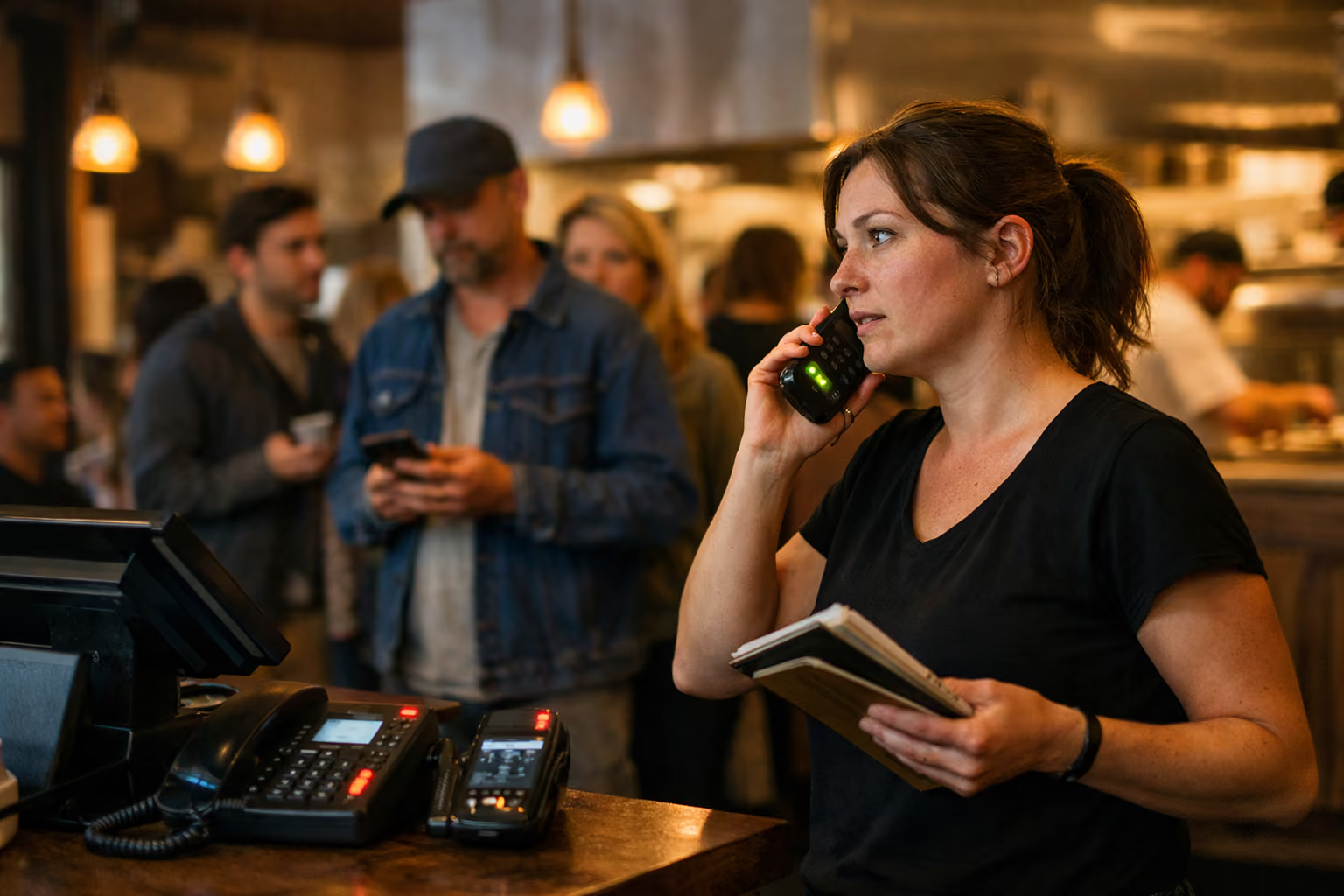
Picture the dinner rush. Your host is seating a party of six, a server is taking an order, and the bartender is slammed. The phone rings. Who answers it? Nobody. The in-house customer standing right there always wins over the invisible voice on the phone. That's human nature.
The phone rings again, but your kitchen is backed up and your manager is handling a complaint. It goes to voicemail. That's not just a missed call; that's a $45 order walking out the door. This impossible choice between serving present guests and answering the phone creates a constant drain on potential revenue and puts unnecessary stress on your team, which is where automated tools can help with front-of-house operations.
The real cost of a ringing phone
Let's quantify what those unanswered calls actually cost. If your restaurant gets 50 calls a day and 43% go unanswered, that's about 22 missed calls. Assuming half would have placed an order, you're losing 11 orders daily.
At an average of $32 per order, that's over $126,000 in lost annual revenue.
| Metric | Daily Loss | Monthly Loss | Annual Loss |
|---|---|---|---|
| Missed Calls (22/day) | 11 Lost Orders | 330 Lost Orders | 3,960 Lost Orders |
| Lost Revenue (@ $32/order) | $352 | $10,560 | $126,720 |
This doesn't even account for the customer who calls twice, gets no answer, and decides to order from your competitor instead, potentially for good.
Online vs. phone ordering for restaurants
A smart operator knows they serve different customers and uses both, phone and online ordering, to maximize revenue. Viewing them as complementary parts of a single strategy is the key to building a resilient business that captures every possible sale.
It's not a competition, it's a complete strategy
Online ordering is perfect for customers who want to browse a menu visually, customize at their own pace, and order without speaking to anyone. It excels with younger demographics and those who value digital convenience.
Phone ordering is essential for customers who prioritize speed, clarity, and the ability to ask questions. It's the go-to channel for complex orders, catering inquiries, and loyal regulars who want a quick, familiar experience. A restaurant that only optimizes for online is leaving 30-40% of its off-premise revenue on the table.
Building a direct ordering ecosystem
The goal is to create a seamless direct ordering ecosystem where customers can reach you however they prefer. Every order, whether from your website or your phone line, should flow directly into your POS without third-party fees or manual entry errors.
Your online system handles the browsers, and your phone system handles the callers. Both should capture customer data, integrate with your POS, and provide opportunities for upselling. When you build this way, you're not choosing between channels. You're building a complete revenue-capture machine that meets every customer where they are.
Turning your phone line into a revenue engine
The solution to missed calls isn't hiring more staff. It's treating your phone line like the critical revenue channel it is and automating it intelligently. Modern technology can turn this operational bottleneck into a powerful, consistent source of income.
Intelligent automation for your restaurant phone line
Modern AI phone ordering systems act as your most reliable employee, answering 100% of calls, 24/7, without ever putting a customer on hold. This isn't a clunky answering service. It's conversational voice AI that sounds natural, understands complex orders, and integrates directly with your POS.
When a customer calls during a Saturday rush, the AI answers instantly. It can greet regulars by name, take a customized order, suggest a profitable add-on, process payment, and send the ticket directly to your kitchen printer. Your staff never touches the phone, the order is 100% accurate, and you capture revenue you would have otherwise lost.
How AI captures every order and boosts your bottom line
The financial impact is immediate. Restaurants using voice AI often recover over 30% in phone order revenue in the first month. An AI system with flat monthly pricing can capture thousands of dollars in orders that were previously being missed, generating a massive return on investment.
Beyond just answering calls, AI consistently upsells. While a busy human might forget to suggest add-ons, an AI never does, leading to a 15-20% increase in average order value. These systems integrate with major POS platforms like Toast, Square, and Clover, so orders flow directly into your workflow without errors. For those wondering how to implement voice AI in restaurants, the process is surprisingly fast, often taking less than 48 hours to go live.
Making your phone line a profit center, not a problem
Stop thinking of your phone as a distraction. Start seeing it as a direct revenue channel that deserves the same strategic attention as your online presence. The restaurants winning in 2026 are not choosing between digital and traditional; they are building complete ordering ecosystems that capture every customer.
They use strategic tools like AI phone answering for restaurants to handle the volume their staff can't manage, turning a cost center into a profit engine. Your phone is ringing with money. The only question is whether you're going to answer it.
To convince yourself, get a free restaurant voice AI demo with our Certus experts.
Frequently asked questions about restaurant phone systems
Will customers actually talk to an AI, or will they hang up?
Customer acceptance is higher than you might think. Studies show that a majority of consumers prefer AI over a human if it means faster, better service without being put on hold. As long as the AI sounds conversational and handles their request efficiently, most customers are happy. The key is using a system built for restaurants, not a robotic IVR that frustrates people.
Can AI really handle complex modifications and special requests?
Yes, if the system is purpose-built for restaurants. Generic voice AI struggles with menu nuances, but a specialized AI can easily handle requests like "no onions, extra sauce on the side." The AI confirms the order back to the customer for accuracy before sending it to your POS. For truly unique requests, it can intelligently route the call to a staff member while handling 95% of standard orders autonomously. You can learn more about how AI can handle complex restaurant orders.
What happens if the AI doesn't understand a customer?
Modern restaurant voice AI has fallback protocols. If it encounters something it can't handle, it smoothly transfers the call to a staff member with context about the customer's request. The system also learns from these interactions to improve over time. Because the AI repeats the order back for confirmation, error rates are typically lower than human-handled orders during a chaotic rush.
How does voice AI integrate with my existing POS and online ordering?
Leading voice AI systems integrate directly with major POS platforms like Toast, Square, and Clover. When the AI takes an order, it appears in your POS just as if a server entered it, printing in the kitchen automatically. No extra tablets or manual entry are needed. It works alongside your online ordering system, with both channels feeding into the same workflow. If you're evaluating options, check out this guide on choosing the right restaurant voice AI.
Is voice AI only worth it for high-volume restaurants?
Even smaller restaurants benefit significantly, especially if they are understaffed or have a concentrated rush hour. If you miss just 10 calls a day, you could be losing over $10,000 a month in revenue. For a small monthly investment, the ROI is massive. If phone orders are a meaningful part of your business, voice AI will likely pay for itself immediately. For more guidance, see this breakdown of the best AI phone ordering systems for small restaurants

.svg)
.svg)
.svg)
.svg)