.svg)

.svg)


Key takeaways
- Evaluate Skytab's contract terms carefully. The "free" hardware offer ties you to Shift4 payment processing for 36 months, and early termination can cost thousands.
- Skytab handles in-store operations well but doesn't answer your phone. You will still miss calls during rush hours, which means lost revenue from takeout, catering, and reservations.
- Processing rates matter more than software fees. The $29.99 per month software cost is low, but your real expense is the 2.4% to 2.75% processing rate on every single transaction.
- Pair Skytab with an AI phone agent to close the revenue gap. A system like Certus AI integrates directly with Skytab, turning every phone call into an order without staff intervention.
What is Skytab POS and why is everyone's talking about it?
Operators in my network keep asking me about Skytab. Three times last week alone, someone mentioned they were evaluating it or had just signed up. I grew up answering phones in my family's restaurants and managed 11 locations by 17, so I've seen every POS pitch imaginable. When a system starts coming up this often, I pay attention.
Shift4, the company behind Skytab, is growing aggressively. By late 2025, Skytab represented over 40% of Shift4's entire merchant base. That explains why the name keeps popping up in operator conversations. The pitch is simple: a $0 upfront hardware cost. For independent operators running one to three locations, that's a big deal. With rising food and labor costs, the idea of getting a modern POS without a capital outlay sounds like a perfect solution.
But as the cofounder of a restaurant Voice AI, here's what I've learned from talking to operators who actually use Skytab:
The free hardware comes with strings, the real cost is in the processing, and there's a huge gap in the system that most people don't see until they're live. This review is what I wish someone had told me before I evaluated any POS, especially since phone orders still drive significant restaurant revenue and most POS systems ignore them.
A close look at Shift4's restaurant build
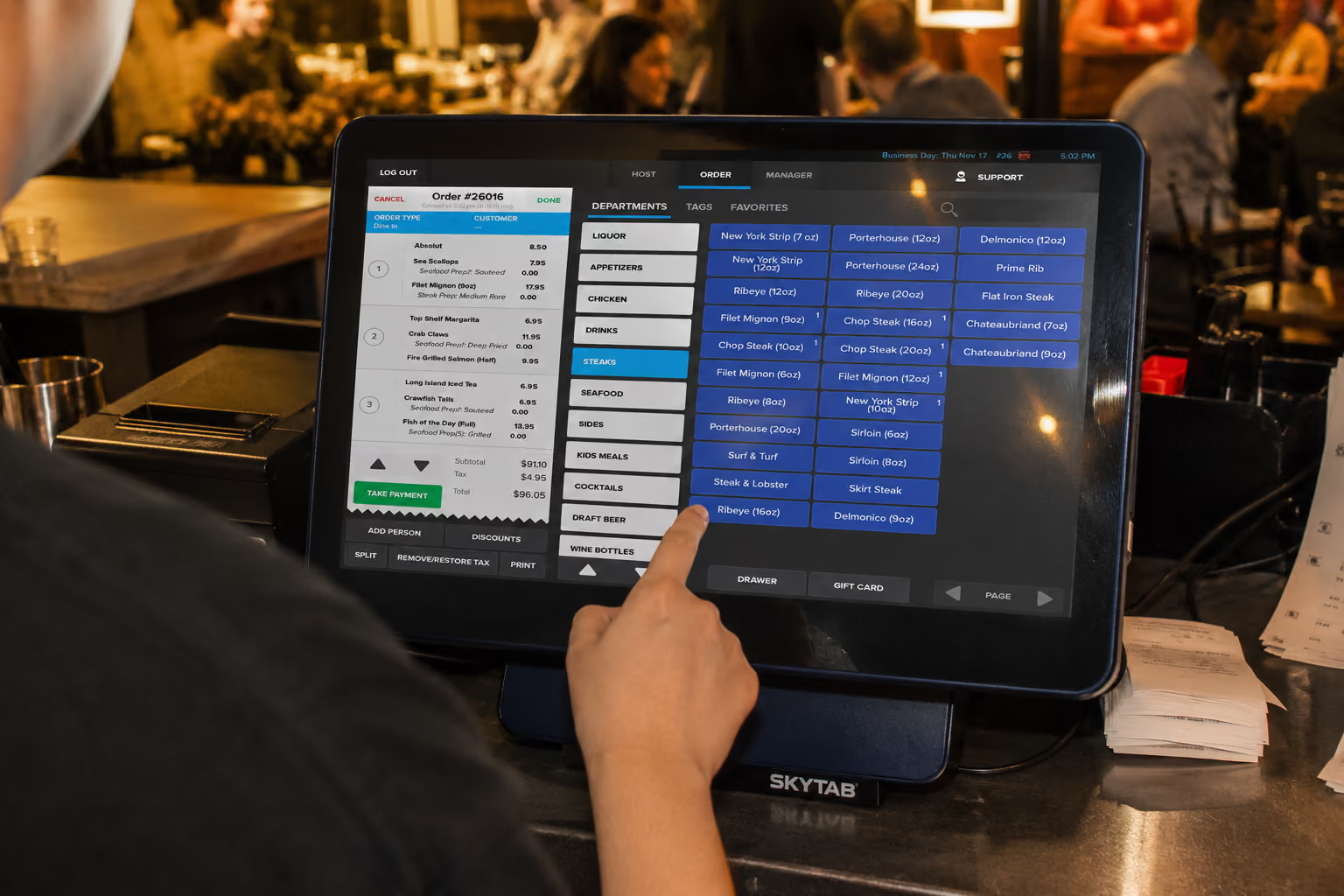
Skytab is an all-in-one restaurant management platform from Shift4, a major payments company. It's designed to be more than just a point of sale terminal. The system includes tableside ordering, online ordering, kitchen display screens (KDS), loyalty programs, and back-office reporting. The goal is to replace your fragmented tech stack with one integrated platform.
The core components include the Skytab POS terminal, Skytab Air for tableside mobile ordering, QR code ordering, and a back-office command center called Lighthouse. Lighthouse is where you manage your menu, track sales, run loyalty programs, and monitor online reviews. The system also connects to third-party delivery services like DoorDash and Uber Eats, so orders from those platforms flow directly into your kitchen. In April 2024, Shift4 added a free business intelligence module, Skytab BI, which provides granular data on menu performance and sales trends.
How Skytab handles your front of house
The front-of-house experience centers on the Skytab terminal and the Skytab Air handheld devices. Servers use the handhelds to take orders tableside, process payments, and split checks. The system supports tip adjustments, custom modifiers, and multi-seat ordering. For quick-service operations, the terminal handles everything from order entry to payment.
QR code ordering lets dine-in guests scan a code, browse the menu on their phone, and place orders directly. The order goes straight to the kitchen without server involvement. Some operators love this for reducing labor needs, while others find their customers prefer a personal touch, especially for complex orders. The built-in online ordering system is a big selling point, allowing you to take orders on your own website. The catch is you still need to drive traffic to that page, competing with the convenience of major third-party apps.
Behind the scenes: kitchen, reporting, and loyalty
The kitchen display system (KDS) replaces paper tickets with a digital screen. Orders appear color-coded by time, and kitchen staff tap items off as they're prepared. The system tracks ticket times, helping you identify bottlenecks during a rush.
Lighthouse, the back-office platform, gives you access to sales reports, labor data, and menu performance. You can see which items sell best, which servers are upselling most effectively, and where your food costs are running high. The loyalty program module is basic compared to dedicated platforms but functional for starting out. The reporting is solid, and the Skytab BI module adds deeper analytics like hour-by-hour sales trends and item-level profitability, saving you time on spreadsheet analysis.
What operators tell me about Skytab in practice: the real-world experience
Operators running Skytab say the system works well for in-store operations. The interface is intuitive, orders flow smoothly, and the handhelds are reliable. But there are trade-offs that aren't obvious until you're committed. The "free hardware" offer is the main draw, but it's tied to a 3-year contract requiring you to use Shift4 for all payment processing. The hardware remains Shift4's property, and you have to return it if you cancel.
User feedback on usability is mixed. Some operators find the system incredibly user-friendly, while others report a difficult learning curve, especially when setting up complex menus. One operator told me they spent hours on the phone with support working out bugs in their menu configuration. Customer support reviews are varied, with some praising responsive sales reps while others note slow response times from technical support.
The integrated payment processing question
The base software subscription is $29.99 per month, which is low. But the real cost is in the payment processing. Rates can be quoted as high as 2.75% plus $0.15 per transaction. You may be able to negotiate effective rates between 2.4% and 2.75%, but you have to ask. Some operators report billing mistakes and extra processor markups that weren't clearly disclosed upfront.
Here's the math. If you process $100,000 per month, a 0.2% difference in your rate ($2,600 vs. $2,400) adds up to $2,400 over a year. That's real money. The lesson is to negotiate your rate before you sign and check your monthly statements carefully. The exclusive processing requirement is the bigger issue. You can't shop around for better rates once you're in the contract without paying a hefty early termination fee.
Understanding Skytab's contract terms and support
The 36-month contract is standard, but you must read the fine print. Early termination fees are calculated based on the time left on your contract and the value of the hardware. Early termination fees vary widely. Shift4's liquidated damages formula is remaining contract months × average monthly processing fees × profit margin. For a restaurant doing $50,000/month in card volume, canceling at month 13 of a 36-month contract can result in fees exceeding $37,000. Smaller operators with lower volume see fees in the $500-$2,000 range.
However they do also offer a 30-day trial period where merchants can cancel without penalty.
Support is a mixed bag. Sales reps are helpful during evaluation, but technical support can be slower once you're live. Some operators report waiting hours for a callback on urgent issues. The onboarding process takes about a week for a simple menu, but expect it to take longer if you have many modifiers or integrations. Skytab provides training materials, but some operators say they had to figure out a lot on their own.
Skytab vs Toast: the head-to-head operators keep asking about
The comparison that comes up most in my conversations is Skytab vs Toast, and the honest answer is that they win different fights. Toast brings the bigger software ecosystem, with published tiers that start at free and the deepest add-on shelf in the industry, though as I found in my full Toast POS review, the real monthly cost climbs fast once those add-ons stack up. Skytab's pitch is value: $29.99 per month software, hardware without the upfront outlay, and processing in the 2.4% to 2.75% range covered above, in exchange for that 36-month Shift4 commitment.
So choose by what you are optimising for. If you want the widest software shelf and can stomach the growing bill, Toast is the safer pick, and if you want strong fundamentals at a price that leaves your margin alone and you are comfortable with the contract, Skytab earns its spot. If the name sitting opposite Toast on your list is Square rather than Skytab, I ran that same head-to-head in my Toast vs Square comparison for independents. Either way, the gap in the next section follows you to both.
Where Skytab leaves a gap: the phone line problem
Skytab handles in-store and digital orders well. But it doesn't answer your phone. This is a bigger problem than most operators realize. Restaurants miss a huge number of incoming calls, especially during peak hours when staff are busy. With an average order value of $25, even a few missed calls a day lead to thousands in lost revenue annually.
Phone calls aren't just for simple questions. They are a major channel for high-value transactions like catering, private events, and large takeout orders. These almost always start with a phone call. When a call goes unanswered, 85% of customers will not call back. They just move on to a competitor. This is why the old IVR systems are dead and AI phone agents are the future.
Why traditional phone systems fail restaurants
During the lunch and dinner rush, your staff are slammed. The phone rings, and no one picks up. Or someone puts the caller on hold and forgets them. Or they take the order but write it down wrong because they're distracted. You can hire someone just for phones, but they call in sick or quit, and you're back to square one.
The problem is that traditional phone systems require human intervention. Someone has to pick up, listen, take the order, and enter it into the POS. That takes time and attention, both of which are in short supply during peak hours. Skytab is a great POS, but it doesn't solve this fundamental operational bottleneck. Only automated restaurant phone answering can.
How Certus AI and Skytab work together, integrating voice AI with a POS
An AI phone agent like Certus AI integrates directly with major POS systems, including Skytab. When Certus takes a takeout or delivery order over the phone, the order is sent straight to your Skytab POS and kitchen printer. No manual entry. No staff interruption. The order just appears, exactly as if a server entered it. This is a key differentiator from other AI phone ordering systems for small restaurants.
Certus answers every call, 24/7. It handles complex orders, answers menu questions, takes reservations, and routes high-value inquiries like catering to your team. It speaks English and Spanish with automatic language detection. If a caller asks about gluten-free options or wants to customize an order, Certus handles it. It also upsells by suggesting add-ons, increasing your average order value without any extra effort from your staff.
How does an AI phone agent integrate with Skytab?
Restaurant AI phone answering like Certus AI integrates with Skytab via an API. When Certus takes an order, it sends the data to your Skytab POS using the same API that third-party delivery platforms use. The order prints at your kitchen printer and appears on your KDS just like any other order. Your staff just have to prepare the food.
This is different from systems that text callers a link to an online menu. Many people call because they are driving or simply prefer ordering by phone. Certus AI automatically takes restaurant orders on the phone, ensuring you capture the revenue instead of creating another step for the customer. The setup takes less than a day. You provide your menu, connect to your Skytab account, and forward your phone line. That's it.
--> Learn about all major POS systems Certus integrate with.
Why Certus AI stands out from other solutions
Certus uses flat monthly pricing, so you pay the same amount regardless of call volume. This is different from competitors that use per-minute pricing, which can lead to unpredictable costs during busy months. I have written a full breakdown of Loman AI reviews and pricing if you want to see that comparison with real numbers. Certus also includes Spanish support with automatic detection, a feature many competitors lack. I wrote a full piece on what a bilingual answering service changes for restaurants whose callers order in Spanish. Restaurants like Dirty Bird went from sceptic to super fans of Certus. This multilingual capability is crucial.
The most important factor is reliability and accuracy. The AI is built specifically for the chaos of a restaurant environment. It understands complex menus and custom requests, ensuring orders are captured correctly every time. This focus on execution is how restaurants like Gold Coast Kitchen recover $30,000 a month in missed revenue.
About the author
I'm Gurveer Singh, the CEO and co-founder of Certus AI. Before starting this company, I spent my life in restaurants. I know the pain of a constantly ringing phone that no one has time to answer. Skytab is a solid POS for managing what happens inside your four walls, but it leaves a massive revenue channel completely exposed.
Pairing Skytab with an AI phone agent for restaurants closes that gap. You get a best-in-class POS for your floor staff and a perfect, 24/7 employee answering every single call. You stop losing orders, your staff is less stressed, and your customers are happier. It's the combination that modern restaurants need to not just survive, but thrive.
I've since written full operator reviews of Toast, Clover, Square, and Aloha if Skytab isn't the only system on your list.
If you're tired of hearing a ringing phone you can't answer, see what's possible in a free restaurant voicebot demo.

.svg)
.svg)
.svg)
.svg)