.svg)

.svg)


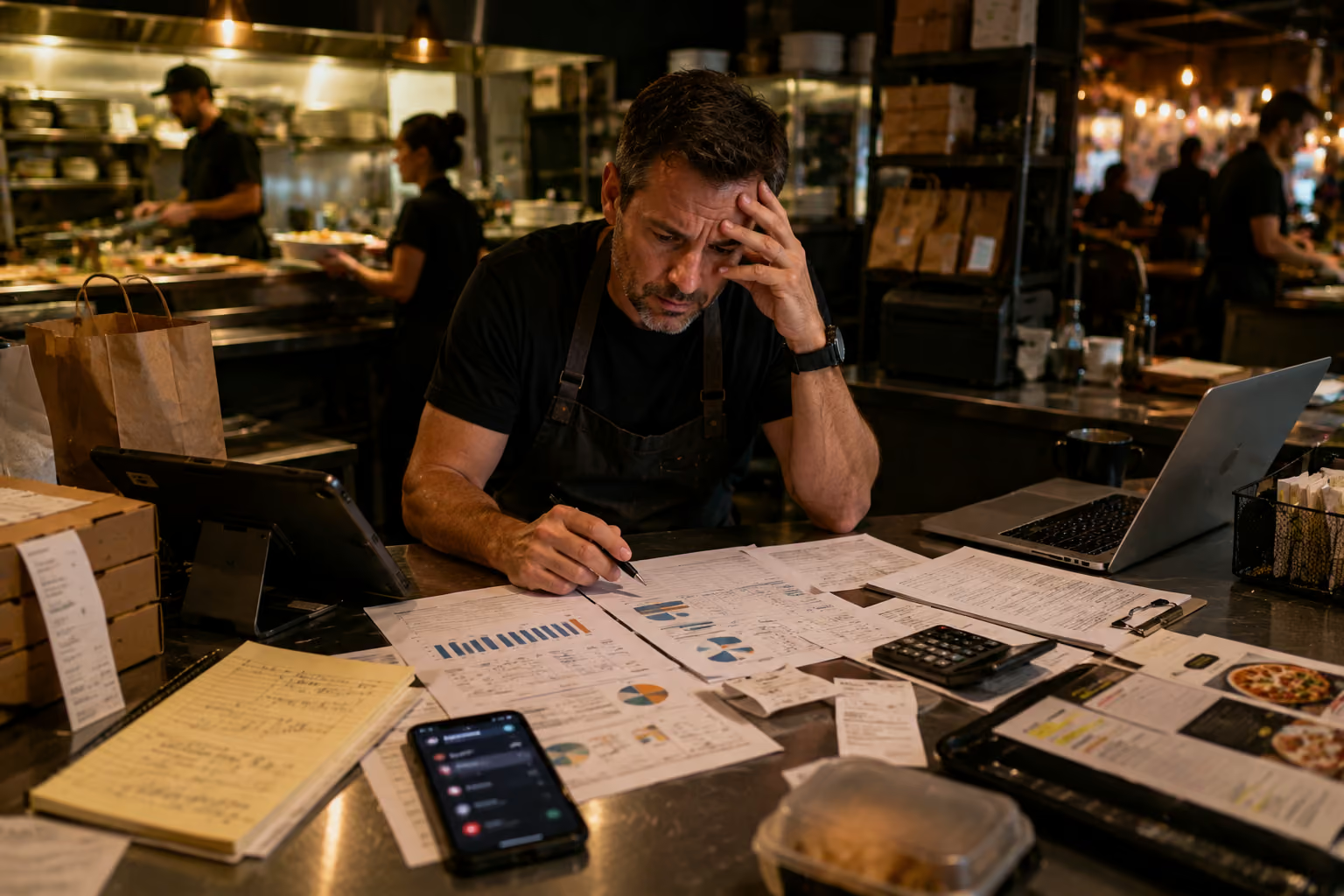
There are different reasons why restaurants get rich. And different reasons why they fail.
But most restaurants that fail don't fail because the food is bad. They fail because the owner never looked at the numbers the right way. Not the accountant's monthly report. The actual numbers, week by week, call by call, dish by dish.
This article breaks down the 8 financial formulas every operator needs to know. Run these with your own numbers and you will almost always find between $80,000 and $200,000 in either costs that are too high or revenue that's quietly walking out the door.
You can also watch the full breakdown on YouTube.
1. Food cost percentage: are you tracking it at the right time?
Food cost percentage is your food purchases divided by food sales, times 100.
Spent $2,500 on food this week. Did $10,000 in sales. Your food cost is 25%.
The healthy range for an independent restaurant sits between 28% and 35%. Most operators I talk to are sitting closer to 40 or 42%.
The difference between 30% and 40% on a restaurant doing $50,000 a month in food sales is $6,000 a month. That's $72,000 a year. Same menu, same tables, same everything.
Where this goes wrong is not the formula. It's the timing. Most operators pull this from a monthly accountant report. By then, whatever was bleeding has already bled. A supplier quietly raised a price. Portions started creeping in the kitchen. You ran a promo without checking the margin first.
Operators who stay inside the healthy range check this every single week. One calculation, purchases divided by sales. That habit alone puts most restaurants back in range within 60 days.
2. Labor cost percentage: are you counting yourself?
Labor cost percentage is total labor divided by total revenue, times 100.
$15,000 in wages this month. $50,000 in revenue. Labor cost is 30%.
The healthy range is again 28% to 35%. Most operators think they're inside that. A lot of them are, on paper.
Here's where it breaks. Most operators don't pay themselves properly. Some don't pay themselves at all. That makes your labor cost look clean, but it isn't real.
If you replaced yourself tomorrow, a general manager costs between $50,000 and $80,000 a year minimum. That's $4,000 to $6,000 a month. Add that back in and most operators see an immediate 6 to 10 point jump.
The restaurant you thought was running at 30% labor is actually running at 40. Combined with a food cost at 40, that's 80% of your revenue gone before rent, utilities, or anything else.
Run your labor cost right now. Include what you pay yourself. That is the actual number.
--> For labor and front-of-house costs specifically, the breakdown of AI phone system costs vs hiring a host in 2026 lays out the numbers clearly.
3. Prime cost: the single most important metric in your restaurant
Prime cost is your food cost percentage plus your labor cost percentage. That's it.
Food cost 32%, labor cost 31%. Prime cost is 63%.
Think about every dollar that comes into your restaurant. Four things are fighting for it: food cost, labor cost, overhead (rent, utilities, insurance), and profit.
Overhead for most independent restaurants runs between 20% and 30% of revenue. It doesn't move much. Your rent doesn't go down because you had a slow Tuesday.
If your prime cost is 70%, you have somewhere between 0% and 10% left for profit. Before anything goes wrong.
60% is the target. At 60% prime cost with 25% overhead, you're sitting at at least 15% profit margin. A business that can absorb a bad month, reinvest, and grow.
Every point above 60 comes directly out of your bottom line.
4. Break even point: do you know your survival number?
Break even is your total fixed costs divided by your contribution margin percentage.
Fixed costs are everything that stays the same regardless of how busy you are. Rent, insurance, utilities, loan repayments.
Contribution margin is what's left of every dollar after you subtract prime costs. If your prime cost is 60%, your contribution margin is 40%.
Fixed costs of $20,000 a month, prime cost of 60%, contribution margin of 40%. Break even is $20,000 divided by 0.4. That's $50,000 a month. Everything before that number is just paying for the right to be open.
Most operators have a feeling about this number but have never actually calculated it. One operator I know had a great launch, full tables most nights. But when we ran his break even for the first time, it came out at $68,000 a month. He was averaging $62,000 in revenue. Full tables and profit are not the same thing.
5. Menu engineering: which dishes are actually making you money?
Take any item on your menu. Subtract the ingredient cost from the price you charge. That's your profit per dish.
Then plot every item across two questions: how much profit does it make, and how often does it sell?
That gives you four categories:
Plow horses are dangerous. They're your bestsellers, but every time someone orders one, you're busy and not profitable. Most restaurants have two or three of these eating into their margin.
Puzzles are hidden gems. Onion rings are a classic example. Oil, batter, and onions. Maybe 40 cents to make. $8 on the menu. That's 5% food cost and $7.60 in pure profit with almost no labor attached.
Take your top 10 selling items and your bottom 10 margin items. Run the formula on all of them this week.
--> Read our restaurant menu engineering guide
6. Upsell conversion rate: how much are you leaving on the table every night?
Every restaurant has two types of revenue. The revenue customers came in planning to spend. And the revenue they spend because someone asked them to.
Upsell conversion rate measures the second one.
The formula is: average upsell value, multiplied by daily covers, multiplied by upsell attach rate, multiplied by 365.
Say your restaurant does 80 covers a night. Average upsell is worth $8. Staff are upselling on 20% of tables. That's 16 tables a night, $128 a day.
Move that attach rate from 20% to 50%. Same 80 covers, same $8 upsells. Now you're at 40 tables a night, $320 a day. That's $192 more per day, or roughly $70,000 a year.
Same customers. Same menu. Same restaurant. Just asking the question more consistently.
This applies everywhere a customer interacts with your restaurant, not just in the dining room. On the phone too. This is one of the clearest areas where AI for restaurant operations makes a measurable difference. An AI phone agent never forgets to upsell. It never gets tired during a Friday rush. On a restaurant doing $10,000 a month in phone revenue, consistent upselling on calls can add $4,000 to $5,000 a month.
7. Customer lifetime value: stop thinking about tonight's bill
Every time a customer walks in, most operators think about one thing. How much are they spending tonight?
That's the most expensive way to see them.
Customer lifetime value is: average spend per visit, multiplied by visits per year, multiplied by years as a regular.
Average spend $45. Visits twice a month. Regular for 3 years. That customer is worth $3,240 to your restaurant. Not $45. $3,240.
The last time a customer complained and you debated whether to comp a $20 meal, you weren't deciding whether to spend $20. You were deciding whether to protect a $3,000 relationship.
This also changes how you think about marketing. A new customer costs five times more to acquire than keeping an existing one. When you know what a regular is actually worth, you start making very different decisions about service, loyalty, and how you handle complaints.
Run this formula with your numbers. Average check, visits per year, how long a loyal customer stays. The number at the end is the number you're protecting every single time you make a decision about your restaurant.
8. Missed call revenue: the $100,000 loss hiding on no report
This is the formula most operators have never calculated. And it's the one that tends to come out highest.
The formula is: total daily calls, multiplied by missed call rate, multiplied by average order value, multiplied by 365.
25 calls a day. That's a regular Tuesday. Industry research shows roughly 25% of restaurant calls go unanswered. Staff are on the floor, in the kitchen, in the middle of service. The phone rings and nobody gets to it.
25 calls, 25% missed. That's 6 calls a day. Six people who called your restaurant and were ready to give you their money.
At $40 average order value, that's $240 a day. $240 times 365 is $87,600 a year.
If your restaurant takes just 5 more calls per day, 30 calls total, that number goes to over $116,000 a year. Quietly, every single year, not showing up on any report, not appearing anywhere. Just gone.
This is different from every other formula in this article. Most of these require real operational change. Purchasing habits, scheduling, menu engineering, staff behavior. Those things take time.
This one has a switch.
The reason those calls are being missed is not because nobody cares. It's because your team is physically unable to be in two places at once. They're serving the customers already in front of them.
An AI phone answering system for restaurants solves this directly. It answers every call, takes orders, handles reservations, and upsells consistently, around the clock. The order goes directly into your POS. No new hardware. No additional staff.
The restaurants using automated restaurant ordering through AI phone systems typically recover this revenue within the first 30 days. Not from changing their menu or renegotiating with suppliers. Just from answering the phones.
How to run all 8 restaurant success strategies this week
Here's what to actually do with this:
- Food cost: Take last week's food purchases and divide by last week's food sales. Is it above 35%?
- Labor cost: Add your own salary back in. Is it above 35%?
- Prime cost: Add the two together. Is it above 60%?
- Break even: Take your fixed monthly costs and divide by your contribution margin. Is it higher than your average monthly revenue?
- Menu engineering: Pick your top 10 sellers. Run profit per dish. Find the plow horses and puzzles.
- Upsell rate: Estimate what percentage of tables are being upsold. Multiply by $8 and by your daily covers. What's the annual number?
- Customer lifetime value: Average check times average visits per year times average years as a regular. That's what you're protecting.
- Missed calls: Take your daily call volume, apply 25% miss rate, multiply by your average order value, then by 365.
Most operators who run all eight find somewhere between $80,000 and $200,000 in either costs that are too high or revenue being left behind. Usually both.
What this means for how you run your restaurant
None of these formulas require an accounting degree. None of them take more than a few minutes each. Together they give you a complete picture of your restaurant's financial health that most operators have never had.
The restaurants that scale are not smarter than the ones that don't. They just know their numbers.
For formulas 6 and 8, the upsell rate and the missed call revenue, restaurant technology is now able to fix both automatically. How independent restaurants can compete using AI has changed significantly in the last two years. The same tools that were only available to large chains are now accessible to independent operators.
If you want to understand how this fits into your wider tech setup, the best restaurant tech investments that pay off in 2026 is worth reading before you make any decisions.
The revenue you're losing is already there
The $100,000 number from formula 8 is not money you need to go earn. It's money that was already trying to come into your restaurant and couldn't get through.
That's the part most operators find uncomfortable when they first calculate it. Because it's not a future opportunity. It's a current loss.
If you want to see how much your restaurant is losing to missed calls specifically, how to increase restaurant sales by fixing inbound call handling is one of the fastest and most measurable changes you can make.
Book a demo with Certus and see exactly what recovering that revenue looks like for your restaurant.
Watch the full video:

.svg)
.svg)
.svg)
.svg)