.svg)

.svg)


Key takeaways
- GoTab is built around the open tab. Guests scan, order, and keep a tab running from anywhere in the venue. That makes it a strong fit for breweries, taprooms, food halls and hotels, and an odd fit for fast counter lines.
- Software runs $15 to $229 a month depending on tier. The real bill is processing at 2.40% plus 15 cents per in-person transaction, with extra charges for Amex and international cards.
- The add-ons stack up. Extra stations and kitchen screens run $25 to $35 a month each, loyalty and gift cards $35, delivery aggregation $55.
- If you take reservations or host private events, your phone is its own revenue channel, and those calls arrive during the exact hours your team is buried.
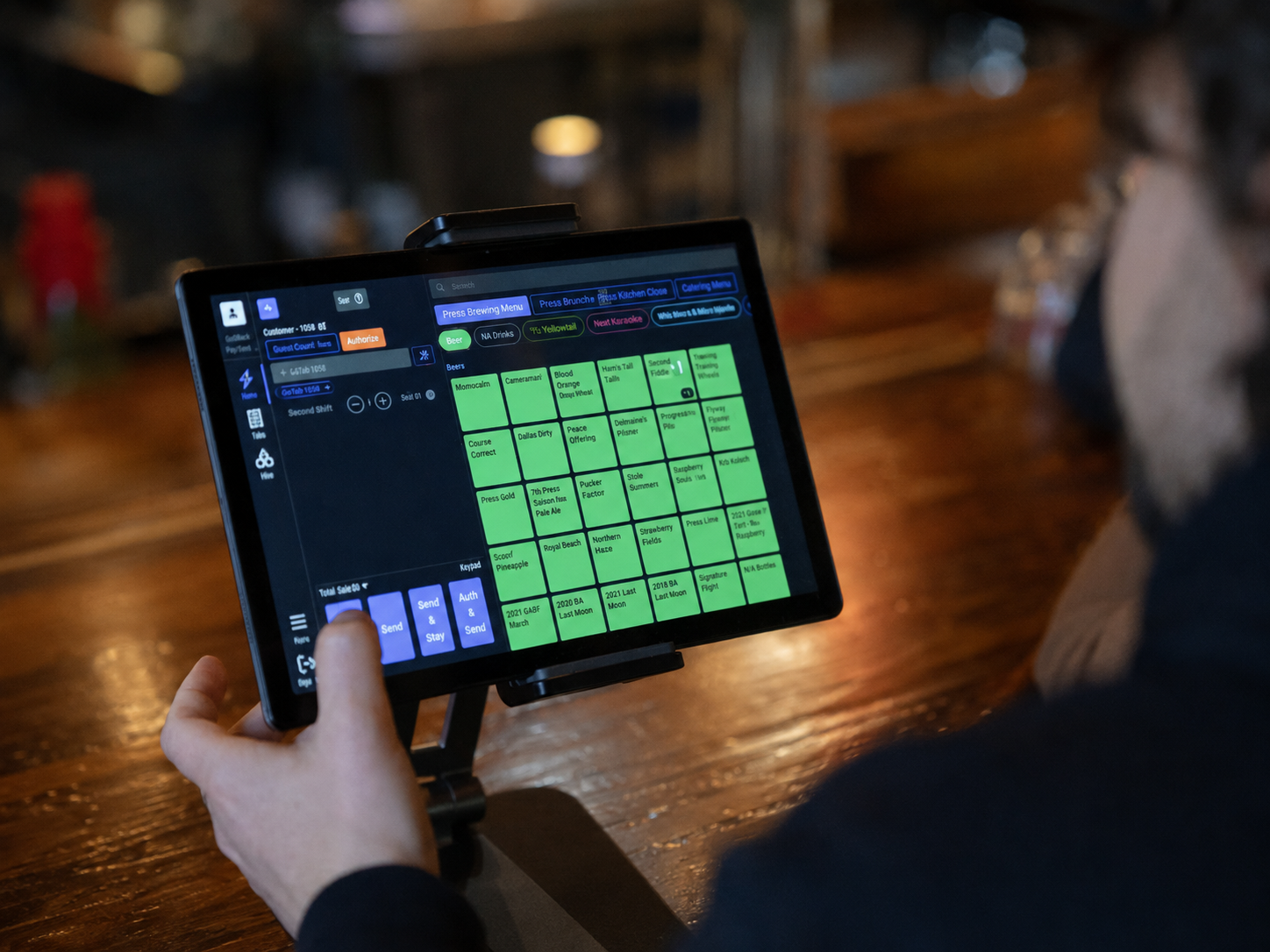
My family's restaurants ran from takeaway counters to a brewery, and I was helping manage 11 of them by age 17. The brewery taught me something the takeaways never did: some venues do not run on tickets. They run on tabs that stay open for three hours while a group drifts from the bar to the patio. GoTab is the first POS I have reviewed that was actually designed for that guest.
At Certus we work with hundreds of restaurants across every major POS, so I see what operators actually live with after the sales demo. Here is my honest read on GoTab: where it earns its keep, what it really costs, and the channel it was never asked to carry.
What GoTab is
GoTab calls itself a commerce platform for hospitality, and the label fits better than "restaurant POS." The system is built for venues where guests move around and keep spending: breweries, taprooms, food halls, hotels, bars, and entertainment venues. Reviewers consistently describe it as strongest in exactly those rooms, with venues running 2,500 or more tabs in a single day on it.
The core idea is the shared, portable tab. A guest scans a QR code, opens a tab, and orders from their phone. They can add rounds from the patio, split with friends, and close out without flagging anyone down. Your staff take orders on handhelds too, and both flows land on the same tab. For a brewery pouring for a Saturday crowd, that is the whole game: fewer lines at the bar, more rounds ordered, nobody waiting to pay.
There is no per-cover fee. GoTab charges for software and processing, and does not take a cut per guest served, which matters at high-volume venues where per-cover models get expensive fast.
GoTab pricing: the real math
GoTab publishes three software tiers. As of July 2026:
- Basic: $15 a month. The entry point for simple setups.
- Pro: $99 a month. The tier most full venues actually need.
- Sync: $229 a month. Adds on-premises failover, so the system keeps working if your internet drops.
Processing starts at 2.40% plus 15 cents per in-person transaction. Amex adds 0.85% on top. International cards add 1.5%. Run that against your own card mix before you decide anything, because a venue doing $80,000 a month in cards pays roughly $1,900 a month in processing at the base rate. The software fee is a rounding error next to that.
Then come the add-ons. Extra POS stations, kitchen display screens, and kiosks run $25 to $35 a month each. Loyalty and gift cards cost $35 a month. Delivery aggregation, which pulls your delivery apps into one screen, is $55 a month. Setup fees are quoted per venue rather than published, and GoTab offers 0% financing over 24 to 36 months if you want to spread hardware costs.
A realistic Pro setup for a mid-size taproom, with two extra stations, a kitchen screen, and loyalty, lands around $200 to $250 a month in software before processing. That is honest money, and still cheaper than most of the category if the tab model fits how you serve.
What operators like
The tab model is the review theme that repeats everywhere. Guests order more when ordering is easy, and nothing is easier than adding a round from your seat. Venues report the QR flow genuinely reduces bar lines instead of just moving them.
The pricing structure earns praise too. Flat software tiers with no per-cover fees mean a packed Saturday does not raise your bill. And the Sync tier's offline failover answers the question every operator asks about cloud systems: what happens when the wifi dies mid-service.
Where it struggles
Point it at the wrong venue and the strengths invert. Reviewers describe GoTab as overbuilt for fast counter service. If your whole operation is a line of people ordering burritos to go, the tab machinery is weight you carry without using. A counter-service spot is usually better served by the mainstream systems, and I have written full operator reviews of Toast, Square, Clover, and SkyTab with real fees in each.
The add-on stack deserves a hard look too. $15 a month is the advertised number, but almost nobody runs a real venue on Basic alone. Price the tier and add-ons you will actually use, the same discipline I push in every review here.
And GoTab is a smaller company than the giants it competes with. That cuts both ways: operators report more direct attention than they got from the big platforms, and a smaller integration shelf than Toast or Square offers.
The verdict
If you run a brewery, taproom, food hall, hotel outlet, or any room where guests roam and tabs stay open, GoTab deserves a spot on your shortlist. It was built for your service model, the pricing respects your volume, and the $99 Pro tier is fair for what it does.
If you run counter service or a straightforward takeaway, skip it. You would be paying for machinery designed around a guest who does not visit your restaurant. Start with the mainstream reviews linked above instead.
Reservations, private events, and your phone
If you are the type of venue that is looking at GoTab in the first place, chances are you take reservations, host private events, or both. That matters more than it sounds, because bookings are the one part of your operation that will never arrive through a QR code. They come from people who have not walked in yet, they almost always arrive by phone, and they land during service, when nobody can step away from the bar to answer.
The money on those calls is real. A brewery's best Saturday is often the one a stranger tried to book three weeks earlier, whether that was a 40-person birthday, a company happy hour, or a rehearsal dinner, and DoorDash research reported by Restaurant Dive found that half of all calls to restaurants go unanswered. Losing a single event inquiry can outweigh a whole night of walk-in bar sales.
Then there is the steady drip of questions: are dogs allowed on the patio, do you take walk-ins, is there parking, can we watch the game. Each one pulls a staff member off the floor for a couple of minutes, dozens of times a day, and not one of them actually needed a human.
That workload is what we built Certus AI for. It answers every call around the clock in English or Spanish, both included, handles the routine questions straight from your own menu and policies, and takes reservations and books them through OpenTable. When a caller wants to talk about a 40-person event, it captures the details and routes the inquiry to your team instead of losing it to voicemail. For venues that take phone orders too, it sends those straight into the POS, and it works with all major POS systems including Toast, Square, Clover, Skytab, and Aloha NCR.
It runs on flat monthly pricing with a 30-day rolling contract, setup happens the same day, and a 30-day money-back guarantee stands behind all of it. Our Trustpilot rating is 4.5 stars. Book a demo and ask it your venue's five most annoying questions, then ask it to book a table.
About the author
I'm Gurveer Singh, CEO and co-founder of Certus AI. We work with hundreds of restaurants across every major POS, from single-location independents to chains and franchises. Before this I managed 11 of my family's restaurants by age 17, from takeaways to breweries, which is where I learned that the till you pick matters less than the calls you never hear about.
References
- RestaurantTools.ai: GoTab review (July 2026 pricing tiers and processing rates)
- Hotel Tech Report: GoTab reviews, pricing and software features
- Capterra: GoTab POS pricing and reviews
- Software Advice: GoTab POS reviews and pricing
- GetApp: GoTab POS 2026 pricing and features
- Restaurant Dive: DoorDash automated AI phone ordering research

.svg)
.svg)
.svg)
.svg)