.svg)

.svg)


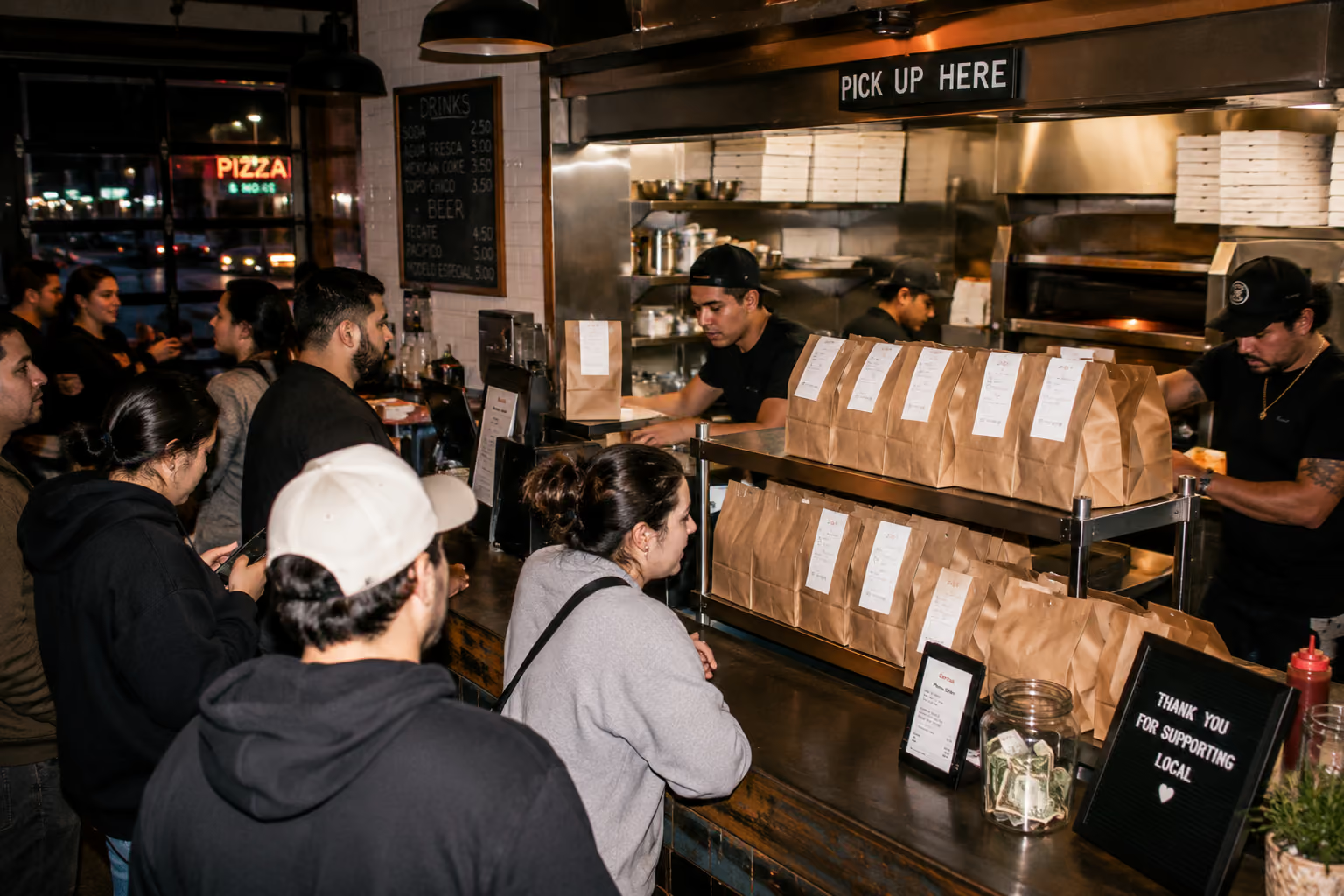
Major chains are closing lots of locations in 2026. But their customers have to eat somewhere.
The question is whether your restaurant will be the one to catch them.
What do chain closures mean for your restaurant?
Major restaurant chains are closing hundreds of locations in 2026. This isn't an industry collapse, it's a strategic realignment. Wendy's announced plans to close up to 358 restaurants, Pizza Hut is shuttering 250 locations, and Papa John's is closing approximately 200 units. Jack in the Box plans to close up to 100 locations, while Noodles & Company announced it expects to close 30 to 35 locations this year.
These closures often stem from underperforming units, rising operational costs, and shifts in consumer behavior. Some chains, like Red Robin and Denny's, have closed locations abruptly. Others are pruning strategically, aiming to direct sales to nearby stores while keeping delivery options open.
Here's the part that matters for you: despite these closures, the National Restaurant Association projects total industry sales will reach a record $1.55 trillion in 2026. The demand isn't vanishing. It's redistributing. When a chain closes, its customers search for the next closest option, and if you're prepared, that option can be you.
From my family's experience: when a competitor closed down the street
That franchise closure we had near our restaurant taught me a lesson I still use today. We saw an immediate 15-20% bump in calls during the first two weeks. But within a month, half of those new customers had disappeared.
The ones who stayed were the ones we impressed on the first order. Perfect timing, accurate order, and food that met or beat what they were used to. The ones who left? We messed up their order, they waited too long, or the person who answered the phone was short with them. They gave us exactly one chance.
Industry data backs this up. Jack in the Box saw a 30% sales lift at locations near a closed unit, but experts warn this bump evaporates if the new experience is substandard. The opportunity is real, but it's fragile. You get one shot.
Where do displaced restaurant customers go?
Displaced customers follow a predictable path, and you can intercept them at three critical moments: the search, the phone call, and the first order experience.
When their usual spot closes, they pull out their phone and search "pizza near me" or "breakfast near me." They're looking for convenience first. Research on retail closures shows customers choose the most convenient nearby option. A physical presence also builds trust for online ordering, as it provides assurance and an easy return point.
The second moment is the phone call. They find your number, they call, and if you don't answer, they call the next restaurant on the list. A displaced chain customer calling you for the first time will not leave a voicemail. They're impatient, hungry, and have other options. This is a key moment to have 24/7 restaurant call handling in place.
The third moment is the first order. This is where you either earn a repeat customer or lose them forever. Order accuracy, speed, and a reason to come back all matter here. If the food is good but the wait is 90 minutes, they won't return. If the order is wrong, they won't give you a second chance.
How can you capture new business from chain closures?
Here's how to position your restaurant to catch the demand that chains are leaving behind. These are practical moves I've seen work in our family's restaurants and in the restaurants we work with at Certus AI across the US.
Make your Google Business Profile and local pages airtight
Your Google Business Profile is your new storefront. When a displaced customer searches "pizza near me," Google decides who shows up first based on proximity, relevance, and prominence. You control two of those three.
Start with the basics. Keep your hours accurate. Use high-quality photos of your food, interior, and team. Update your menu with current prices. Respond to every review, good or bad, within 24 hours. Add posts about specials or new menu items at least once a week.
Then go deeper. Add attributes like "wheelchair accessible" or "family-friendly." List your most popular dishes in the menu section. Enable online ordering directly through your profile. The goal is to give a displaced customer every reason to choose you over the next result.
Learn more about how to get more positive Google reviews for your restaurant.
How to answer every call, every time
This is the easiest way to lose the opportunity. A displaced chain customer calls you for the first time. Your staff is slammed. The phone rings six times and goes to voicemail. That customer hangs up and calls the next restaurant. You just lost $40, and you'll never get another chance.
A phone call is the highest-intent moment in the customer journey. They're ready to order right now. If you don't answer, someone else will.
This is where AI helps independents automate orders. An AI phone agent like Certus AI answers in under a second, takes the order accurately, and syncs it directly to your POS. It works 24/7, handles English and Spanish, and never puts a customer on hold.
Boardwalk Pizza captured $70,000 in orders it was missing just by making sure every call got answered. Choosing the right AI system is crucial for handling your restaurant's unique needs.
How to optimize the order experience
You've won the search, you've answered the call, and now the order is in. This is your one chance to turn a trial customer into a repeat customer.
Start with accuracy. Double-check every order before it goes out. If the customer ordered no onions, there better not be onions. These small mistakes can kill trust with new customers.
Speed matters, but don't sacrifice quality. If your normal ticket time is 25 minutes, aim for 20 for a first-timer. If you're slammed and it's going to take 45 minutes, tell them upfront when they order. Honesty builds trust. Surprises kill it.
Add a small, memorable touch. A handwritten "thank you" on the receipt. A free dessert with a note that says "Welcome, first-timers." A 20% off coupon for their next visit. One of our family's restaurants included a business card with first-time delivery orders. On the back, we wrote "Your next order is on us" with a $10 off code. The redemption rate was over 40%, turning a small discount into thousands in lifetime value. This is how independent restaurants can compete with MC Donalds and other fast food chains.
Pick up the chain's occasions
Every closed chain served specific occasions. Pizza Hut owned family pizza night. Denny's owned late-night breakfast. Jack in the Box owned the drive-thru lunch rush. When they close, those occasions are up for grabs.
Figure out what occasions the closed chain served, then build offers around them. If a family pizza chain closed, create a family meal deal: large pizza, breadsticks, and a 2-liter for $35. Promote it on Friday afternoons.
If a breakfast chain closed, run a weekday breakfast special: two eggs, bacon, toast, and coffee for $8. Advertise it on local radio during the morning commute. If a lunch spot near offices closed, offer a "lunch ready in 15 minutes" guarantee and promote it in local business groups. The key is to make it easy for customers to replace their old habit with a new one at your restaurant.
Watch your trade area and act fast
Chain closures are often announced weeks or months in advance. When you see a closure announcement in your area, you have a window to prepare.
Ramp up local advertising before the doors shut. Run Facebook and Instagram ads targeted to a two-mile radius around the closing location. Promote your family meal deals, your hours, and your phone number.
Consider temporary capacity increases. If you know a nearby chain is closing in two weeks, schedule extra staff for the following month. Stock up on popular ingredients. Make sure your POS and kitchen can handle a 20-30% bump in volume. The restaurants that win are the ones that act before the closure happens, not after.
What is the real revenue from one new customer at your restaurant?
Let's do the operator math on what one captured household is worth. A family that orders pizza once a week spends about $40 per order. That's $160 per month, or roughly $2,000 per year. If you capture ten of those families from a chain closure, you've added $20,000 in annual revenue. Twenty families? $40,000.
The National Restaurant Association reports that 61% of consumers consider restaurant use an essential part of their lifestyles. These aren't discretionary customers. They're going to order from someone.
You don't need to capture every displaced customer. If a chain doing $30,000 a month closes, capturing just 10% of that is an extra $36,000 a year, a huge win for most independents. Focus on the high-value, repeat customers. The family that orders every Friday, the office that orders lunch twice a week. These are the customers worth fighting for.
The short version: Be ready when they call
Chain restaurants are closing hundreds of locations in 2026, but the restaurant industry as a whole is still growing. The demand isn't disappearing, it's redistributing to nearby restaurants. Independents are in the best position to capture it.
The opportunity is real, but it's not automatic. Displaced customers will give you exactly one chance. If you're easy to find, you answer the phone, and you nail the first order, you can turn a competitor's closure into thousands in new annual revenue.
Focus on the three critical moments: the search, the phone call, and the first order. Make your Google Business Profile airtight. Answer every call. Nail the first experience. The chains are handing you customers. Be ready to catch them. Explore how a strategic AI phone answering system for restaurants can ensure you never miss a call from a new customer.
Can a small restaurant handle the extra volume from a chain closure?
Most small restaurants can handle a 15-20% increase in volume with minor adjustments, like scheduling extra staff and stocking up on popular ingredients. You don't need to capture every displaced customer. Focus on the high-value, repeat customers and build capacity gradually. Using one of the best AI phone ordering systems for small restaurants can also help manage the influx without overwhelming staff.
About the Author
Gurveer Singh is the Co-Founder and CEO of Certus AI, a Y Combinator-backed company building AI receptionists for restaurants. He grew up working in his family's 11-location restaurant chain, taking phone orders at age 9 and managing front-of-house operations by 17. Certus AI won the Innovation Award 2025 at the Restaurant & Takeaway Innovation Expo and now serves restaurants across the United States.
Book a free demo call today for personal consulting and a closer look.

.svg)
.svg)
.svg)
.svg)