.svg)

.svg)


Key takeaways
- Do not try to match McDonald's on price. You will lose money and your brand identity in the process.
- Win on phone responsiveness, customization, and recognition. These are structural advantages that chains cannot replicate at scale.
- Build value bundles and master upselling to increase average tickets without changing your menu prices.
- Invest in operational speed and accuracy to deliver a takeout experience that feels premium, not rushed.
Introduction
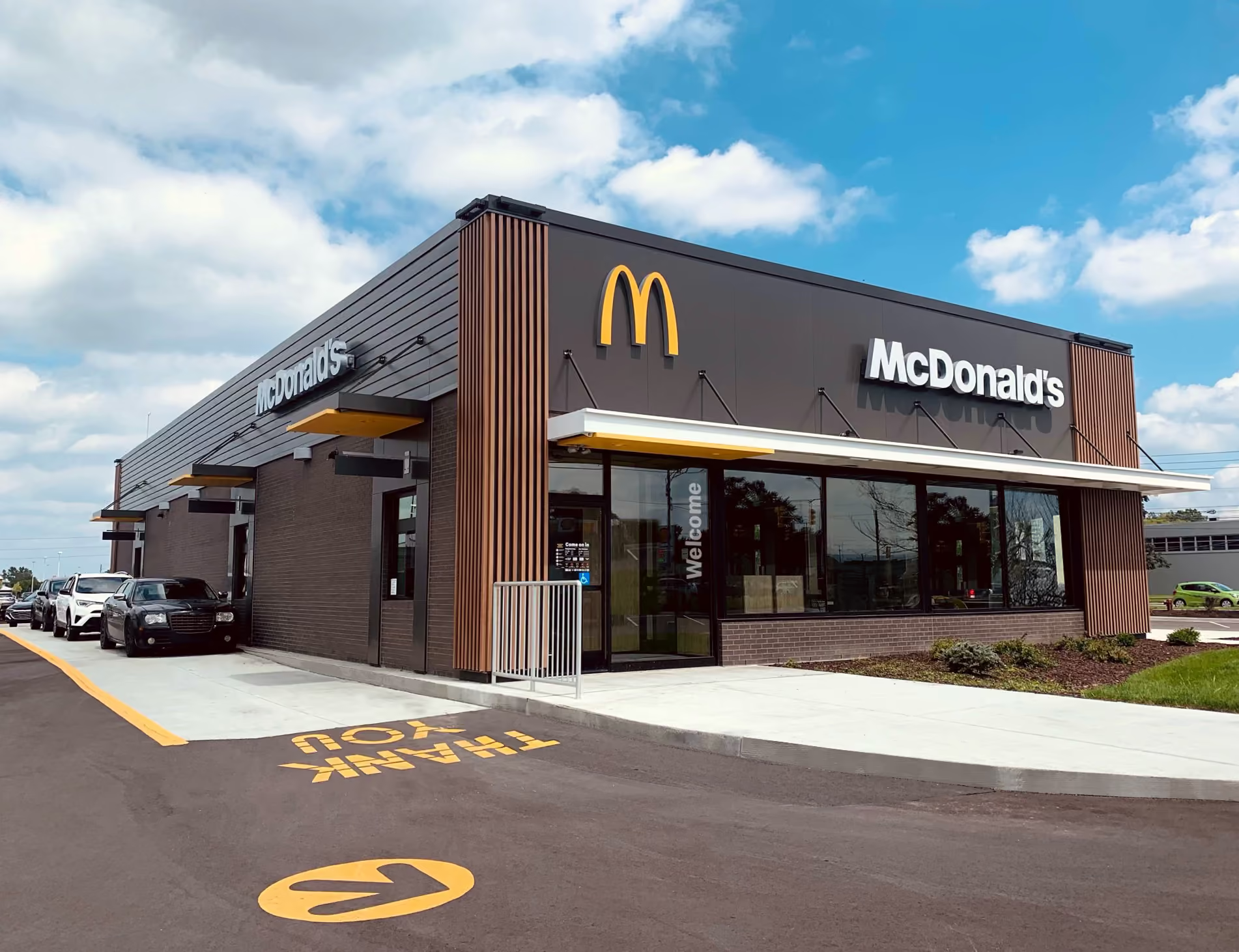
On April 21, 2026, McDonald's launches its Under $3 Menu with at least 10 items, plus a $4 Breakfast Meal Deal. If you run an independent restaurant, you have probably already done the math. Your chicken sandwich costs $12. Theirs costs $2.79. Your burger is $14. Theirs is under three bucks.
The panic is real. I've watched my family navigate these moments across 11 restaurant locations. The instinct is always the same: drop prices, match the chains, protect traffic. Trying to out-cheap McDonald's is like trying to out-ship Amazon. You can't, and the attempt will destroy your margins.
McDonald's has over 13,000 U.S. locations and supply chain leverage you'll never touch. They can lose money on a $3 menu to drive foot traffic and make it back on fries and drinks. You can't. But you can win on everything they structurally cannot deliver.
Why competing on prices doesn't make sense for restaurants
Competing with fast food giants on price is a losing battle for independent restaurants. It erodes margins, diminishes food quality, and burns out staff, ultimately making you work harder for less money while damaging your brand's unique identity. This is why you must learn how to save money as a restaurant with voice AI and other smart tech, not by cutting corners.
McKinsey's 2026 consumer analysis confirms that value and pricing are top-of-mind for diners, but the same research warns that obsessing over price as the only measure of value creates uninspired experiences. Diners are more deliberate now. They're comparing your $14 burger to McDonald's $2.79 option and asking what the extra $11.21 buys them.
If your answer is "nothing," you're in trouble. If your answer is "a burger made exactly how you want it, handed to you by someone who knows your name, in 90 seconds," you have a business model that survives value wars. The math on price-cutting is brutal. Drop your average ticket from $18 to $12 to compete, and you need 50% more customers just to break even on revenue, which is an unsustainable model.
How can independent restaurants stand out?
Independent restaurants can stand out by focusing on their inherent strengths that large chains cannot replicate. This means superior, responsive phone service, offering deep customization, and building genuine customer recognition to create loyalty beyond price. McDonald's optimizes for speed and consistency, which means they sacrifice the personal connection - that is your greatest opportunity.
Use restaurant phone automation
Try calling your local McDonald's. You'll likely get an automated system, a long hold, or no answer at all. Chains have phone systems designed to push customers to apps, creating a cold experience. Your phone line is a competitive weapon. Every call is a potential order, reservation, or catering inquiry. Missing calls means leaving money on the table.
The solution isn't hiring more staff to sit by the phone. It's using a strategic AI phone agent for restaurants that answers every call with warmth, takes orders accurately, and syncs directly to your POS. Tools like Certus AI handle complex orders, answer menu questions, and even upsell add-ons, all while sounding like your best employee. The system works 24/7, capturing revenue you're currently losing for a fraction of the cost of a full-time hire.
Why customization and recognition build loyalty
Chains charge extra for modifications. You can include them as part of the experience. A customer who wants no onions and extra pickles gets nickel-and-dimed at a chain. At your place, they get "of course, no problem." This flexibility extends beyond food to accommodating dietary restrictions and creating off-menu items for regulars.
Recognition is even more powerful. Knowing a regular's name or remembering their usual order creates a sense of belonging that no loyalty app can replicate. Chains use technology to track purchases, but there's no substitute for a real human interaction where someone actually remembers you. This personal connection is why customers will pay $14 for your burger.
Smart pricing strategies for restaurants
Instead of cutting prices, independent restaurants should use smart pricing to create perceived value and increase average ticket size. This involves creating strategic value bundles, mastering the art of upselling, and developing profitable new revenue streams like catering. This approach frames value in a way that makes your pricing feel fair and justified.
How value bundles outperform cheap individual items
A $3 sandwich feels cheap, but a $14 family meal feels like a deal. Bundles create perceived value because customers assume they're saving money, even if your margin remains healthy. Build bundles that make sense for your menu, like a "Date Night Special" or a "Family Feast."
Structure bundles to increase your average ticket. For example, if your average order is $18, a $45 "Date Night" bundle for two raises that to $22.50 per person. You increase revenue by 25% while the customer feels they got a deal. Your bundles can be higher quality and more customizable than the generic deals offered by chains like Chili's or Wendy's.
Are you missing out on these profit centers?
Upselling is the fastest way to increase revenue. A well-trained server or a smart AI phone system can lift average ticket sizes by 10% to 30% just by suggesting add-ons. On the phone, an AI voice technology restaurant can suggest pairings and specials without getting tired or forgetting to ask.
Catering and family meals are another underutilized profit center. Chains struggle with large custom orders, but you can own this space. A $200 catering order is often more profitable and easier to manage than ten individual $20 orders. If you're not actively promoting catering on your website and phone calls, you're leaving money on the table.
Operational excellence: Delivering on your promises
Delivering on your promises of quality and service requires operational excellence. This means focusing on the speed and accuracy of your takeout process and empowering your team by automating repetitive tasks, which allows them to provide superior hospitality. Your competitive advantages only matter if you can execute them consistently.
Why speed and accuracy define your brand
While fast food chains win on speed, it comes with tradeoffs like no customization. You can compete by optimizing your takeout and pickup process. Design a dedicated pickup area where orders are ready and waiting. A customer who can grab their order and leave in under 90 seconds has an experience that is faster than a drive-thru and feels premium.
Accuracy is just as important. A wrong order destroys trust. Integrating your phone system with your POS eliminates manual entry errors. When an AI phone agent for your restaurant handles complex orders and syncs them to your kitchen, the order is perfect every time. Reliability is a competitive advantage that compounds over time.
How can you empower your team for better service?
Your staff can't deliver great hospitality if they're drowning in phone calls and juggling orders. The solution is to remove tasks that don't require a human touch, especially when you have an understaffed kitchen or front of house.
But there is a way to free your team to focus on the customers in front of them. Instead of running to the phone during a dinner rush, they can give full attention to the tables they're serving, resulting in better service and less staff burnout - with automated phone ordering.
What's your restaurant's long-term competitive edge?
Your long-term competitive edge is building a durable brand by leaning into your unique story, your role in the community, and the emotional connection you build with your customers. The value wars will come and go, but a strong brand keeps you in control.
Your restaurant's story is your strongest asset
Why did you open your restaurant? What makes your food different? These stories are your moat. McDonald's can't tell them because they don't have them. Lean into your story, whether you're a 30-year family-run spot or a new concept built on local ingredients. It's a lesson even giants like Domino's learned; you can build a billion-dollar empire without having the best product if you perfect the experience.
Your story gives customers a reason to choose you that has nothing to do with price. It creates an emotional connection, which is far more durable than a discount. People will pay more to support a restaurant they feel connected to. You win on meaning, connection and get more good Google reviews, while McDonald's wins on price.
Final thoughts: Your restaurant is not a commodity
McDonald's wants you to believe that all burgers are the same, so price is the only thing that matters. That's how they win. Your job is to prove them wrong every single day.
You do that by answering every call, knowing your regulars, customizing orders without hesitation, and delivering food that's made with care. You do it by building bundles that feel like deals, upselling in ways that add value, and owning the catering space that chains can't touch. You do it by telling your story and making your restaurant a place people choose because of what it represents, not just what it costs.
The $3 menu is a distraction. Let McDonald's have it. You're building something they can't replicate.
How do I communicate value to customers who are price-sensitive?
Frame value as the total experience, not just the menu price. Highlight customization, quality ingredients, fast pickup times, and personal service. Use bundles and family meals to create price points that feel competitive while maintaining healthy margins.
About the author: Gurveer Singh is the Co-Founder and CEO of Certus AI, a Y Combinator-backed company building AI phone agents for restaurants. He grew up working in his family's 11-location restaurant chain, taking phone orders at age 9 and managing front-of-house operations by 16. Certus AI has helped over 100 restaurants recover thousands in missed revenue by answering every call with AI that sounds human and integrates directly with POS systems.
Ready to stop missing calls and start capturing every order? Book a personal demo to see how Certus AI can answer your phones 24/7, take complex orders, and sync directly to your POS system, all for less than the cost of a part-time employee.

.svg)
.svg)
.svg)
.svg)