.svg)

.svg)


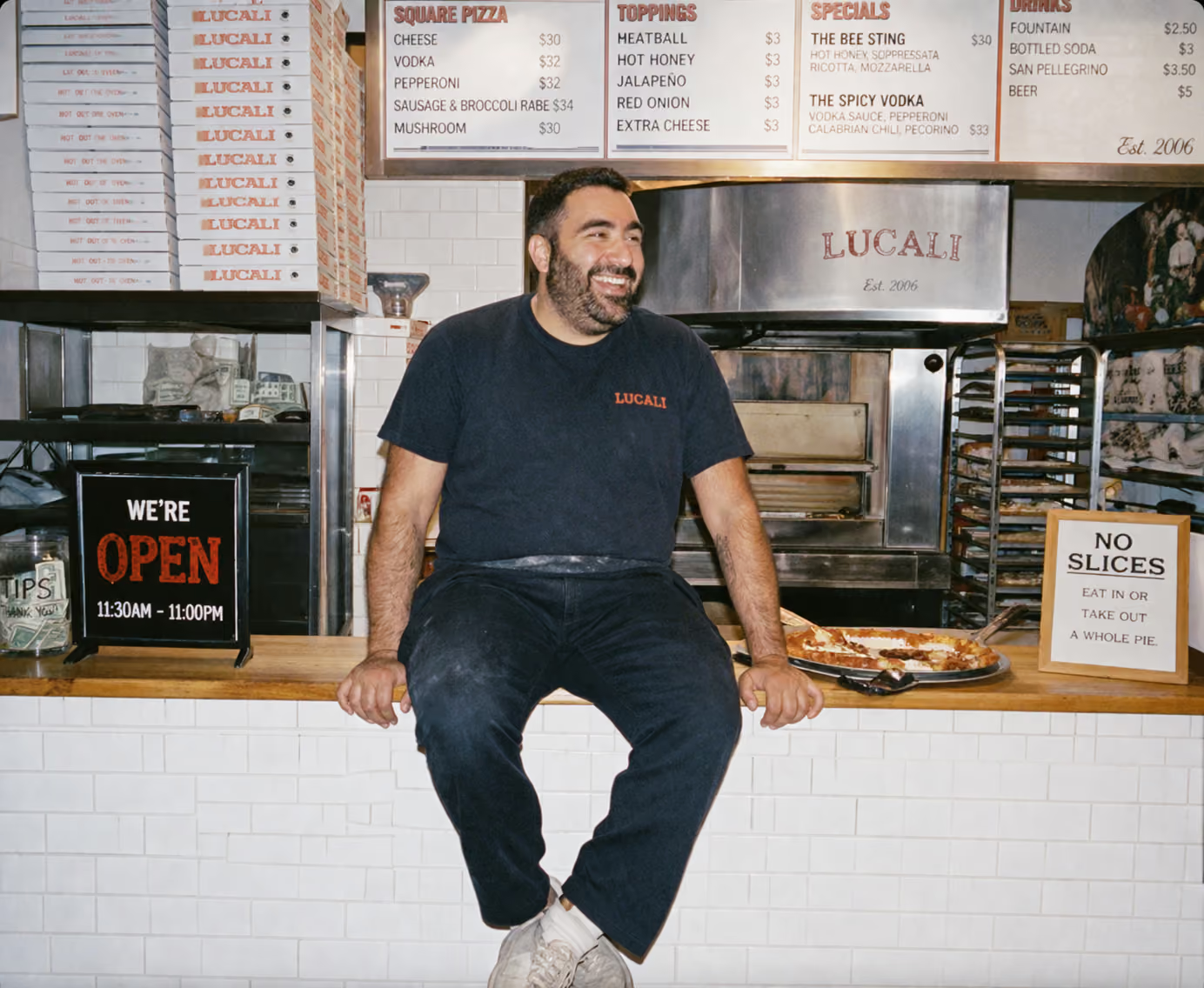
You just served 200 covers. The kitchen crushed it, your servers were on fire, and you heard at least a dozen genuine compliments. You check your Google profile the next morning expecting a flood of five-star reviews and find only two. One is three stars because "parking was hard."
This is the reality for many restaurants. You deliver great experiences every night, but your Google profile doesn't reflect it. Meanwhile, your competitor down the street with mediocre food has 4.8 stars and hundreds of reviews because they built a system to get them. Those reviews are sending customers to their door instead of yours. This is a common struggle, as many restaurants are adding more tech but customers are getting less happy, often because the fundamentals are missed.
In this guide, we'll break down a step-by-step system to turn your happy, silent customers into vocal advocates on Google to boost your ranking, reputation, and revenue.
Why Google reviews are so valuable for restaurants
Google reviews are the single most important factor in whether new customers find you or your competitor. Restaurants with a rating of 4 stars or higher can receive up to 30% more clicks on their Google listings compared to lower-rated competitors. Additionally, around 94% of consumers say that positive reviews increase their likelihood of visiting a business, highlighting the strong impact of customer feedback on decision-making (Source).
When someone searches "Italian restaurant near me" at 6 PM on a Tuesday, your star rating is often the deciding factor. But it's not just about the rating. Google's algorithm heavily weighs recency. A restaurant with 50 fresh reviews from the past three months can outrank a competitor with 2,000 older ones. Google sees new reviews as a signal that your business is active and relevant, making a consistent review strategy for 2026 essential for growth.
The silent customer and the lost opportunity
Your happiest customers are sometimes your quietest. They finish their meal, tell you it was amazing, leave a generous tip, and walk out the door. They meant to leave a review, but by the time they get home, the moment has passed. This happens dozens of times every week, representing five-star experiences that never become five-star reviews because there's no system to capture them. Meanwhile, unhappy customers are highly motivated to share their experience without any prompting.
How reviews directly impact your bottom line
Let's do the math on what reviews are actually worth. Data from Sunday App shows that a 0.1-star increase in your Google rating correlates to a 1% increase in covers. A full one-star improvement can drive about 10% more customers through your door. If you serve 700 customers a week with an average check of $30, a half-star rating increase could bring in 35 additional guests weekly. That's $1,050 in new revenue every week, or $54,600 annually.
Now consider discovery. Research indicates that 80% of local mobile searches convert, often within 24 hours. When someone searches for restaurants on their phone, they're ready to eat now. Your review profile is competing for that immediate decision. A strong rating doesn't just build long-term reputation, it captures hungry customers in real time, much like how Domino's built an empire on convenience and systemization.
The best Restaurant Google reviews tips to consistently earn 5-star reviews
The difference between a 3.9-star restaurant and a 4.6-star one usually is a repeatable system for turning great experiences into Google reviews. Building this system costs nothing but requires training, simple tools, and a commitment to consistency.
Here is the step-by-step playbook that works for hundreds of independent restaurants.
Tactic 1: Ask at the right moment, every time
Timing is everything. The worst time to ask for a review is during payment, when your customer is distracted. The ideal moment is right after a genuine compliment or positive interaction. Train your staff to listen for verbal cues like, "That was the best pasta I've had in years."
The response should feel natural, not scripted: "I'm so glad you enjoyed everything. If you have a moment, a quick Google review would really help us out. It makes a huge difference for a small place like ours."
Asking in that moment feels like a natural extension of the conversation. Empower your team to ask every time they hear a compliment. Make it part of the service flow, just like offering dessert or refilling water.
Tactic 2: Make leaving a review effortless
Even motivated customers won't leave a review if it's complicated. Asking them to "find us on Google" adds too much friction. You can eliminate this by using a QR code that links directly to your Google review page. Put it on receipts, table tents, and takeout bags. One scan should take them straight to the review form.
To create your direct review link, go to your Google Business Profile, click "Get more reviews," and copy the short URL. Use a free QR code generator to turn that link into a scannable code. Print it with simple text: "Loved your meal? Scan to leave us a review."
Tactic 3: Empower your team to ask naturally
Your staff won't ask for reviews if they feel awkward or don't understand why it matters. Training is the foundation of a successful review generation system. Start by explaining the "why." Show them how reviews directly impact the restaurant's success, which affects their job security and tips.
Give them a simple, comfortable script they can adapt, like: "I'm so glad you enjoyed your meal. If you have a moment, a quick review on Google would mean a lot to our team." Practice it in role-play scenarios during pre-shift meetings. It's also critical to train them on Google's policies: never offer discounts for reviews or "gate" requests by only asking people you think are happy. This protects your profile from being penalized.
Engaging with reviews
Responding to reviews is a powerful, and often overlooked, strategy for improving your local SEO and customer perception. Google has explicitly stated that active engagement with reviews can positively influence local search ranking. When you respond, you're signaling to Google that your business is well-managed and customer-focused.
Responding to every review, good or bad
Make it a policy to respond to every review within 48 hours. For positive reviews, keep it short and genuine. "Thank you so much, Maria. We're thrilled you enjoyed the carbonara. Hope to see you again soon." Personalize it by mentioning a specific dish or server they praised.
This shows future readers that you read and care about feedback, and it encourages reviewers to mention specific menu items, which can boost your keyword rankings for those dishes.
Turning negative feedback into positive outcomes
A thoughtful public response can turn a one-star review into a showcase of your customer service. Use this simple framework: acknowledge the issue, apologize sincerely, and offer to make it right offline.
For example: "We're truly sorry to hear about your experience, John. This doesn't reflect the standard we hold ourselves to. Please call us directly at (555) 123-4567 so we can address this personally and make things right." This response shows accountability to the unhappy customer and future readers, and it moves the sensitive conversation off a public platform.
Why Google rewards active engagement
Google's goal is to provide searchers with the best possible local businesses. When the algorithm sees a business owner actively responding to feedback, it interprets this as a sign of a healthy, customer-centric operation. This engagement, combined with keeping your business information (hours, address, menu) perfectly up-to-date, tells Google your profile is trustworthy and deserves to be shown to more people. This active management is a key part of a modern restaurant reputation management strategy.
The phone experience: An overlooked review driver
Here's something most restaurant operators don't connect: your phone line directly impacts your Google review profile. Every missed call is a potential one-star review. Every rushed, distracted phone interaction is a customer who won't come back or recommend you. The phone is often a customer's first interaction with your brand, and if it's frustrating, no amount of great food will fix it.
On the other hand: A great and reliable phone line will help you increase restaurant reviews 2026 and beyond.
How missed calls and rushed service kill your reputation
The average restaurant misses about 150 calls per month, with around 60% being actionable orders or reservations. Research shows that 85% of callers who get no answer won't call back. They just move on to the next restaurant. But before they do, some leave a review: "Called three times, no one answered. Went somewhere else."
During peak hours, your staff are stuck trying to serve in-person guests while the phone rings nonstop. When they do answer, they sound rushed and stressed. That's not the experience that earns five-star reviews. And if the caller speaks Spanish while nobody on shift does, the call ends even faster. I wrote about why Spanish-speaking customers hang up and what it costs in repeat business.
How to turn phone orders into reviews
This is where AI voice technology for restaurants changes the game. An AI phone agent for restaurant operations answers every call, 24/7, with perfect consistency. No hold times, no missed calls, and no stressed staff.
These automated phone ordering systems can handle complex orders, answer menu questions, and integrate directly with your POS.
The customer experience is smooth and professional every time, which eliminates negative reviews caused by a chaotic phone experience. But here's the key: a good restaurant AI assistant can automatically send an SMS with a Google review link to every phone order customer 30 to 60 minutes after their order. This turns every successful call into a review opportunity on autopilot.
Systems like Certus AI are designed to handle this entire workflow with a strategic approach. The restaurant voice AI answers the call, takes the order (even if it's complex), sends it to your kitchen, and follows up with a review request. Your staff never touch the phone, your customers get better service, and your review count grows automatically.
Get more good Google Reviews and improve your reputation
Stop chasing reviews and start earning your reputation. Reviews are a lagging indicator, they reflect the experiences you delivered last week or last month. The real work is in perfecting the experience itself. Every missed call is a future one-star review. Every rushed phone order is a lost customer.
Building a strong Google review profile in 2026 requires two things: consistently delivering experiences worth reviewing and having a system that captures them. Fix your phone experience. Train your team to ask at the right moment. Make leaving a review effortless. Respond to every piece of feedback like your reputation depends on it, because it does. Do this consistently for three months and watch what happens to your rating, your review count, and your revenue.
Ready to stop missing calls and start earning more 5-star reviews? Book a demo call with our experts and get consulting on your strategy.
Frequently asked questions
How many Google reviews does a restaurant need to rank well locally?
There's no magic number, as recency and consistency matter more than the total count. A restaurant with 50 reviews from the past three months will often outrank one with 500 older reviews. Google's algorithm prioritizes fresh feedback as a signal of current relevance. Aim for a steady flow of 10 to 20 new reviews per month.
Should I respond to every single Google review?
Yes. Google rewards active engagement, and responding to every review signals that your business is well-managed and values customer feedback. Even a simple "Thank you, we appreciate you" for a positive review is better than silence. It takes seconds and can improve your local search ranking.
What's the best way to handle a fake negative review?
First, flag it through your Google Business Profile. While waiting for Google to review it, respond publicly and professionally. A good response is: "We have no record of your visit under this name and would love to resolve this. Please contact us directly at [phone number]." This shows future readers you are proactive while questioning the review's legitimacy.
Can an AI phone agent really handle my restaurant's unique menu?
Modern AI phone agents are built for this. Unlike old IVR systems, they use conversational AI to understand natural language, accents, and complex requests. A well-designed AI phone agent can handle complex orders with large menus, custom modifications, and allergy questions, integrating them directly into your POS.

.svg)
.svg)
.svg)
.svg)