.svg)

.svg)


Key takeaways
- The traditional phone line is a hidden cost center, not just a communication tool. It drains staff time and loses revenue every day.
- Hiring a human host costs far more than just their hourly wage. You must factor in benefits, training, turnover, and missed opportunities.
- AI phone agents offer a predictable, lower-cost alternative with significant revenue recovery potential. They never miss a call or an upsell.
- Calculating your true ROI means looking beyond direct costs to include recovered revenue from missed calls and improved staff efficiency.
The unseen drain on your restaurant's bottom line
Your phone line is likely bleeding revenue, and the wound is bigger than you think. An AI phone agent can stop this bleeding by making sure every call is answered. Research shows that restaurants miss about 10% of incoming calls, which can translate to thousands in lost monthly revenue. For many, an AI answering machine for restaurants is the first step to fixing this.
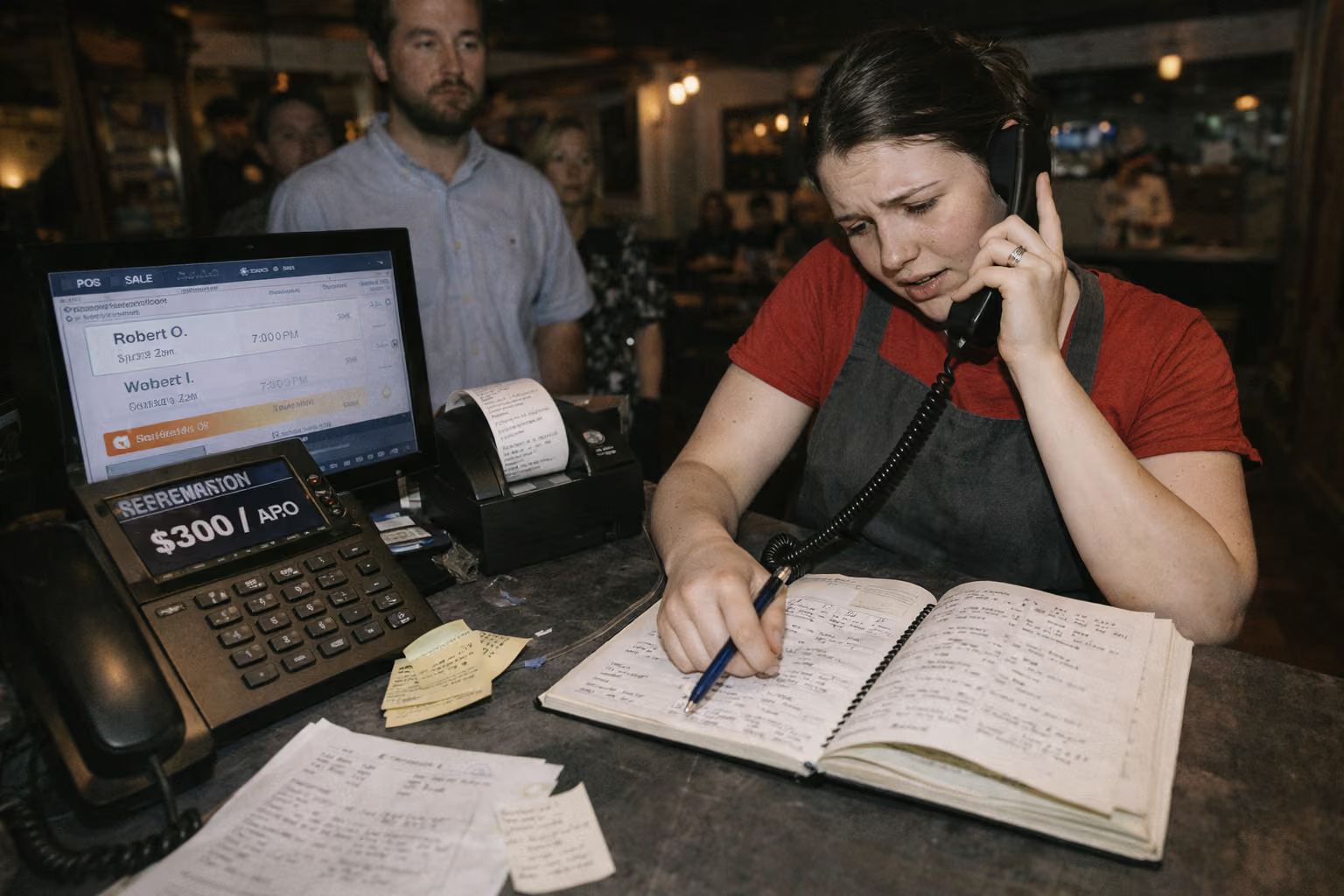
The problem compounds during your busiest, most profitable hours. Your staff faces an impossible choice: provide excellent service to the guests in front of them, or answer the phone. Either way, you lose. Miss the call, and you lose the order. Answer it, and your in-house service quality drops, which affects tips, reviews, and repeat business. For a 50-seat restaurant, the annual cost of missed calls alone can reach $27,000.
Understanding the cost of a human host in 2026
The true cost of a human host goes far beyond their hourly wage, with taxes, benefits, training, and the high price of turnover.
When you add up these expenses, the total investment is often 30-50% higher than the salary, revealing a much larger financial commitment than most owners realize.
The average base salary for a restaurant host in the United States is approximately $30,750 per year, or $14.78 per hour. But this baseline figure represents only the direct wage cost. The moment you hire someone, you're committing to a much larger financial obligation that extends well beyond what appears on their pay stub.
Employee benefits add roughly 30% to a worker's base salary. For your $30,750 host, that means an additional $9,225 in annual costs. This includes mandatory expenses like FICA taxes (7.65%), unemployment insurance, and workers' compensation. Then there are competitive benefits like health insurance, paid time off, and sick leave. Your $30,750 host actually costs you closer to $40,000 per year.
On top of that the restaurant industry has one of the highest turnover rates of any sector, often exceeding 70%. The cost to replace a single hourly restaurant employee is approximately $5,864. This includes productivity loss, recruiting costs, and training the replacement. Over a two-year period, you might go through three or four hosts, absorbing that replacement cost each time.
The cost of human error and inconsistency
Even your best host has off days. They mishear an order, forget to mention the daily special, or get overwhelmed during a rush. Each mistake has a cost. A missed upsell on a $40 order might mean losing an additional $8 in revenue. An incorrectly taken order leads to wasted food and an unhappy customer. The customer experience varies depending on who answers the phone, making it hard to build a reliable brand.
What exactly is an AI phone agent for restaurants?
An AI phone agent is a voice-based software that answers your restaurant's phone calls, understands what the caller wants, and handles the interaction from start to finish. It sounds like a real person and can manage the full range of tasks your human host handles, from taking orders and booking reservations to answering menu questions. This is a world away from frustrating IVR systems of the past.
Modern AI phone agents integrate with your existing technology, like Toast, Square, or Clover. They inject orders directly into your kitchen display system just as if a server had entered them. They can handle multiple calls at once, so when three people call during a rush, the AI answers all three instantly. No hold music, no missed calls.
Breaking down AI phone agent pricing models
AI phone answering services for restaurants typically use a subscription-based model, but the details vary. Understanding these models helps you compare options accurately. The most common structure is a flat monthly fee per location, generally ranging from $99 to $599 per month, depending on the feature set and call volume included.
Some providers charge per-minute rates, which can be costly for high-volume restaurants. Watch for hidden costs like setup fees, integration fees, and overage charges. The most transparent pricing is a flat monthly rate with unlimited calls and included integrations. This gives you predictable costs. At Certus AI, we use this approach: a flat monthly rate per location with unlimited calls and direct POS integration included.
The direct cost comparison: AI vs. human host
A side-by-side comparison reveals the stark financial difference between hiring a human and implementing AI.
An AI phone agent provides constant coverage for a fraction of the cost of a single full-time employee, without the associated expenses of benefits, turnover, or training, while also actively generating new revenue.
- Base Cost:
- Full-Time Human Host: $30,750/year (avg. salary)
- AI Phone Agent (Certus AI): flat monthly fee, a small fraction of a host's total cost
- Benefits & Taxes:
- Full-Time Human Host: +$9,225/year (approx. 30%)
- AI Phone Agent: $0
- Turnover & Training:
- Full-Time Human Host: +$3,909/year (average)
- AI Phone Agent: $0
- Availability:
- Full-Time Human Host: 40 hours/week
- AI Phone Agent: 24/7/365
- Upselling:
- Full-Time Human Host: Inconsistent
- AI Phone Agent: Consistent on every call
- Missed Calls:
- Full-Time Human Host: 10–20% during peak hours
- AI Phone Agent: <1%
- Total Annual Cost:
- Full-Time Human Host: ~$44,000
- AI Phone Agent: a small fraction of a host's cost
The common mistake: Underestimating human labor costs
Most owners make hiring decisions based on hourly wage alone, missing 40-50% of the true cost. They also assume one host solves the phone problem. If you're open 70 hours per week, you need 1.75 full-time employees for full coverage. That doubles your labor cost, while the AI cost stays the same whether you're open 40 or 100 hours a week.
The power of consistent upselling with AI
Human upselling is inconsistent. A restaurant AI assistant, however, can be programmed to suggest pairings, mention specials, and offer add-ons on every single call.
If your average phone order is $35 and the AI increases that by just 15%, you're adding $5.25 per order. Across 1,000 monthly phone orders, that's an extra $5,250 in monthly revenue.
Staff morale and efficiency
When your host isn't drowning in phone calls, they can focus on what they do best: greeting guests and managing the floor. Your servers aren't interrupted, and your kitchen isn't dealing with miscommunicated orders. This has a real financial impact. Happier staff stay longer, reducing turnover costs. Better in-house service leads to higher tips and better reviews.
24/7 availability with and consistency
An AI works around the clock, capturing late-night takeout orders and early-morning reservation requests long after your staff has gone home. Every caller receives the same high-quality, professional experience, whether it's a Tuesday morning or a Saturday night. This consistency builds brand trust and reliability.
And as your business grows, an AI scales with you. Opening a second or third location doesn't require hiring a new front-of-house team for each spot.
How to calculate your restaurant's real ROI with an AI phone agent?
To calculate your true return on investment, you need to look beyond simple cost savings. The real value lies in recovered revenue and increased efficiency. A clear understanding of the strategic ROI of AI phone answering helps justify the investment.
Here’s a simple framework:
- Estimate Lost Revenue: (Avg. Daily Missed Calls) x (Avg. Order Value) x 30 days = Monthly Revenue Lost.
- Estimate Upsell Revenue: (Avg. Monthly Phone Orders) x (Avg. Order Value) x (15% Upsell Increase) = Monthly Upsell Gain.
- Calculate Labor Savings: (True Annual Cost of Host) / 12 = Monthly Labor Savings.
- Total Monthly Gain: (Recovered Revenue + Upsell Revenue + Labor Savings) - (Monthly AI Cost) = Net Monthly ROI.
For many restaurants, the AI pays for itself in the first few days of the month just by capturing calls you were already missing.
How to choose the right AI phone agent for your restaurant
Selecting the right AI partner is crucial for success. Look beyond the price tag and evaluate the technology's core capabilities, integration potential, and the provider's support system. The goal is to find a solution that feels like a natural extension of your team.
Integration with your existing POS system
The AI must integrate seamlessly with your Point of Sale (POS) system. An agent that injects orders directly into your workflow without requiring manual entry is essential. Make surethe provider supports your specific POS, whether it's Toast, Square, Clover, or another platform. This is a key feature of a great AI alternative to dedicated phone staff.
Handling menu complexity and modifications
Your menu is unique. The AI needs to handle it. Can it navigate 100+ items? Does it understand modifiers like "extra sauce" or "no onions"? Ask potential providers how their AI handles complex menu modifications and daily specials to ensure it can manage your specific offerings.
Natural language understanding and accents
The AI should sound human and understand how real people talk. It needs to handle different accents, background noise, and conversational detours. The difference between a robotic script and a natural conversation is a core differentiator. A quality system is more than a chatbot; it's true conversational AI for restaurant phone orders.
If you serve a diverse community, multilingual capabilities are a game-changer. An AI that can switch between English and Spanish ensures you can provide excellent service to every customer, regardless of their native language.
Robust analytics and reporting
Good data leads to better decisions. Your restaurant phone system should provide a dashboard with key metrics: calls answered, revenue recovered, peak call times, and popular menu items. This information helps you understand your customers and optimize your operations.
Customer support and onboarding
Technology is only as good as the team behind it. Look for a provider that offers strong customer support and a simple onboarding process. You should have a direct line to real people who can help you, not be stuck dealing with chatbots or support tickets.
Implementing AI: what to expect and how to integrate
Getting started with an AI phone agent should be a straightforward process that doesn't disrupt your operations. The right partner will handle the heavy lifting, allowing you to see an impact almost immediately. The process of how to implement voice AI in your restaurant is simpler than you might think.
Deployment should be fast. At Certus AI, we can get a restaurant live in a daywith just 45 minutes of the owner's time. There's no new hardware to install. The system works with your existing phone line and POS, making the transition seamless.
Training the AI (and your staff)
The AI is trained on your specific menu, hours, and policies during setup. Your team doesn't need extensive training. Instead, they just need to understand that the AI is handling the phones, freeing them up to focus on in-house guests. The system is designed to empower your staff, not replace them.
Once live, you can track the voice AI's performance through an analytics dashboard. You'll see how many calls are answered, how much revenue is captured, and what your busiest times are.
This data allows you and your AI provider to fine-tune the system for even better results over time.
The future of your restaurant's front of house: a mindset shift
By automating the repetitive, high-volume task of answering phones, you free up your human team to do what they do best: deliver exceptional hospitality. The phone line is no longer a bottleneck but a streamlined, revenue-generating channel.
Ready to see how much revenue your phone line is leaving on the table? Stop losing orders and start maximizing your profit.
Book a demo with Certus AI today and discover how our AI Phone Agent can transform your front of house.
Frequently asked questions about AI phone agents
Will an AI phone agent sound robotic or impersonal?
No, modern AI phone agents for restaurants use advanced technology to sound remarkably human. They can understand context, speak in natural cadences, and even recognize different accents. The goal is for your customers to have a smooth, pleasant conversation without ever realizing they're speaking to an AI.
What if a customer has a really complex or unusual request?
The best AI systems are designed to handle a wide range of scenarios. They can answer detailed questions and process complicated orders. For truly unique situations or when a customer asks to speak to a person, the AI can seamlessly transfer the call to a manager on-site. You can learn more about how AI phone agents handle complex orders.
Is my restaurant too small for an AI phone agent?
Not at all. AI phone agents are incredibly cost-effective, making them a perfect fit for operations of all sizes. For a small restaurant, the cost of a single missed $35 order can be significant. An AI ensures you capture that revenue, making it one of the best AI phone ordering systems for small restaurants.
How secure is my customer and order data with an AI system?
Data security is a top priority. Reputable AI providers use encryption and follow strict data privacy protocols to protect your business and customer information. All order data and personal details are handled within a secure environment, ensuring compliance and peace of mind.

.svg)
.svg)
.svg)
.svg)