.svg)
.svg)


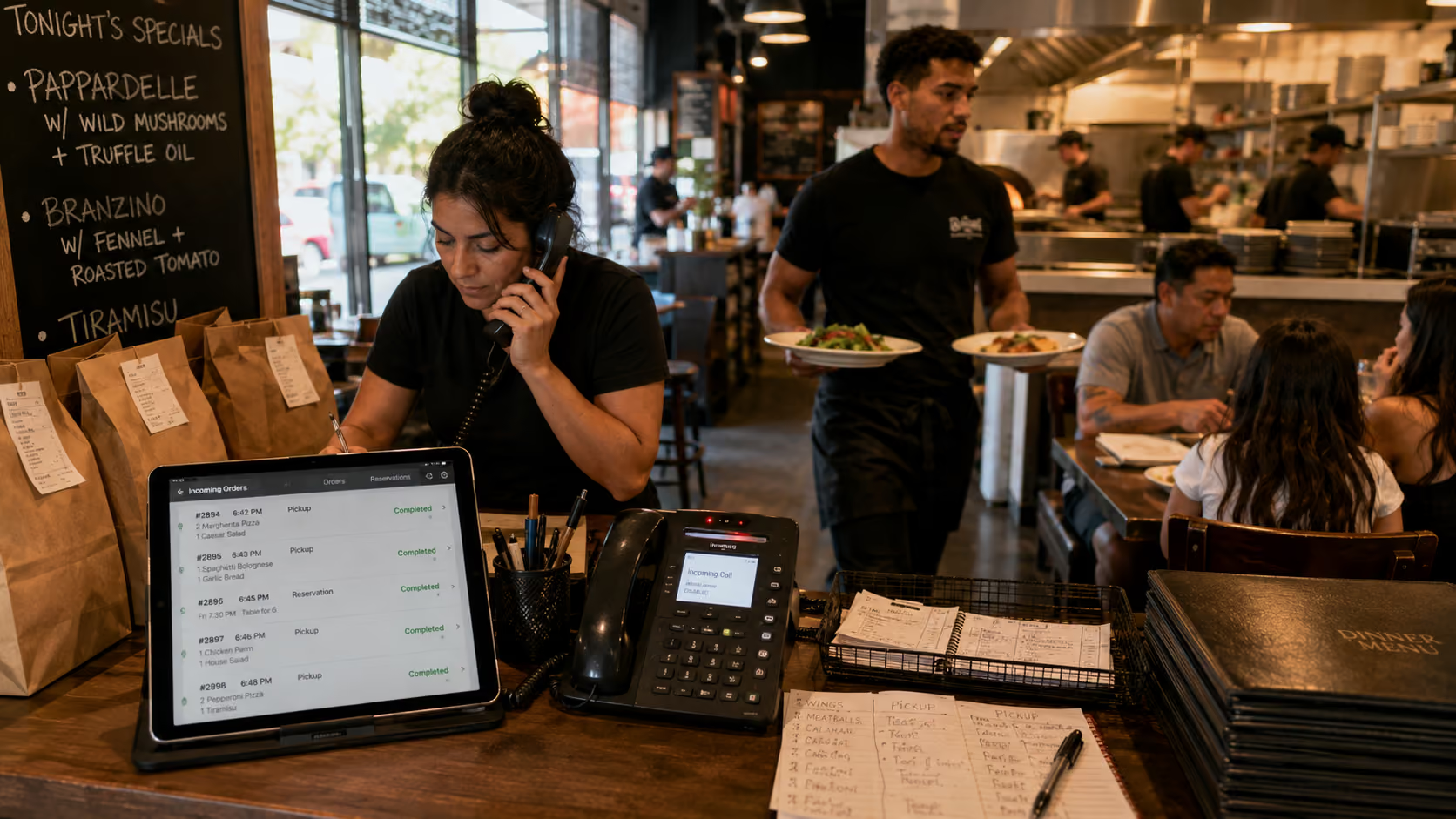
Phone calls have always been important for restaurants.
What changed is who, or what, is answering them.
For years the setup was the same. A customer calls. A staff member tries to get to it between taking an order, running food, and dealing with the table that just walked in. Sometimes they get there. Often they don't. The caller hangs up and the revenue disappears without a trace.
Voice AI for restaurants was built to fix exactly that. And in the last two years, it has moved from a niche experiment to a technology that independent operators are adopting faster than large chains. This article breaks down where voice agents stand today, where they are heading, and what that means for your restaurant in practical terms.
Where restaurant voice AI stands right now
The numbers are clear about how fast this has moved.
Voice AI adoption has reached 34% across restaurants in 2025, up sharply from just a few years ago. The market for voice AI in restaurants is projected to grow from $10 billion to $49 billion by 2029. And over half of restaurants now either use AI in their operations or plan to adopt itwith year-over-year adoption growing at 7 percentage points.
That growth is not coming from large chains moving slowly through procurement committees. It is coming from independent operators and small multi-unit groups who are facing a staffing crisis and cannot afford to keep losing calls.
The average annual restaurant staff turnover rate is 79.6%, and 45% of operators say they don't have enough staff. When you cannot reliably staff the phone, you cannot reliably capture revenue. That is the problem voice agents solve first.
What can today's voice agents achieve?
Current AI phone agents for restaurants handle the full phone conversation from start to finish. Not just routing. Not just reading out hours. The full thing.
A caller places an order with modifications. The agent takes it. A customer asks whether the risotto contains dairy. The agent answers from the menu. Someone wants to book a table for six on Friday at 7:30. The agent checks availability and confirms the booking. All of this happens without the call ever touching your front-of-house team.
The order goes directly into your POS. It prints in the kitchen the same way a server-entered order does. There is no manual re-entry. No errors from a rushed member of staff trying to write something down while managing three other things.
Today's systems also upsell consistently. Every call. Without forgetting. Without being too tired during the Friday rush to mention the new side dish. That consistency is where significant revenue sits, and it is one of the clearest financial gains from AI for restaurant operations.
For a direct comparison of how this differs from older IVR setups, IVR systems for restaurants vs voice AI covers the gap in detail.
Learn more about voice agents for restaurants in our video:
Why latency is the technical problem that matters most
Scott Stephenson, CEO of Deepgram, one of the leading speech recognition infrastructure companies powering voice AI, made a point worth understanding: real-time vs non-real-time is the defining technical debate in voice AI, not small models vs large models. And as he put it, latency is geography. You cannot route around it.
For restaurants this matters in a direct way. A voice agent with even a half-second lag on responses sounds wrong. Callers notice it. The conversation feels off. They lose trust in the system and ask to speak to someone.
The best voice agents in 2026 have closed this gap. Response latency is low enough that most callers do not know they are speaking to an AI unless they ask. That shift, from obviously robotic to indistinguishable from a trained staff member, is what moved this technology from a novelty to something operators actually rely on.
What's coming next for restaurant voice AI
The current generation handles inbound calls well. What's coming is a broader set of capabilities that will make the phone channel a fully managed revenue operation.
Memory and personalisation. Voice agents are beginning to recognize returning callers and recall past orders. A regular who always orders the same thing on a Thursday gets greeted accordingly. The AI can suggest their usual. It can flag that they haven't ordered in three weeks and mention a new dish they might like. This is the kind of interaction that currently only happens at a restaurant where the owner knows the regulars by name.
Predictive upselling. Rather than applying the same upsell script to every call, future systems will adjust based on order history, time of day, and current menu margins. In fact, Certus AI's automated phone ordering knows that if a caller always orders a specific pasta, suggesting the wine pairing that works with it, makes sense.
Outbound calling. The next step beyond inbound is restaurants using voice agents proactively. Confirming large reservations the day before. Following up on catering enquiries. Notifying customers that their table is ready. This turns the phone from a reactive channel into an active one.
Deeper POS and loyalty integration. Right now most systems push orders into a POS. What's coming is a tighter loop where the agent can also read from the POS, check loyalty balances, apply rewards on the call, and update customer records in real time. --> Read our Skytab POS Review.
Multilingual handling as standard. This is already available in some systems. It will become a baseline expectation. A bilingual AI phone system for restaurant takeout is no longer a premium add-on for operators in diverse neighbourhoods. It is a basic capability.
How voice agents affect the front-of-house team
One of the common concerns operators raise is whether voice AI removes the human element that makes a restaurant feel welcoming. The short answer is no, and understanding why matters.
Voice agents handle the transactional calls. Orders, reservations, hours, menu questions. These are calls where what the customer wants is accuracy and speed, not a conversation. The human element that matters to guests, the warmth of being seated, the recommendation from a server who knows the menu, the manager checking in mid-meal, none of that is on the phone.
What voice AI gives your team back is time and attention. Staff who are not tied to the phone during a rush can focus entirely on the guests already in front of them. That tends to improve service quality, not diminish it.
There is also a staffing cost angle that most operators underestimate. AI phone system costs vs hiring a host in 2026 lays out the numbers clearly. The math is not close.
The risk of adding technology that callers don't trust
Not all voice agents are built equally, and this matters. A poorly implemented system that mishears orders, gives wrong information, or handles modifications badly will damage customer trust faster than not having it at all.
Operators need to be aware that the restaurant answering service they choose represents their brand on every call. If the agent sounds robotic, gives incorrect menu information, or fails on a basic modification, that caller's experience of your restaurant gets worse, not better.
The selection criteria that matter are accuracy on complex orders, how the system handles edge cases it doesn't recognise, response latency, and how errors get flagged and corrected. A well-configured system improves with use. A poorly configured one creates problems that are hard to trace back to the phone.
Restaurants are adding more tech, customers are getting less happy is worth reading before any operator makes a decision. The point is not that technology is the problem. It is that technology deployed without proper setup and testing often creates friction rather than removing it.
What restaurants with high phone volume should do now
If your restaurant takes a meaningful portion of its orders by phone, here is how to think about this practically.
First, calculate what you are currently losing. Take your daily call volume, apply a 25% miss rate during peak hours, multiply by your average order value, and multiply by 365. That number is your baseline. For most restaurants doing moderate call volume, it comes out above $80,000 a year in revenue that is simply not being captured.
Second, test before you commit. Any credible voice AI provider will let you hear the system on a live demo call before you sign anything. Do that. Call it yourself. Place a complex order with a modification and a question. See how it handles it.
Third, check the POS integration before anything else. A voice agent that cannot push orders directly into your existing POS adds work rather than removing it. The integration should be confirmed before setup begins, not discovered as a problem after.
The operators who get the most from restaurant voice AI are the ones who treat the phone as a revenue channel worth managing, not just a communication tool. Once you measure what the phone brings in and what it misses, the case for automating it becomes straightforward.
The restaurant phone is becoming a managed revenue channel for voice agents
Secure AI phone ordering is no longer early-stage technology. Voice agents are live in thousands of restaurants today, taking orders, booking tables, and upselling on every call. The underlying infrastructure, driven by advances in real-time speech recognition and natural language processing, has closed the gap between what sounds human and what is AI.
What comes next, memory, predictive behaviour, outbound calling, tighter integrations, is already in development. The operators who are running these systems now will have a meaningful head start when those capabilities arrive.
If you want to see what a voice agent for restaurants looks like on a live call for your operation, book a demo with Certus and hear it answer the phone.

.svg)
.svg)
.svg)
.svg)