.svg)

.svg)


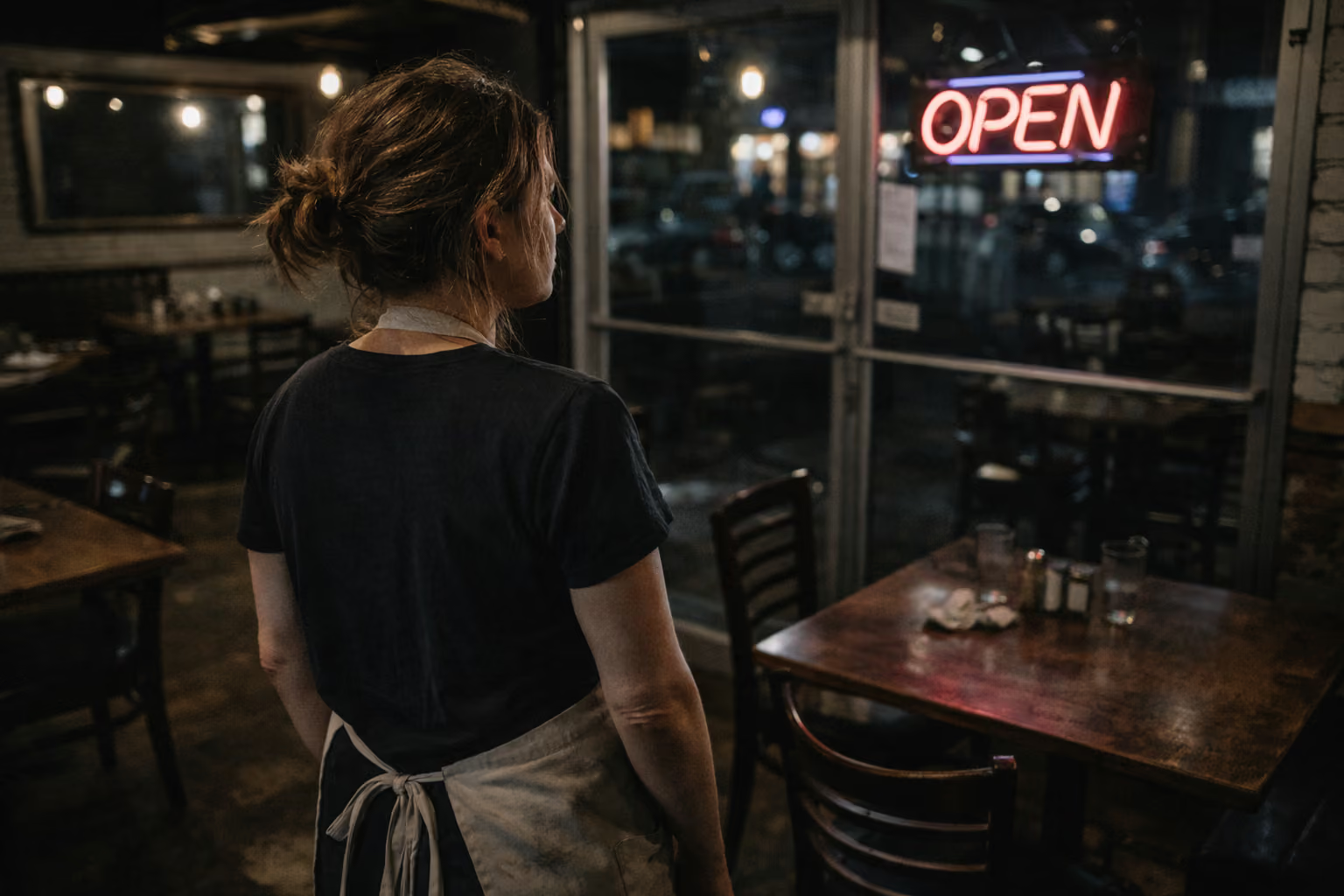
38% of diners are spending less: how restaurants fight back
Introduction: the new reality on the restaurant floor
You've felt it. The lunch rush that used to run until 1:30 p.m. now dies down by 12:45. The Friday night waitlist that stretched to 90 minutes is now just 30. Your regulars are coming in every other week instead of twice a week. This isn't just a feeling, it's the new reality for restaurants in 2026.
I grew up taking phone orders at my family's restaurants, and I've seen slow periods before, but this one feels different. The data confirms what you're seeing on your floor: 38% of consumers are now spending less at restaurants according to Q1 2026 data. The National Restaurant Association reports that over 60% of operators saw traffic declines as consumers cut back.
This started with lower-income households, but now middle-income consumers are joining them. The slowdown is spreading. But here's what I learned from operators who survived 2008 and 2020: the restaurants that make it through don't just cut costs and hope. They get sharper. They capture revenue others miss and maximize every single customer.
Why this matters: every dollar counts more than ever
When sales are down, every single dollar of revenue becomes exponentially more important for survival. With the National Restaurant Association projecting real sales growth of just 1.3%, your margins are under immense pressure from rising food, labor, and rent costs. This is a time to protect your profitability at all costs.
Most independent restaurants operate on thin 3-6% net margins. When sales drop 10% but your fixed costs stay the same, you might not be making 10% less profit, you might be making zero profit or even operating at a loss.
This is why missed opportunities hurt so much right now. Every unanswered phone call, every table that doesn't order dessert, and every regular customer who drifts away after one bad experience can have a big impact.
Know your true restaurant numbers
To survive a downturn, you must know your numbers cold, because you can't fix what you don't measure. Many operators think they know their finances, but "flying blind" by only checking bank balances or monthly POS reports is a recipe for disaster. The operators who thrive are the ones who track the right metrics weekly and understand the formulas that drive profitability.
I recorded a detailed walkthrough of the eight financial formulas that separate profitable restaurants from struggling ones. Watch this before you continue reading, then come back and apply these to your own numbers:
Why is tracking prime cost so critical?
Prime cost, which is your total food and labor cost, should be 60% or less of your total sales. If you only check this number monthly, you won't catch problems until you've already lost thousands of dollars. For example, a small price increase from a supplier can push your prime cost from a tight 62% to a dangerous 65%, costing you nearly $4,000 in profit on $100,000 in sales. Weekly tracking lets you catch this in week one and adjust immediately.
How do you calculate your break-even point?
Your break-even point is the minimum revenue you need to cover all your fixed and variable costs. Knowing this number transforms vague goals like "good sales" into concrete daily and weekly targets. Below this number, you're losing money. Above it, you're profitable. The video shows you the exact formula, a crucial tool for setting realistic goals when every sale counts.
What is missed revenue and how do you find it?
Missed revenue is the income you should be generating but aren't because of operational gaps, with the biggest culprit being unanswered phone calls. The formula is simple: (missed calls per day) × (average order value) × (days per month). If you miss 10 calls a day with a $35 average order, that's over $7,000 in lost revenue each month. This loss is invisible on any report, but it's real money walking out the door. Learning about strategic AI phone answering for restaurants can help you start to quantify and recover this loss.
Turn every customer interaction into revenue
When customer traffic is down, you must maximize the value of every person who chooses your restaurant. This means capturing every single order attempt, increasing the average check size through smart suggestions, and creating flawless experiences that build loyalty. You can't afford to let a single opportunity slip through the cracks.
How can you capture every phone order?
During peak hours, your phone is ringing, but your staff is buried. Industry data shows 43% of restaurant phone calls go unanswered, and most of those callers simply ring up your competitor. Missing just 10 calls a day at a $25 average order value adds up to $7,500 in lost revenue per month. This is a massive, self-inflicted wound.
This is where restaurant order automation with an AI phone agent becomes critical. An AI system answers every call instantly, 24/7, takes the order accurately, and sends it directly to your POS. No hold times, no missed calls, and no frustrated customers. For restaurants like Boardwalk Pizza, this approach freed up 195 hours of staff time and captured $70,000 in orders.
How does smart upselling lead to higher checks?
The difference between a 20% and a 50% upsell attach rate is enormous. On 100 phone orders a week, increasing your upsell rate from 20% to 50% on a $5 add-on can generate an extra $39,000 in annual revenue from the same number of customers. Human staff forget or feel awkward upselling, but an AI is consistent.
An AI phone agent that handles complex orders can suggest relevant pairings on every single call. "Would you like to add garlic knots to that pizza?" "Can I get you a side of ranch for those wings?" This consistency is key to maximizing your average order value without any extra effort from your team.
Why is protecting customer lifetime value essential?
A regular customer is worth thousands of dollars in lifetime value. Losing them because they couldn't get through on the phone is a devastating and preventable financial loss. Bad phone experiences, like long holds or incorrect orders, create friction that drives loyal customers to your competitors.
The restaurants that thrive deliver consistent, reliable experiences. While food and service can have off days, your phone system should work perfectly every time. This is why many restaurants are adding tech to fix customer friction points. A reliable ordering process builds trust, and trust builds lifetime value that will carry you through any downturn.
Cut smart, not just deep
When sales drop, the first instinct is to slash costs across the board, but this can backfire by hurting quality and driving more customers away. Instead of using an axe, you need a scalpel. The operators who survive downturns get surgical by identifying waste, eliminating low-profit activities, and doubling down on what actually makes money.
Menu engineering for profit
Menu engineering is the process of analyzing each dish's profitability and popularity. Most restaurants have menu items that are complex, use expensive ingredients, and don't sell well. These are profit killers. By identifying and removing a low-margin, high-effort dish and promoting a high-margin, popular one, you simplify operations, lower food costs, and improve overall profitability.
Shifting to direct ordering channels
Third-party delivery platforms charge 15-30% commission on every order, which can wipe out your profit margin. If you do $40,000 a month in third-party delivery, you could be paying $10,000 in fees. Shifting even half of that volume to direct orders through your website or phone line saves you $5,000 a month. Encourage direct ordering with small incentives and make your phone line flawlessly efficient.
Tightening food cost tracking
If you only track food costs monthly, you're always looking at old data. By the time you spot a price increase from a supplier, you've already lost significant profit. Shifting to weekly food cost tracking allows you to react instantly to price changes or waste, protecting your margins in real time. This is a key discipline that separates the pros from the amateurs, much like how Domino's uses technology to track everything.
The operators who survived got sharper
History shows us that economic downturns, like the ones in 2008 and 2020, are crucibles that forge stronger businesses. The operators who made it through didn't just endure the pain, they used the pressure to innovate, streamline, and eliminate operational fat they had ignored in good times.
This moment is no different. The current challenge isn't just a threat, it's an opportunity to re-examine every part of your business. It forces you to know your numbers, to value every customer, and to adopt tools that create real efficiency. The operators who embrace this mindset will not only survive, they will emerge from this period leaner, smarter, and more profitable than ever before.
Frequently asked questions about navigating a restaurant downturn
How quickly can I see results from these strategies?
Financial tracking strategies like monitoring prime cost can show you where you're leaking profit within the first week. Implementing an AI phone agent to capture missed calls can recover lost revenue on day one, with some restaurants recovering over $8,000 in the first month. Menu engineering may take a few weeks to show a clear impact on your bottom line.
Is investing in new tech worth it when sales are down?
Yes, if it provides a clear and immediate return on investment. The key is to avoid tech that is just a "nice to have" and focus on solutions that directly solve a financial problem. For example, an AI phone system that costs a few hundred dollars a month but recovers thousands in lost orders pays for itself almost instantly, making it one of the best AI phone ordering systems for small restaurants.
What's the single most important number I should track right now?
Your weekly prime cost (food + labor as a percentage of sales). This number is the ultimate health metric for a restaurant. If your prime cost is creeping above 60-65%, you are likely unprofitable, and you need to take immediate action on your menu, pricing, or staffing.
How do I balance cost-cutting with maintaining quality?
Focus on cutting waste, not quality. Use menu engineering to remove low-profit, high-cost items rather than buying cheaper ingredients for your bestsellers. Shift customers from high-commission third-party apps to direct ordering channels. Automate repetitive tasks like answering phones to free up staff to provide better in-person service, replacing frustrating legacy IVR systems with modern AI phone agents.
About the author & next steps
Gurveer Singh is the CEO and co-founder of Certus AI, a Y Combinator-backed company dedicated to helping restaurants turn every phone call into revenue. Growing up in his family's restaurant business, he saw firsthand how missed calls and operational bottlenecks cost operators thousands. He founded Certus AI to solve that problem with an intelligent, autonomous voice AI that never misses a call.
The restaurants that survive and thrive in this new economy will be the ones that get sharper. They will use data to make decisions and technology to capture every dollar.
If you're ready to stop losing revenue to a ringing phone, book restaurant voice AI demo to see how Certus AI can help you recover thousands in missed orders and improve your operational efficiency.

.svg)
.svg)
.svg)
.svg)