.svg)

.svg)


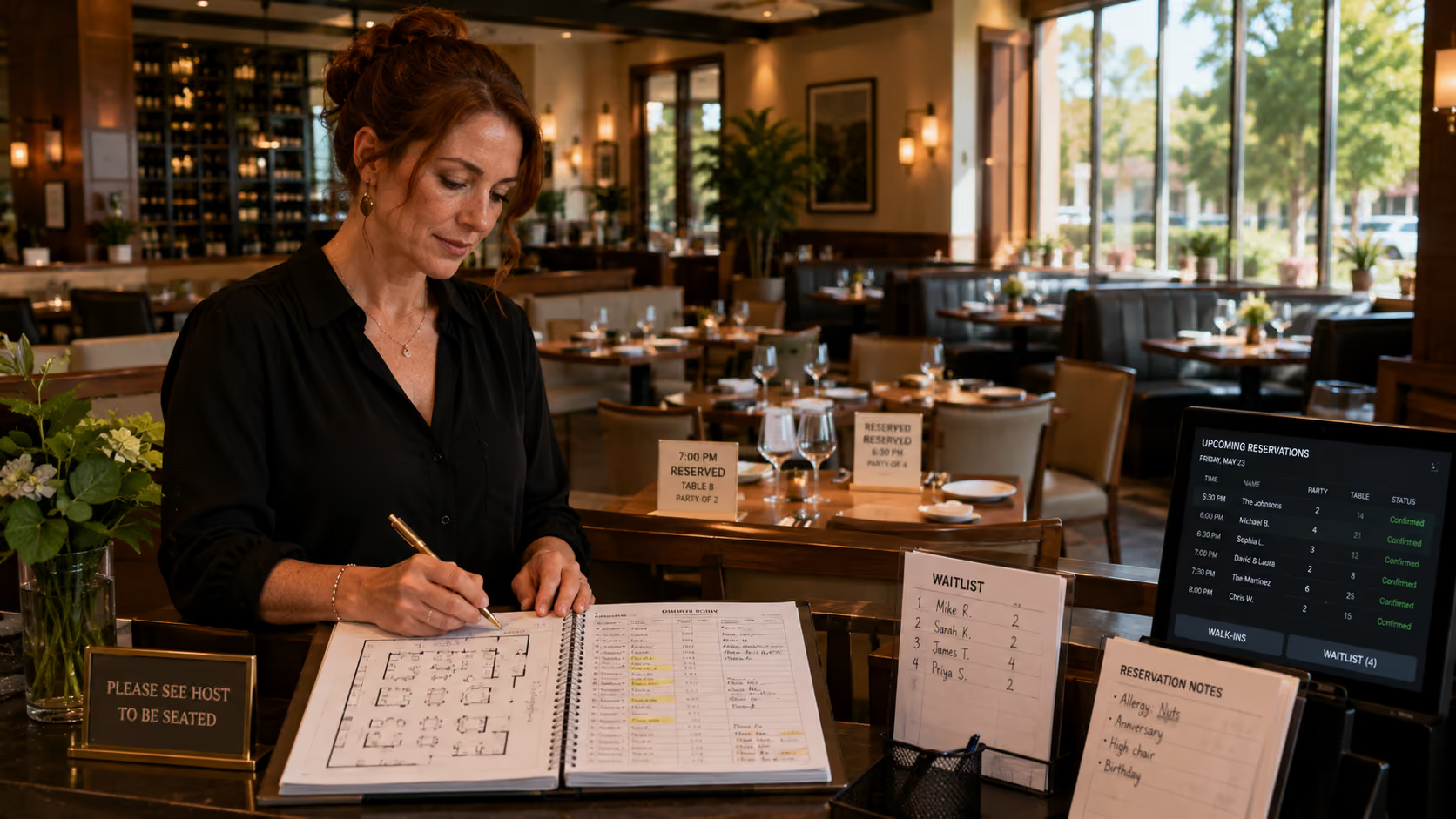
A table sitting empty because of a no-show costs you money twice. You turned away a walk-in to hold that spot, and now it sits dark through half a service. Multiply that by a few nights a week and the numbers get painful fast.
Reservations management is one of the most underestimated levers in a restaurant's operation. Done well, it fills your dining room consistently, reduces no-shows, and keeps your front-of-house team running smoothly. Done poorly, it creates chaos, frustrates guests, and bleeds revenue you never even see leaving.
This guide covers the strategies that work best in 2026, from the basics of booking policy to how restaurant AI technology is changing what is possible for independent restaurants and growing groups alike.
TLDR
Effective reservations management means having the right booking policy, reducing no-shows through confirmations and deposits, handling phone reservations without pulling staff off the floor, and using data to fill slow shifts.
AI tools, particularly voice agents and integrated phone systems, are making it much easier to capture reservations around the clock without adding headcount. The restaurants that implement good reservation management strategies can fill more covers, turn tables faster, and build more loyal regulars.
Why reservations management is important for restaurants
Missed and mishandled reservations are a daily revenue leak for most full-service restaurants. According to Toast's Q3 2024 Restaurant Trends Report, 17% of reservations were cancelled in that quarter, down from 19% the year before. That is real progress, but it still means nearly one in five bookings does not show up as planned.
In that same report, 45% of reservations were made for the same day, which means guests are becoming more spontaneous. Your reservation system needs to handle last-minute bookings just as smoothly as ones made a week out.
Toast's Q3 2025 data showed seated reservations up 8% year-over-year, but cancellations also rose 7%. More people are booking, and more people are bailing. Getting ahead of that pattern is one of the most valuable things a restaurant operator can do right now.
What does a solid reservation policy look like?
Before you touch any software or automation, you need a clear policy. Without one, your team makes different calls on different nights and guests learn nothing consistent about what to expect from you.
A good restaurant reservation policy covers:
- Booking window: How far in advance can guests book? Most casual dining restaurants do well with a two to four week window. Fine dining may go further.
- Party size limits: Set a maximum party size for standard reservations. Larger groups should go through a separate inquiry process.
- Hold time: How long will you hold a table? Twelve to fifteen minutes is standard. Communicate it at booking confirmation.
- Cancellation window: Give guests a clear deadline to cancel without a fee. 24 to 48 hours is reasonable and widely accepted.
- No-show and late cancellation fees: Credit card holds at booking reduce no-shows significantly. The growing number of restaurants implementing cancellation fees is widely credited with driving down no-show rates in recent years.
Write this policy out, put it on your booking confirmation email, and brief your team on it so it is applied consistently every night.
How to reduce no-shows without frustrating your guests
No-shows are not fully preventable, but they are manageable. The right combination of friction at booking and communication before the visit brings them down sharply.
Require a credit card to hold the booking.
This single step filters out casual bookings made by guests who were never fully committed. You do not have to charge it unless they no-show. The act of entering payment details creates enough commitment to change behavior.
Send automated confirmation messages.
A confirmation email right after booking, followed by a reminder 24 hours before and another two hours before service, keeps the reservation front of mind. Most guests who forget they had a booking would have cancelled if reminded in time. This can be automated easily by using an AI agent for restaurants.
Make cancellation easy.
The easier it is to cancel, the more guests will do it instead of just not showing up. A one-click cancellation link in your reminder email costs you nothing and recovers your table faster.
Waitlist open slots in real time.
When a cancellation comes in, your system should automatically notify waitlisted guests. If you are doing this manually, you are too slow. By the time a host calls through a waitlist, the window is often gone.
What is the best way to handle phone reservations in a busy restaurant?
Phone reservations are where most restaurants lose the most ground. A guest calls during dinner service, nobody picks up, and they book somewhere else.
Most diners book online these days, but a meaningful share still calls. For group bookings, special occasions, and catering inquiries, the phone remains the primary channel. Missing those calls is not a minor operational hiccup. It is lost revenue.
An AI receptionist for restaurants solves this directly. A voice agent answers every call, regardless of what is happening on the floor. It collects party size, date, time, and contact details, checks availability in real time, and confirms the reservation without any staff involvement. The booking goes straight into your system.
This is especially valuable during peak hours, when your team is least able to answer the phone but most likely to receive high-intent calls. Unlike a human host, a voice agent never puts a caller on hold or misses a booking detail under pressure. For more on how this works day to day, see our post on AI receptionists for restaurants.
How to fill slow shifts using reservation data
Most restaurants have a predictable shape to their week. Fridays and Saturdays fill themselves. Tuesdays and Wednesdays need work. Your reservation data tells you exactly what that shape looks like and gives you a place to start.
According to Toast's Q3 2024 Restaurant Trends Report, same-store reservations rose 11% on Mondays and Tuesdays and 8% on Wednesdays year-over-year. Weeknight dining is growing, but it needs to be encouraged. Guests are not going to fill your Tuesday night on their own without a reason.
A few strategies that work:
- Weeknight-only offers: A fixed-price menu or a featured pairing available only Sunday through Thursday gives guests a reason to come on a slow night rather than waiting for the weekend.
- Early bird slots: Toast's Q3 2025 report found that the 4 p.m. early bird slot saw a 15% year-over-year jump in reservations. Earlier dining is growing. Promote it actively.
- Last-minute availability posts: A quick Instagram story showing open tables for tonight drives same-day bookings from guests who are already deciding where to eat.
- Email your regulars first: Before a reservation opens to the public, give your email list 24 hours of early access. It rewards loyalty and fills covers fast.
Choosing the right reservation system for your restaurant
The right platform depends on your volume, your budget, and what you need it to do. Here is a practical breakdown.
- Independent casual dining (under 80 covers): OpenTable, Resy, or a simple Google booking link
- Growing independents and multi-location groups: SevenRooms or Tock for deeper guest data and CRM
- QSR or fast casual with light reservation needs: Google Reserve or a basic online form
- Full-service with heavy phone traffic: Any of the above plus a voice AI layer for phone bookings
No platform handles phone calls well on its own. That channel requires a separate solution, which is where an AI phone system for restaurants becomes essential for full-service restaurants that still rely on phone reservations. Most booking platforms focus on the online side and leave the phone entirely to your staff.
If you are running Square POS and looking for a voice AI that integrates directly, see how Dirty Bird stopped losing phone orders on Square POS.
How does AI for restaurant management help with reservations specifically?
AI for restaurant management is a whole category of tools that handle specific tasks automatically.
For reservations, the most useful applications are:
Voice agents for phone bookings. As covered above, these answer calls, collect booking details, confirm availability, and complete the reservation without staff involvement. This is the highest-impact use case for most restaurants.
Automated confirmation and reminder sequences. AI-powered messaging tools send the right message at the right time without anyone manually scheduling them. Confirmations go out immediately. Reminders go out on schedule. Cancellation links are always included.
Waitlist management. When a table opens, AI can notify the first available waitlisted guest automatically, fill the slot, and update the floor plan, all without a host making a phone call.
Multilingual booking support. In markets with diverse guest populations, handling reservations in multiple languages is a real operational challenge. An AI phone agent handles this without needing multilingual staff. Our post on bilingual AI phone systems for restaurants goes deeper on this.
What should a restaurant do when a no-show happens anyway?
Even with the best systems in place, no-shows happen. Having a clear process for when they do protects your revenue and keeps your team from scrambling.
- Hold the table for your stated window, then release it. Do not hold longer out of goodwill. Your policy exists for a reason.
- Charge the no-show fee if you have one. Apply it consistently, not selectively. Inconsistency creates resentment from guests who did pay.
- Check your waitlist immediately. A released table at 7:15 p.m. can still be filled if your process is fast.
- Log the no-show in your guest profile. If you are using a CRM-enabled reservation platform like SevenRooms, this data matters. Repeat no-shows can be flagged and required to prepay on future bookings.
- Review patterns monthly. If no-shows cluster on certain nights or time slots, that is useful information. It might point to overbooking, poor confirmation timing, or a specific channel that is attracting low-commitment guests.
Building a reservations system that works at full service speed
The best reservations management is invisible during service. Guests arrive on time, tables are ready, the host is not scrambling, and the kitchen knows what to expect. Getting there requires the phone, the booking platform, and your team protocols to work together.
For most restaurants, the weakest link is the phone. It is the channel with the least automation, the most dependency on available staff, and the highest risk of a missed booking during peak hours.
A restaurant answering service built on voice AI closes that gap without adding a person to the payroll. Every call gets answered. Every reservation gets logged. Your host focuses on the guests already in the building.
If you want a wider view of which technology investments are worth prioritising this year, our guide to running a successful restaurant in 2026 covers the full picture.
Automate your reservations
Every no-show, missed call, and empty table during a slow Tuesday is a problem that has a solution. The tools exist. The strategies are proven. The only thing left is putting them in place.
If you want to see how Certus AI handles phone reservations for your restaurant automatically, book a free demo here. You will see exactly how it works with your current setup, and you can have it running within a week.

.svg)
.svg)
.svg)
.svg)