.svg)

.svg)


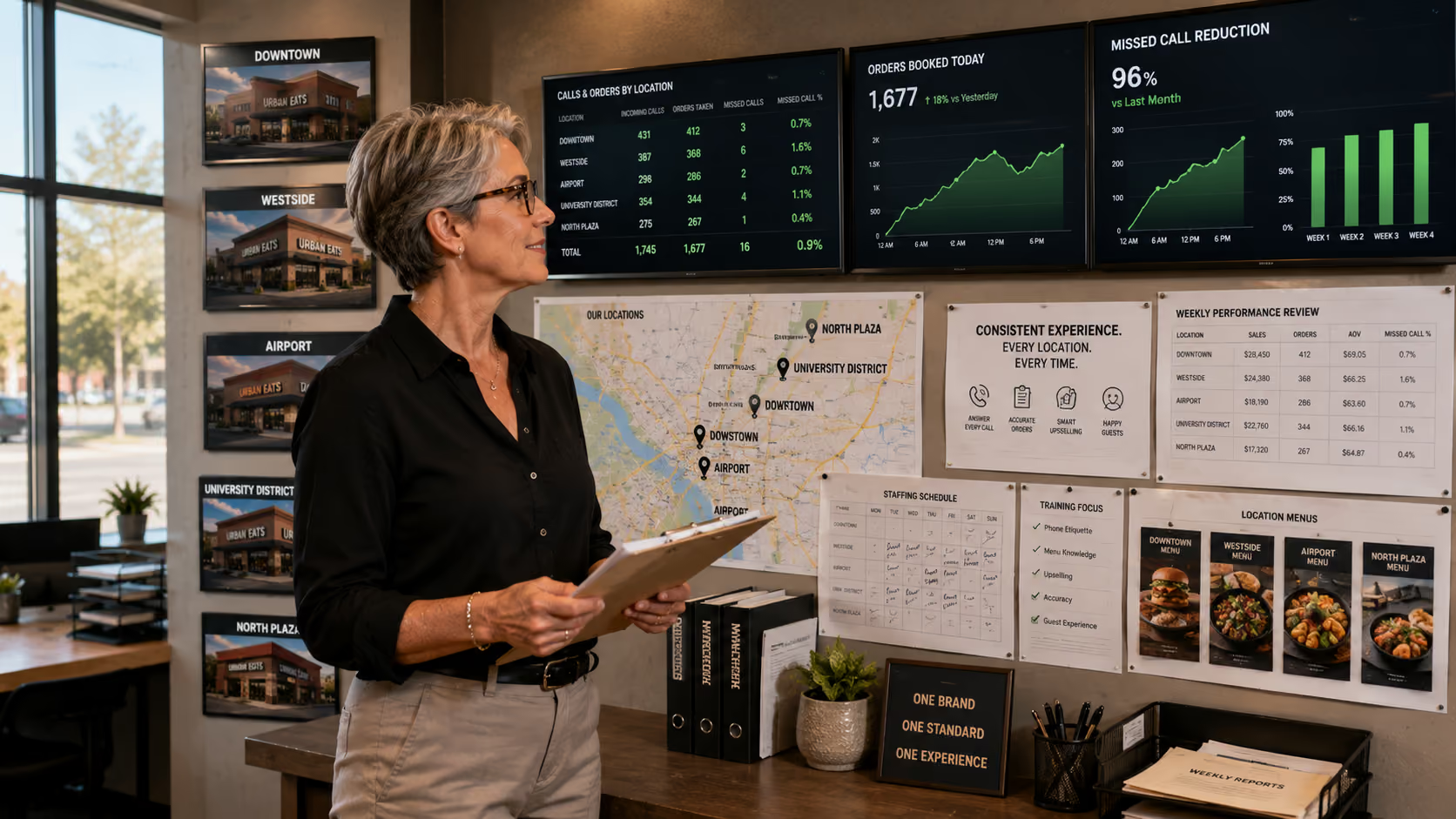
Running one restaurant is hard. Running three, five, or ten is a different problem entirely.
When you have multiple locations, phone calls become a liability instead of an asset. Each site handles calls differently. Staff levels change. Peak hours hit at different times. And every missed call at every location quietly drains revenue you never even see leaving.
That's the core problem restaurant voice AI was built to fix.
What restaurants with multiple locations mean for your phone line
A single busy restaurant gets between 800 and 1,000 calls per month, according to 2024-2025 data. Scale that across five locations and you're looking at up to 5,000 calls a month that your team needs to handle perfectly.
They won't. Not even close.
During peak hours, the missed call rate in restaurants sits at 30 to 47%, based on the same dataset. That means almost half of your callers are hitting silence, getting put on hold, or calling a competitor. Across five locations, those losses stack up fast.
The problem here is that humans can't answer a ringing phone while managing in-person guests, expo, and the front counter at the same time.
Why phone consistency breaks down across locations
When every location manages its own calls, you lose control over the guest experience the moment someone dials in.
- One location answers every call. Another misses half of them during the dinner rush.
- Upselling is done by some staff and skipped entirely by others.
- One manager trains the team on phone etiquette. The next one doesn't bother.
- A location with high turnover resets its call quality every few weeks.
The result is a brand that feels inconsistent. Guests who love your food at one location call another and get a completely different experience. That breaks trust, and more importantly, it costs real money.
How much revenue is at risk per location?
A February 2025 Breez study found that 43% of restaurant calls go unanswered. For a typical mid-volume restaurant, that adds up to roughly $12,000 in lost revenue per location, per year.
Multiply that across three locations and you're looking at $36,000 in annual revenue walking out the door. Across ten locations, it's over $100,000.
Hiring more people won't fix it. You need a system that answers every call, every time, without relying on whoever happens to be free.
What is restaurant voice AI, and how does it work across locations?
A restaurant AI phone system replaces or supplements your front-of-house phone handling with an AI voice agent. The AI picks up every call instantly, takes orders directly into your POS, handles reservations, answers menu questions, and upsells automatically.
The key difference for multi-location operators is this: the same AI behavior runs at every site. Same upsells. Same tone. Same accuracy. Whether a guest calls your downtown location or your suburban one, they get the same quality experience.
With Certus AI, setup is completed the same day for each location. There's no new hardware. Your existing phone number stays the same. You just forward calls to Certus during rush hours, or all day, and the system handles everything from there. Book a free demo call to learn more.
Operational benchmarks to know before you deploy
Before committing to any voice AI rollout, it helps to know what realistic performance looks like:
| Metric | Without voice AI | With voice AI |
|---|---|---|
| Peak-hour missed call rate | 30–47% | Under 5% |
| Order accuracy | Variable (staff-dependent) | 95–99% |
| Average hold time | 3–8 minutes | Near zero |
| Staff hours spent on calls per week | 10–15 hours | 1–2 hours (overflow only) |
| Deployment time per location | N/A | Same day |
The staffing savings alone are significant. If your front-of-house spends 12 hours a week on phone calls across a three-location group, that's 36 hours per week you can redirect to in-person service.
How to handle peak-hour call volume at scale
Peak hours are where multi-location operators bleed the most. A busy Friday at 7pm means every location is slammed at once. Your staff can't split attention between the person standing in front of them and the phone ringing behind the counter.
A restaurant answering service built on voice AI solves this because it has no capacity ceiling. One location getting 30 calls in an hour or 100, the AI answers every single one without delay.
For operators running QSR or fast-casual formats, this is especially critical. According to a 2024-2025 analysis of 500,000 restaurant calls, AI phone systems deliver an 87% reduction in missed calls during peak hours compared to live staff handling phones.
If you're running multiple locations and your peak hours overlap, the math is simple. You either need voice AI, or you keep losing orders.
Does voice AI work for bilingual customers?
Yes. This matters more than most operators acknowledge.
If your locations are in areas with a high Spanish-speaking population, or customers who speak other languages, a bilingual AI phone system is not a nice-to-have. It's a revenue decision.
A bilingual AI phone system for restaurants can handle calls in English and Spanish without transferring the caller or putting them on hold. The AI detects the language naturally and responds accordingly.
For multi-location groups, this also removes a training variable. Instead of hoping every location has a bilingual staff member available during rush, the AI handles it at every site, every time.
What to look for in a voice agent for multi-location restaurants
Not every voice agent for restaurants is built for scale. Here's what actually matters when you're running multiple sites:
POS integration per location
Each site likely has its own POS terminal. Your voice AI needs to inject orders into the right system at the right location without manual routing. Certus integrates directly with Toast, Square, Clover, and other major platforms.
Location-specific menus
If your downtown and suburban locations have different menus or pricing, your AI needs to handle that. A generic system will cause order errors. A well-built one handles location-specific menus automatically.
Centralized analytics
You need one dashboard that shows call volume, order capture rate, missed calls, and upsell performance across all sites. Without this, you're managing performance blindly.
Call overflow control
Some operators want AI to handle all calls. Others want it to handle overflow only. Your system should support both, with simple controls per location.
Reservation and event handling
If any of your locations take reservations or host events, your voice agent needs to manage those inquiries without routing them back to a human every time.
How to roll out voice AI across multiple locations
A phased rollout is the most practical approach for groups with three or more sites.
Step 1: Start with your highest-volume location. Pick the site that takes the most calls and has the most to gain from AI coverage. This gives you clear before-and-after data.
Step 2: Configure menus and hours per location. Each site needs its own setup, including menu items, modifiers, hours, and POS connection.
Step 3: Set your call forwarding rules. Decide whether AI answers all calls, or only when staff don't pick up within two rings. Most operators start with the latter.
Step 4: Monitor the dashboard for the first two weeks. Track call volume, missed calls, average order value, and upsell acceptance. Adjust upsell prompts based on what's working.
Step 5: Roll out to remaining locations. With a working template from location one, each additional site takes less time to configure.
With Certus, most locations are live the same day of onboarding. You don't need an IT team or new infrastructure.
Is a restaurant answering service worth it for smaller groups?
Even if you're running two or three locations, the revenue math holds. Read our full breakdown on whether a restaurant answering service is worth it if you're still weighing the decision.
The short version: if you're missing calls during peak hours, you're losing orders. AI pays for itself when it captures orders that would otherwise go unanswered.
And the compounding effect matters for smaller groups too. Recovering $3,000 a month across two locations is $72,000 per year. That's not nothing.
What about security and order accuracy?
Order accuracy is a common concern when switching from human to AI phone handling. In practice, AI systems trained on your specific menu consistently outperform staff in accuracy, especially for complex customizations or high-volume ordering periods.
If you process payments over the phone, security compliance also matters. Read how AI phone ordering handles PCI compliance to understand what to look for.
How franchises and growing groups are using voice AI in 2026
Franchise operators face a unique version of this problem. Franchisees control their own operations, which means phone quality varies even more than in company-owned groups.
Deploying a voice AI for scaling franchises across the network creates a consistent phone experience at the brand level, without requiring franchisees to change their operations. The AI handles the calls. Franchisees benefit from the revenue recovery. Corporate gets visibility into performance.
For brands that are actively growing, this also removes phone handling as a bottleneck to expansion. Opening a new location no longer means hiring and training a call handler. The AI is live the same day.
Modernize your multi location restaurant with Voice AI
Every week you run multiple locations without a voice AI solution is another week of compounding missed calls.
At a 40% peak-hour miss rate across five locations, you could be losing 200 to 400 orders a week to unanswered phones. At an average order value of $40 to $50, that's $8,000 to $20,000 in weekly revenue walking away.
The operators who move on this now are building a real edge. Faster response times, higher call capture rates, and consistent upselling at every location create a compounding revenue advantage over time.
If you're ready to stop the leak, book a demo with Certus AI and see how quickly your locations can get live.

.svg)
.svg)
.svg)
.svg)