.svg)

.svg)


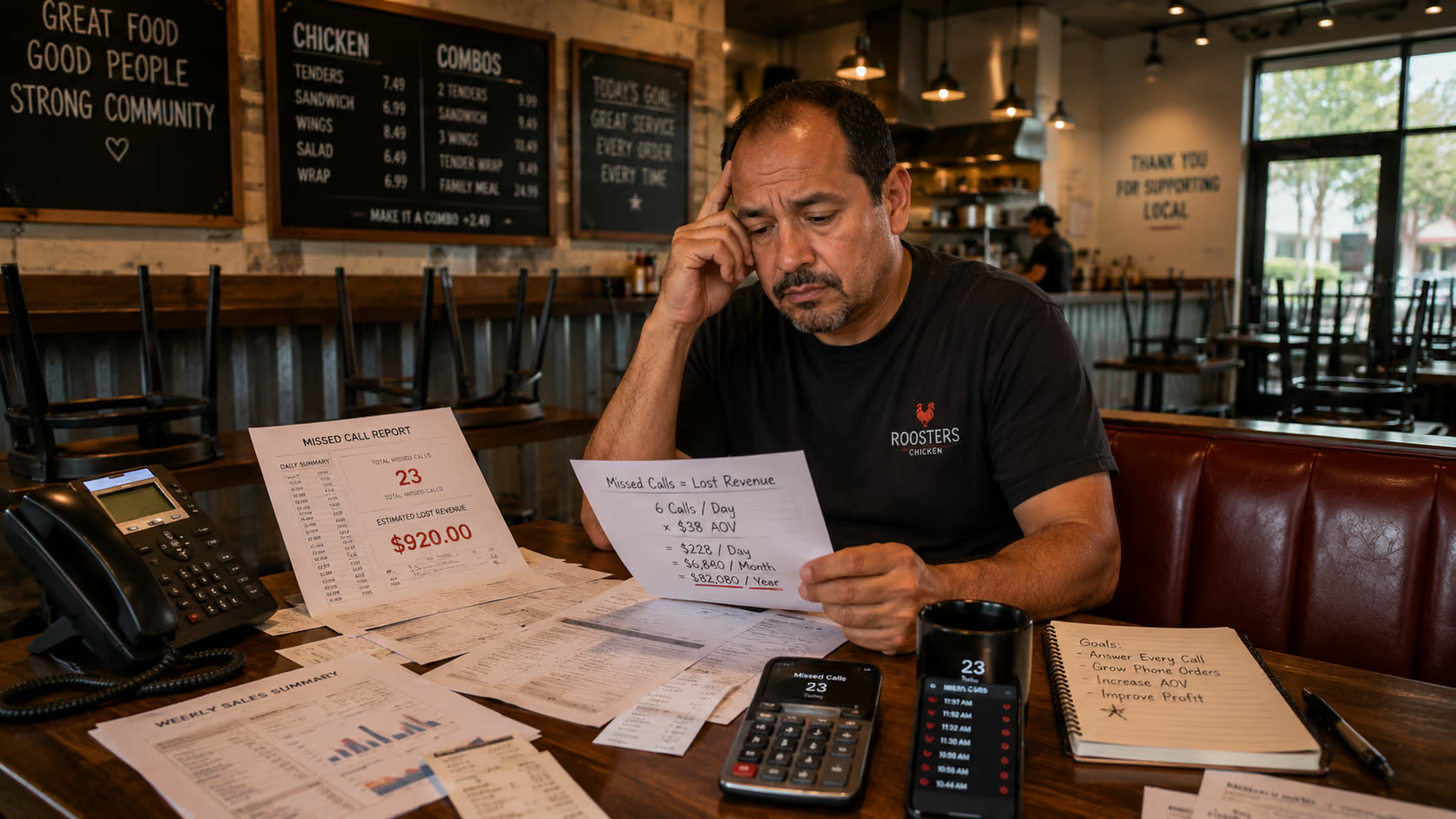
If your restaurant takes phone orders, you are almost certainly missing some of them. Not because your staff are bad at their jobs, but because calls can come in at any moment. The fryer needs attention, the counter has a queue, and the phone rings for the fourth time in ten minutes. Something gives.
A restaurant answering service is designed to make sure the phone is never the thing that gives. But whether it is worth the cost depends on your call volume, your average order value, and what you are currently losing. This article breaks it down so you can make the call yourself.
What is a restaurant answering service?
A restaurant answering service handles inbound calls on behalf of your restaurant. The traditional version is a human call centre that picks up when your staff cannot. The modern version is an AI-powered voice agent for restaurants that answers instantly, takes the full order, and pushes it directly into your POS.
The key difference between the two matters a lot operationally:
A human answering service can take a message or relay basic info. An AI system completes the transaction. For a restaurant that lives on order volume, that distinction is everything.
Do you lose revenue because of missed calls?
According to Invoca's 2024 Call Intelligence Report, businesses across industries miss between 20% and 30% of inbound calls during peak periods. For restaurants, that number is often higher because peak call times overlap directly with peak service times.
Run a simple estimate for your own restaurant:
- How many calls do you receive per day? (estimate 20 as a starting point for a busy takeout operation)
- What percentage of those result in an order? (industry average sits around 65 to 70%)
- What is your average order value?
- How many calls do you think you miss during rush hours?
If you miss 6 calls a day at an average order value of $40, that is $240 in lost revenue daily. Over a month at 26 trading days, that is $6,240. Per year, over $74,000.
How much does a restaurant answering service cost?
Costs vary significantly depending on the type of service:
Human call centre services typically charge per minute or per call. For a restaurant taking 30 to 50 calls per day, monthly costs can range from $400 to over $1,500, and the service still cannot push orders into your POS directly.
AI-powered restaurant answering services typically run on a flat monthly fee. Setup is faster, the system handles unlimited concurrent calls, and orders go straight to the kitchen.
The better question is not what the service costs. It is what the service pays back. A restaurant answering service that recovers 6 missed orders a day at $40 each generates over $6,000 in recovered revenue per month.
Does restaurant voice AI improve order accuracy?
Yes, and this is an underrated benefit.
When staff take phone orders under pressure, mistakes happen. Wrong modifiers, missed add-ons, incorrect quantities. Each error costs time and often a refund or a remake.
An AI-based restaurant phone answering system reads back the full order before confirming it, every single time. There is no rushing, no distraction, no mishearing. Leading platforms report order accuracy rates above 95% on well-trained menus.
For a high-volume QSR or pizza operation where order errors are a daily occurrence, that accuracy improvement alone has real financial value.
How does a restaurant phone systemhandle peak hours?
This is where AI has a structural advantage over any human-based solution.
A human can handle one call at a time. Your busiest periods, Friday evenings, Saturday lunch, the hour before close, are exactly when calls stack up and staff are least available to answer them.
An AI phone agent handles every incoming call simultaneously. There is no queue from the caller's perspective. The phone is answered on the first or second ring, the order is taken, and the call ends. The next call starts immediately on a separate line.
For a restaurant receiving 40 to 60 calls on a busy evening, this means zero missed calls during the period that generates the most revenue. That is the core operational case for restaurant AI technology.
Automated upselling with AI
Most human answering services do not upsell at all. Call centre agents are focused on capturing the order and moving on.
AI systems built for restaurants upsell every single order. Not aggressively, but contextually. If a customer orders a large pizza, the system suggests a side that pairs well. If someone orders two mains, it mentions a dessert that is popular right now. The suggestion is natural, timed well, and based on real menu logic.
According to restaurant operators using AI upselling, average order value increases of 10 to 20% are common once the system is trained and running. For a restaurant with $40 average orders, that is $4 to $8 added per transaction across every phone order taken.
For a deeper look at how this works, read the full guide on automated upselling for restaurants.
Is a restaurant answering service worth it for a single-location operator?
Yes, if phone orders are a meaningful part of your revenue.
Single-site operators are often the most exposed to missed call losses because they have the least staffing redundancy. One person on the counter, one in the kitchen, and the phone ringing during a rush is a daily reality.
The ROI calculation is straightforward. If you are taking 20 or more calls per day and missing even 20% of them, an AI answering service pays for itself quickly. Most operators see payback within the first few weeks of going live.
The strategies that make restaurants profitable consistently include tightening the gaps in inbound revenue capture. The phone line is one of the biggest gaps most operators are not actively managing.
Is a restaurant answering service worth it for multi-location groups?
Even more so.
Multi-location operators compound the problem. Each site is missing calls independently. The revenue leak is multiplied by the number of locations. And there is no visibility into how much is being lost because nobody is tracking it.
An AI-based restaurant answering service gives you a central dashboard showing call volume, orders placed, calls missed, and peak hour patterns by location. That data alone changes how operators manage their phone channels.
Franchise groups and multi-site QSR operators are among the fastest adopters of AI phone agents in 2026, precisely because the ROI scales with location count. For a full comparison of leading platforms, see best AI phone agents for QSRs.
AI answering service vs IVR system for restaurants
IVR systems (the press 1 for orders, press 2 for reservations type) have been around for decades. They are cheap and widely used. They are also widely disliked by customers.
The core problem with IVR is that it creates friction at the exact moment a customer is ready to spend money. Callers hang up, call back later, or just order from somewhere else.
An AI voice agent holds a real conversation. It asks what the customer wants, answers questions about the menu, handles modifications, and confirms the order before ending the call. Customers do not have to navigate a menu tree.
For operators still running IVR, the switch to AI typically results in a meaningful lift in call completion rates. The full comparison is covered in IVR systems vs voice AI for restaurants.
Key benchmarks: what to expect from a restaurant answering service
These are operational benchmarks based on real restaurant deployments. Results vary by call volume, menu complexity, and order type.
What ROI indicators should you track once you go live?
Going live with an AI answering service is the start, not the finish. Track these five metrics from day one:
- Total calls answered vs total calls received (aim for 100%)
- Call-to-order conversion rate (what percentage of answered calls result in a placed order)
- Average order value (is it rising with AI upselling active?)
- Peak hour call completion rate (are you capturing orders during your highest-volume periods?)
- Staff time freed from phone duties (are your team able to focus on in-person service?)
For a full breakdown of how to measure ROI on voice AI, the 5 key voice AI ROI indicators guide covers each one in detail.
Getting the most out of a restaurant answering service
You are a good fit if:
- You take more than 15 phone calls per day
- You know you are missing calls during rush periods
- Your staff are regularly pulled between the counter and the phone
- You have no visibility into call volume or missed call rates
- You want orders in the POS automatically without manual entry
- You run multiple locations and need consistency across sites
You are probably not the right fit yet if:
- Your restaurant is almost entirely walk-in with very few phone orders
- You are pre-launch and do not yet have call volume data
- Your POS is not yet connected to any third-party tools
A restaurant answering service is worth it when it is connected to your POS, trained on your menu, and actually capturing orders rather than just logging missed calls. The financial case is strong for any operator with meaningful phone order volume.
If you want to see exactly how much revenue your restaurant is likely losing to missed calls right now, and what an AI system would recover, book a demo with Certus AI.

.svg)
.svg)
.svg)
.svg)