.svg)

.svg)


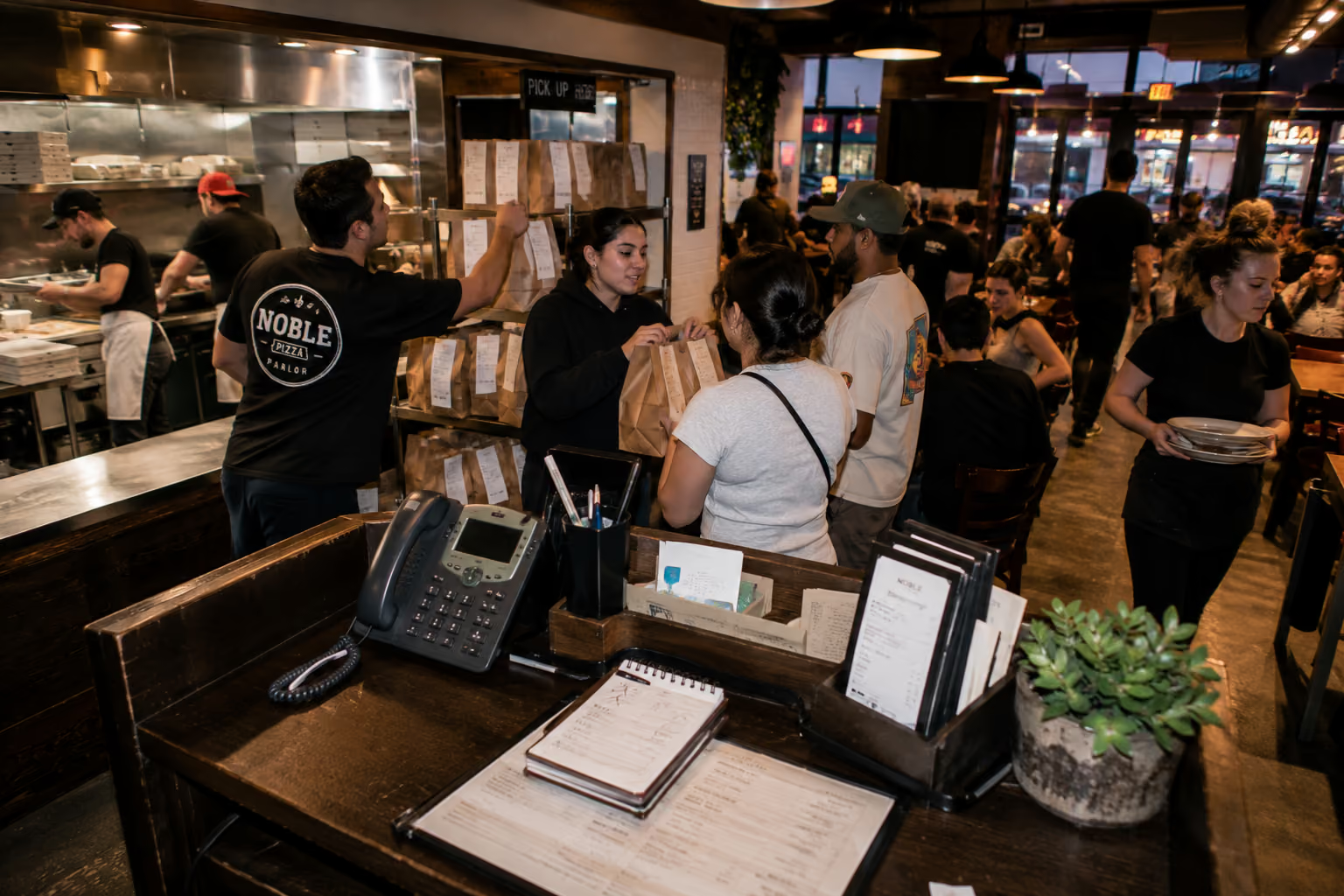
The phone industry has been selling restaurants a product built for offices for thirty years, and it shows. Call queues, extensions, voicemail trees, hold music. All of it assumes the person answering sits at a desk with nothing better to do, and nobody in your building has ever met that person.
I helped run 11 of my family's restaurants by the time I was 17, and the phone was a fight in every single one of them, from the takeaways to the brewery. These days I run Certus AI, where we have worked with hundreds of restaurants on exactly this problem, and the average restaurant working with us adds about $3,000 a week in recovered and upsold phone revenue. So before you sign anything, let me walk you through what a restaurant actually needs from a phone system, what each option really costs in 2026, and where each one falls over.
What a restaurant phone actually does
An office phone connects two people who both want to talk. A restaurant phone does something much harder, because it interrupts.
It rings while your one free pair of hands is carrying three plates, and the person calling wants one of three things: to place an order, to book a table, or to ask a question about hours, parking or allergens. Every one of those calls is worth money, and every one of them arrives at the worst possible moment. That is the job. Any phone system that does not help you take orders and bookings under pressure is an office product wearing a restaurant costume.
With that as the test, here are your four real options.
Option 1: The traditional landline
The default, and what most of my family's restaurants ran for years.
The good part is simplicity, because a landline never needs a software update. The bad part is that the costs stack quietly, since every extra line is another monthly charge, and busy restaurants end up adding lines to stop the busy signal. Frank, who owns Baci Trattoria in Naples, Florida, was running five lines and paying $700 a month between phones and internet before he changed his setup, and his bill dropped to $350 when he did. The detail is in the Baci case study.
The bigger problem is not the bill. Five lines can all ring at once, and a human still has to answer each one.
Option 2: VoIP business phone service
VoIP moves your phone onto the internet, and for pure phone service it is usually cheaper than copper. Business plans run roughly $15 to $50 per user per month depending on tier, with RingCentral at about $20 to $35 and Ooma around $20 to $30. Budget for the quiet extras too, because taxes and regulatory fees typically add 15 to 25 percent to the sticker price.
VoIP gives you useful plumbing: call routing, a second location on the same number, voicemail that emails you. What it does not give you is an answer to the actual restaurant problem, because the phone still rings into a room where everyone is already busy. You have modernised the ring, and the ring was never the issue.
Option 3: POS-bundled phone add-ons
Some POS providers now bundle phone features into their ecosystems, and if you are deep in one system there is real convenience in one bill and one support line.
Two things to check before you commit. First, the pricing, because add-ons are where POS bills grow, and each feature tends to carry its own monthly fee. Second, what happens when the call actually needs handling, because most of these tools manage the call rather than answer it, and a managed missed call is still a missed call.
Option 4: An AI phone agent
This is the newest category and the only one built around the restaurant problem instead of the office problem, which is why it is the one I work on.
An AI phone system for restaurants answers every call instantly, no hold, no voicemail, no ring-out. It takes the order, confirms it, and fires it into your POS. It books the table, answers the parking question, and handles the caller in English or Spanish, and it does this on every call at once, because it cannot be busy.
At Baci, the AI has taken more than 1,000 orders and recovered over $50,000 in revenue from calls that used to ring out, while handing his team back over 130 hours they used to spend wrestling those five lines. Certus runs on flat monthly pricing with no per-minute charges, sets up the same day, and integrates with Toast, Square, Clover, Skytab, and Aloha NCR. If you want the deeper walkthrough of how the ordering side works, my guide to AI phone ordering covers it end to end. And if you are comparing the AI providers themselves, I have written an honest breakdown of Loman AI reviews, pricing, and how it stacks up against Certus, because that choice deserves real numbers too.
The verdict, by restaurant
- Low call volume, some reservations, quiet service: a single landline or entry VoIP plan is honestly fine, so do not let anyone upsell you.
- Any restaurant where the phone drives orders: takeaways, pizzerias, delis, busy casual spots. The maths stops being about the phone bill and starts being about the missed revenue, and I walk through that calculation as formula eight in the money formulas playbook. At 25 calls a day with a quarter missed and a $40 average order, the leak is $87,600 a year, which makes the difference between phone systems a rounding error by comparison.
One last thing about hold music
Hold music is the sound a business makes when it has decided your time is worth less than its staffing plan, and your callers know it. A caller with dinner money in hand will not sit through it twice, because the restaurant down the road answers.
The point of fixing your phone system is not a cheaper bill, even though you will probably get one. The point is that the next $200 catering order that calls your restaurant actually becomes your $200 catering order.
Want to hear how an AI agent answers your menu? Book a demo with Certus AI. Twenty minutes, and you will know exactly what your phone should be doing.

.svg)
.svg)
.svg)
.svg)