.svg)

.svg)


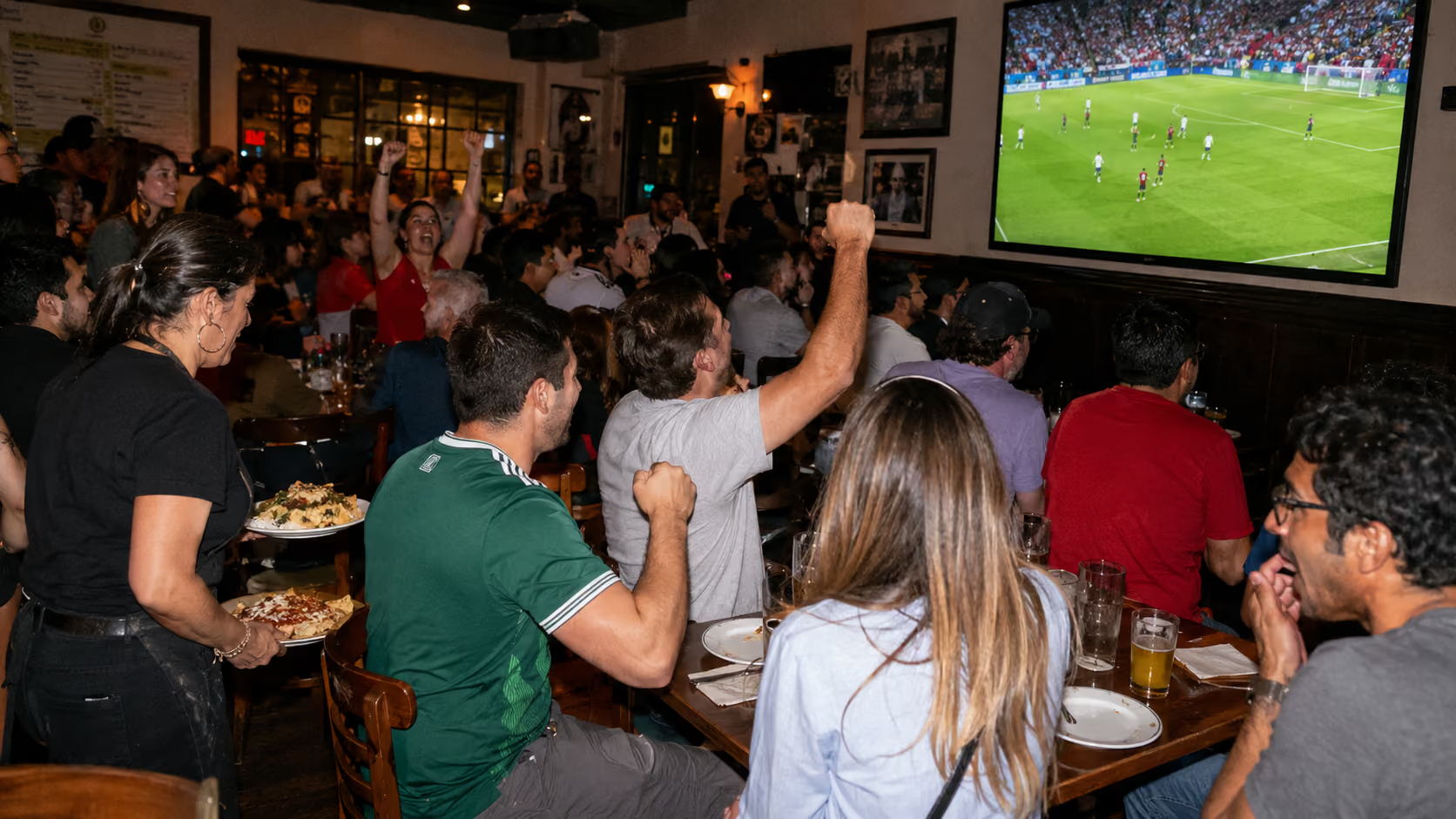
I started working in restaurants when I was nine years old. My family ran eleven of them while I was growing up, from takeaways to breweries, and over the last year I've helped independent operators all over the country stop leaving money on the table. So believe me when I say this: there is more money on the table right now than at any point I can remember.
FIFA expects six and a half million fans at the matches of the biggest sporting event ever staged, and US fans watching at home are projected to drive another 7.5 billion dollars in food, drink, and party spending on top of it. Deutsche Bank told its clients that restaurants, especially sports bars, pizza and wing concepts, and spots near host stadiums, are among the biggest winners from all that spend, lifted by tourism and watch parties both.
The chains have been preparing since 2024. McDonald's built an entire World Cup meal. Buffalo Wild Wings rebuilt their menu around the tournament. Anheuser-Busch committed over 110 million dollars to it. You've got you, your kitchen, and probably not enough hands on a Saturday night. That's not a fair fight, so let me even it out.
First, kill the most expensive assumption operators carried into this tournament: that it's a Super Bowl Sunday you already know how to run. It never was. The Super Bowl is one day. This is 104 matches across 40 days, lunch on a Tuesday, a Thursday night, three matches back to back on a Saturday. If you treated the group stage like one big day, you caught one wave and missed a dozen.
Here's the good news: the tournament saves its biggest waves for last. We're into the knockout rounds now, and the final is July 19. Fewer matches, higher stakes, bigger groups, bigger checks. Square's transaction data from the group stage already shows bars and breweries up 8 percent, late-night transactions up 20 percent, and bar traffic in host cities up as much as 28 percent. Knockout matches hit harder than anything the group stage produced, and every match left is a knockout.
So here are four plays, taken from what the biggest brands are running right now, sized for an independent. Most of them are free. Three come with a ChatGPT prompt you can copy word for word.
Play 1: Build a matchday menu, not a bigger menu
When a big match window hits, you don't have a demand problem. People are walking in. You have a kitchen problem: your regular menu was built for a normal Tuesday, not forty people ordering in the same twenty-minute window before kickoff. Every dish that takes fifteen minutes to fire is strangling your table turns at the exact moment those tables are worth the most all year.
The instinct almost every owner has is to add: themed dishes, new ingredients, new prep, new cost. That just piles complexity onto a kitchen that's already at its limit.
The chains did the opposite. Buffalo Wild Wings didn't reinvent their kitchen - they took the same wings and bolted on six new dipping sauces. TGI Fridays repackaged food they already serve into matchday platters. Krispy Kreme decorated the same doughnut like a soccer ball. Nobody added kitchen complexity. They put a theme on what they already make.
Do the same. Build a tight, one-page matchday menu entirely from what's already in your walk-in: shareable platters, beer-and-app bundles, pitchers - things that fire fast and feed a group. And one number to build it around: 65 percent of the tournament-themed menu items restaurants have added are drinks, per point-of-sale data reported by Restaurant Dive. That's where the margin and the volume live. Lead with beverages.
The chains pay agencies and menu consultants for this. You can do it in ten minutes. Open ChatGPT and paste this:
"Here is my current menu with my food costs: [paste menu]. Build me a soccer-tournament-themed matchday menu using ONLY ingredients I already stock - zero new inventory. Prioritize shareable items, high-margin beverages, and dishes that fire in under 8 minutes. Give me bundle pricing for groups of 4 and groups of 8, and a one-line description for each item."
Paste your real menu and real costs so it builds around your actual margins. Print it as a one-page insert. Don't touch your regular menu.
Get that done and you've got demand coming. Which is exactly why play two matters, because all that demand is about to start ringing your phone.
Play 2: Answer every call
This play decides whether everything else turns into money or just into a really busy night with nothing to show for it.
You built a matchday menu, so more people want to order. A huge share of them will pick up the phone and call you. And that call lands right before kickoff - the same moment your host is seating a party of eight, your bartender has twelve tickets hanging, and every hand in the building is full. The busiest moment for your phone and the busiest moment for your floor are the same moment. Nobody can get to it. Not because your team is lazy, but because they can't be in two places at once.
This leak is not a rounding error. Half of the calls made to restaurants go unanswered, according to DoorDash's Restaurant Online Ordering Trends report, and one in five customers still prefers to order by phone. These aren't telemarketers - they're people trying to hand you money: orders, reservations, catering.
Picture it on a match day. A three-hundred-dollar watch-party order comes in twenty minutes before kickoff. It rolls to voicemail. That person doesn't leave a message and doesn't call back - they dial the next restaurant on the list. The spot down the street just got your three hundred dollars, and because that customer hosts again for the semifinal and the final, they probably got your customer for the rest of the tournament too. You did the marketing, built the menu, created the demand, and one phone ringing at the wrong second handed it all to someone else.
Here's how you seal it: put an AI phone agent on your line.
I know how that sounds. Most people picture a robot menu - "press one for hours." This is the opposite. It's a voice that picks up on the first ring, every time, and holds a normal conversation. Someone calls for a table for six for the England match - it answers and books it. If they want food, it takes the whole order, and because it's wired into your POS the ticket fires straight to your kitchen - nobody types a thing. Someone asks about catering, it captures the order with a name and number. And it does all of that on your worst Saturday whether one person is calling or ten are calling at once. Nothing rings out. Nothing goes to the guy down the street.
I'm not coming at this from theory. I grew up in a restaurant family - we went from one location to eleven. I have stood in the middle of a Friday rush, completely buried, listening to the phone ring off the hook, knowing there was money on the other end and nothing I could do about it. That's why this company exists. We built Certus to answer the call I could never get to. We're backed by Y Combinator and by the companies your restaurant may already run on every day - Stripe, DoorDash, Gusto, Instacart.
Don't take my word for any of this. Run a test tonight, free: during your next rush, have a friend call your restaurant like a normal customer 3 or 4 times throughout your dinner rush. Count the rings. See if anyone picks up at all. Most owners who try this walk away rattled.
That's play two. Every other play turns the demand up. This is the one that stops it pouring out the bottom. There's a tournament-only offer on this at the end, but first - let's go get the watch-party money.
Play 3: Win the watch party
One stat rewired how I think about this tournament. YouGov asked Americans where they'd rather watch: 13 percent said a bar or restaurant. Two-thirds said home.
Thirteen percent. And every restaurant in town is fighting over that slice with more TVs and drink specials. The great majority are watching at home, at a friend's place, at the office - in groups. And groups get hungry. If your only plan is bodies through the door, you've capped yourself at a fraction of the opportunity.
The play is watch-party catering packages: pre-order bundles that feed a group. And with the knockout rounds on, it compounds fast - the person who orders for the quarterfinal orders again for the semi and the final. You're not selling a meal, you're selling a habit. This is why Domino's goes so hard on events like this: their whole strategy is built around people watching at home, because that's where the volume is. You don't need their delivery network. You need three bundle sizes and a cutoff time.
"Using my menu [paste menu], build me three watch-party catering tiers - feeds 6, feeds 12, feeds 20 - using only items that hold quality for 45+ minutes of travel. Price each tier at roughly a 15% premium to ordering individually. Name each package with a soccer theme that does not use any protected tournament names."
Three details that make it work. Set a pre-order cutoff - "order by 2 PM for the 6 PM match" - so your kitchen preps in the dead afternoon, not the rush. Post the packages before every remaining match window. And drop a card with a QR code inside every catering order. Hold onto that thought, because the last play shows you why.
One more connection: that catering order reaches you by phone. If nobody answers, the order never lands. That's why we sealed the phone first.
Play 4: Turn July traffic into August regulars
On July 19 the final ends and the crowds vanish overnight. Over these weeks you'll have served hundreds of new faces - first-timers, tourists, locals who never came in before. And if you're like most restaurants, the moment it's over you'll have captured exactly zero of them. No names, no numbers, no way to reach them again. All that traffic was rented, not owned. It's the most expensive mistake on this list: leaving the real money on the table after you did the hard part.
Want proof the database is the real game? Look at Domino's. They put up a million dollars in free pizza if Team USA got a red card - and when Balogun was sent off against Bosnia on July 1, they had to pay it out, up to 63,371 pizzas. Looks like an expensive stunt. Read the fine print: to be eligible, you had to register by June 10 and enroll in Domino's Rewards. That's not a giveaway. That's a customer-database campaign in a giveaway costume - a million dollars of pizza traded for tens of thousands of names and numbers they'll market to for years. The big brands aren't trying to win the tournament. They're trying to win the decade after it.
Two parts: capture during, reactivate after.
Capture is simple. Run a tournament pass - "third visit gets a free dessert." Sign-up is a name and a phone number. QR code on every table, every receipt, and inside every catering order. A tourist comes back twice for the dessert. A local comes back every time their country plays.
Reactivate is where everyone fumbles - numbers get collected and rot in a spreadsheet. Instead, a week after the final, text the list: "You found us during the tournament - here's a reason to come back in August." Text, not email, because texts get read in minutes. And here's where play two pays you twice: with an AI phone system, everyone who called is already captured with a name, number, and order history. The guy who ordered the feeds-twelve package for the semifinal gets a text in August: "Hosting again? Your matchday package is one text away." Personal, not a blast - and it converts like it.
"Write me a 3-message text win-back sequence for customers who first visited during the soccer tournament. Message 1 sends July 20, message 2 early August, message 3 late August. Each under 160 characters, casual tone, each with one specific reason to come back. My restaurant is [type] and my best sellers are [items]."
Run the math on even a modest list. Two hundred contacts, twenty percent return rate, forty-dollar average check: sixteen hundred dollars from one text message. And those aren't tourists anymore - they're regulars. Domino's spends a million dollars to run this play. Yours costs a QR code and a text.
The system, and the clock
Line the four plays up and you'll notice they're not tips, they're a pipeline. The matchday menu creates the demand. The phone catches it. The watch parties multiply it. The database keeps it. Demand in one end, regulars out the other. That's what the big brands understand that most independents don't: they're not winning on better food or bigger budgets. They're winning because every dollar of attention gets fed into a machine built to keep it.
Three of these plays cost you a printer and a prompt, and you can run them this week. The phone is the one that's a real system, wired into your POS - and it goes live the same day you set it up. The biggest matches of the tournament are inside the next sixteen days, and every one you sit out is a match window of calls you don't get back.
So here's what we're doing, only for the tournament. Get Certus on your line and you're covered by a thirty-day, one-hundred-percent money-back guarantee. Run it through the final and the weeks after, when your win-back texts are landing and the calls are still coming. If after thirty days you don't believe it paid for itself many times over, you get every dollar back - no questions, no hoops. All the risk sits on our side. The only thing you can't get back is the money that leaks while you do nothing.
We don't normally run this. It exists for a once-every-four-years moment, and when the final whistle blows on July 19, it's gone. Book a demo through the site and my team will get back to you the same day.
The tournament ends July 19. The system you build during it doesn't.
References
Sources referenced in this article:
- CBS News, "The World Cup will draw millions of fans, but economic payoff is modest" (June 11, 2026) - cbsnews.com
- Numerator, "World Cup 2026: Soccer Scores With US Fans" (May 20, 2026) - numerator.com
- CNBC, "Stocks that could benefit from 2026 FIFA World Cup: Deutsche, Goldman" (June 4, 2026) - cnbc.com
- McDonald's corporate, "The FIFA World Cup 26 Goes to McDonald's" - corporate.mcdonalds.com
- Inspire Brands, "Buffalo Wild Wings Debuts Matchday Menu" (May 27, 2026) - stories.inspirebrands.com
- eMarketer, "The World Cup will capture younger consumers' attention and budgets" (June 8, 2026, citing The New York Times) - emarketer.com
- Restaurant Dive, "How independent restaurants are leaning into World Cup frenzy" (June 8, 2026) - restaurantdive.com
- Restaurant Dive, "World Cup kicks US restaurant traffic up a notch" (July 1, 2026) - restaurantdive.com
- YouGov, "What Americans think about the 2026 World Cup" (May 29, 2026) - yougov.com
- Dexerto, "Domino's giving away $1 million in free pizza for red cards" (May 18, 2026) - dexerto.com; payout confirmed by The Detroit News (July 2, 2026) - detroitnews.com
- Restaurant Dive, "DoorDash adds automated phone ordering for restaurants" (August 28, 2023) - restaurantdive.com

.svg)
.svg)
.svg)
.svg)