.svg)

.svg)


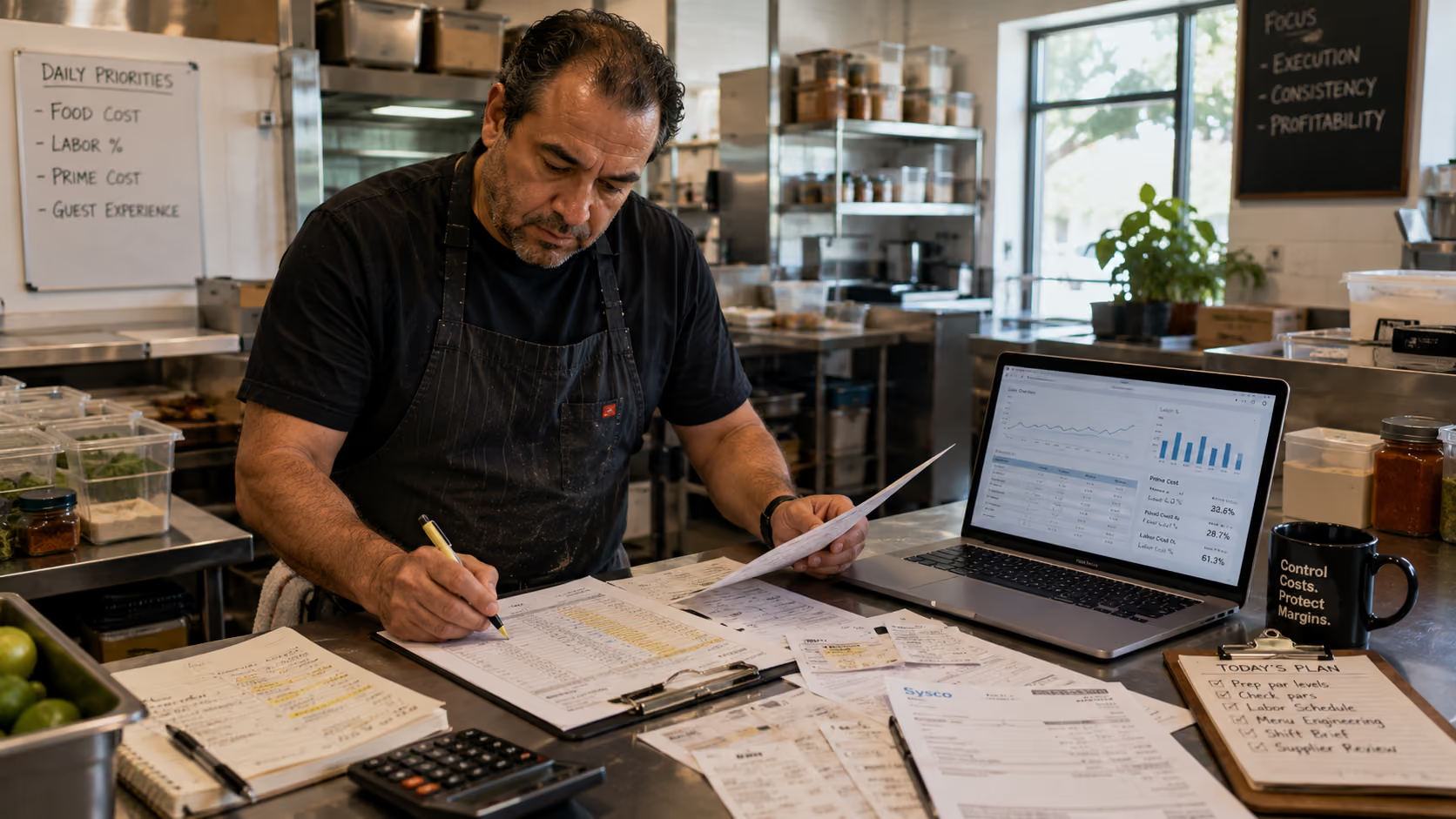
Running a restaurant in 2026 is a different job than it was five years ago. Food and labor costs have both risen by 35% in the last five years, according to the National Restaurant Association. Staff turnover is sitting at over 75% across the industry. And customers have higher expectations than ever, whether they are calling to order, booking online, or walking in off the street.
The operators who are managing well right now are not doing anything exotic. They are running tighter systems, making faster decisions with better data, and cutting the time their best people spend on tasks that should not require them at all.
These 10 tips are practical. They cover everything from how you track costs to how your phone gets answered. Not all of them will apply to every operation, but most operators will find at least three or four they can act on this week.
10 tips for modern restaurant management
1. Track prime cost every week, not every month
Prime cost is your food cost plus your labor cost as a percentage of revenue. Industry benchmarks put a healthy prime cost between 60% and 65%. If yours is above that, your profit margin is getting compressed before you even touch rent or utilities.
Most operators track this monthly, which means problems show up four weeks after they started. A supplier quietly raised a price. Portions crept up in the kitchen. A new roster added hours nobody noticed. By the time the monthly report lands, the damage is already done.
Tracking food cost weekly lets you catch problems before they compound. One calculation, once a week, takes five minutes and consistently keeps operators inside their target range.
The formula: add your food purchases to your total labor cost for the week, divide by total revenue, and multiply by 100. That number tells you whether this week was under control or not.
2. Do a proper menu engineering review every quarter
Most menus have at least two or three items that are hurting the business without anyone realizing it. Restaurant menu engineering helps you see exactly which dishes are working and which ones are not.
Sort every item on your menu into four groups:
Your bestselling dish might also be your worst-margin dish. You're busy but not profitable every time someone orders it. Equally, there is usually at least one item that almost nobody orders but makes strong money when they do. That item deserves a better position on the menu and more staff attention.
Run this review with your actual POS data. It takes a couple of hours and almost always reveals something worth acting on.
3. Get portion control documented and enforced
Portion inconsistency is one of the quietest ways food cost drifts above target. A little extra protein on one plate here, a more generous pour of sauce there, and by the end of the month you've lost real money on hundreds of small overruns.
Recipe cards with weight specs for every dish solve this. Not in someone's head. Printed and in the kitchen. New staff cooking to a standard instead of guessing, experienced staff reminded of what correct looks like.
U.S. restaurants generate 11.4 million tons of food waste each year, at a cost of $25 billion annually. A meaningful chunk of that comes from prep and portioning decisions that were never standardised.
4. Build a staff retention system, not just a hiring process
Replacing a single restaurant employee costs an average of $5,864, and that figure does not include the productivity loss while a replacement gets up to speed, or the extra pressure on the rest of the team during the gap.
Most operators focus heavily on hiring and lightly on retention. The two things that most consistently keep good staff around are schedule predictability and feeling like their time is not being wasted on tasks beneath their skills.
Practical steps that work:
- Publish schedules at least two weeks out
- Cross-train staff so they can cover gaps without the shift feeling chaotic
- Remove repetitive low-skill tasks where possible, so experienced staff spend their time on things that need them
- Have a clear and short onboarding process so new hires feel competent quickly
According to the 2026 State of Restaurants Report, the average restaurant is currently short five team members up from 3.8 the previous year. That gap gets worse when turnover is high and better when retention is treated as a management priority.
5. Use your POS data to make scheduling decisions
Most restaurants under-staff on days that turn out to be busy and over-staff on slow ones. Both are expensive. Under-staffing damages service. Over-staffing burns your labor budget without generating returns.
Your POS has the data to fix this. Sales history by day, by week, and by time of day is enough to build a scheduling pattern that tracks actual demand rather than guessing. Add in local events, weather patterns, and seasonal trends and you can get accurate within a reasonable margin.
Operators who schedule based on data rather than habit consistently sit at the lower end of the healthy labor cost range. That gap between 30% and 35% labor cost on a $50,000-a-month restaurant is $2,500 a month, or $30,000 a year.
--> Read our POS-comparison of Toast vs Square POS.
6. How to answer every phone call during service
This one gets overlooked as a management issue, but it is a revenue issue.
During a busy service, the phone rings and nobody can get to it. That caller was ready to place an order, make a booking, or confirm a reservation. They hang up and either call a competitor or do not call back at all.
Restaurant voice AI solves this without adding headcount. A voice agent answers every call, takes orders, handles reservations, and pushes the order directly into your POS. Your staff stay focused on the floor. Nothing gets missed.
The missed call revenue calculation is straightforward. Take your daily call volume, apply a 25% miss rate during peak hours, multiply by your average order value, and multiply by 365. For most restaurants with moderate call volume, that number comes out above $80,000 a year in revenue that simply was not captured.
For a practical look at how voice agents for restaurants have developed and what they can do today, the options are more accessible than most operators realize.
7. Respond to Google reviews within 24 hours
Your Google review score affects how many new customers find you and whether they decide to come in. Most operators know this in principle but do not have a system for acting on it consistently.
Two things matter: getting more reviews from happy customers, and responding to every review, positive or negative, quickly.
For positive reviews, the simplest system is asking. A card on the table, a prompt at the end of a meal, a note on the receipt. The customers most likely to leave a review are the ones who had a great experience and just needed a small nudge.
For negative reviews, a fast and direct response does more for your reputation than the original complaint damages it. A business that acknowledges a problem and explains how they fixed it looks more trustworthy to new customers reading the reviews, not less.
A full breakdown of how to do this well is covered in how to get more positive Google reviews for your restaurant.
8. Treat online ordering as a managed channel, not a set-and-forget tool
Most restaurants that use third-party delivery platforms set them up once and do not revisit them. The menu is outdated. Items are listed that are out of stock. Prices have not been adjusted to reflect rising ingredient costs. Photos are missing on half the dishes.
Your online menu is often the first thing a new customer sees. It shapes their impression of your operation before they have tasted anything.
Review your delivery platform listings quarterly. Check that every item has a photo, an accurate description, and a price that reflects your current costs. Remove anything that is not available consistently. Add the high-margin items that might do well with delivery customers.
Commission rates on third-party platforms typically run between 15% and 30%. That makes it essential to know which items still make money at that margin and which ones do not. Selling a low-margin plow horse through a 25% commission platform at scale is actively damaging your business.
9. Use AI for the repetitive, rules-based work
There are tasks in restaurant management that follow clear rules and do not need human judgement. Responding to booking enquiry emails. Answering the same questions on Google Business or Instagram. Sending confirmation messages to reservation holders the day before.
These tasks take time that managers and front-of-house leads could spend on something more valuable. Restaurant AI automation handles them without requiring constant supervision.
Restaurant management AI tools in 2026 also extend to inventory forecasting, which predicts how much of each item you will need based on sales history, so you order the right amount and reduce spoilage. The return on these tools comes from the hours they free up and the consistency they bring, not from any single dramatic improvement.
For independent operators wondering how to approach AI without overcomplicating things, the AI strategy lesson from Starbucks is a useful frame for thinking about where to start.
10. Know your break-even before anything else
Every other tip in this article is more useful once you know your break-even point. It is the number your restaurant needs to hit in revenue before a single dollar of profit is possible.
The formula: total fixed costs divided by your contribution margin percentage. Fixed costs are everything that does not change with volume. Rent, insurance, utilities, loan repayments. Contribution margin is what is left of each revenue dollar after prime costs.
If your fixed costs are $20,000 a month and your prime cost is 60%, your contribution margin is 40%, and your break-even is $50,000 a month.
Learn more in our article on how to create a restaurant budget that works.
Most operators have a feeling about this number but have never calculated it precisely. When you do, two things happen. You start making decisions about promotions, staffing, and pricing based on whether they move you toward that number or away from it. And you stop assuming that full tables means the business is profitable.
What good restaurant management looks like in practice
For good modern restaurant management in 2026, make sure to follow the basics tips consistently, with better data and fewer manual processes than your competitors.
Here's what sets the best restaurants apart:
They know their prime cost every week. They answer every call. They have retention systems that keep good staff around. They use restaurant AI technology to handle the work that does not need a person, so the people they have can focus on the things that do.
Most of the improvements in this list do not require significant investment. They require deciding to measure something you have not been measuring, or fixing a process that has been running on habit rather than intention.
For operators who want to understand how independent restaurants are competing and winning right now, how independent restaurants can compete with McDonald's covers the strategic angle clearly.
If you want to see how restaurant AI automation through a voice agent fits into your operation specifically, book a demo with Certus and see what it looks like on a live call.

.svg)
.svg)
.svg)
.svg)