.svg)

.svg)


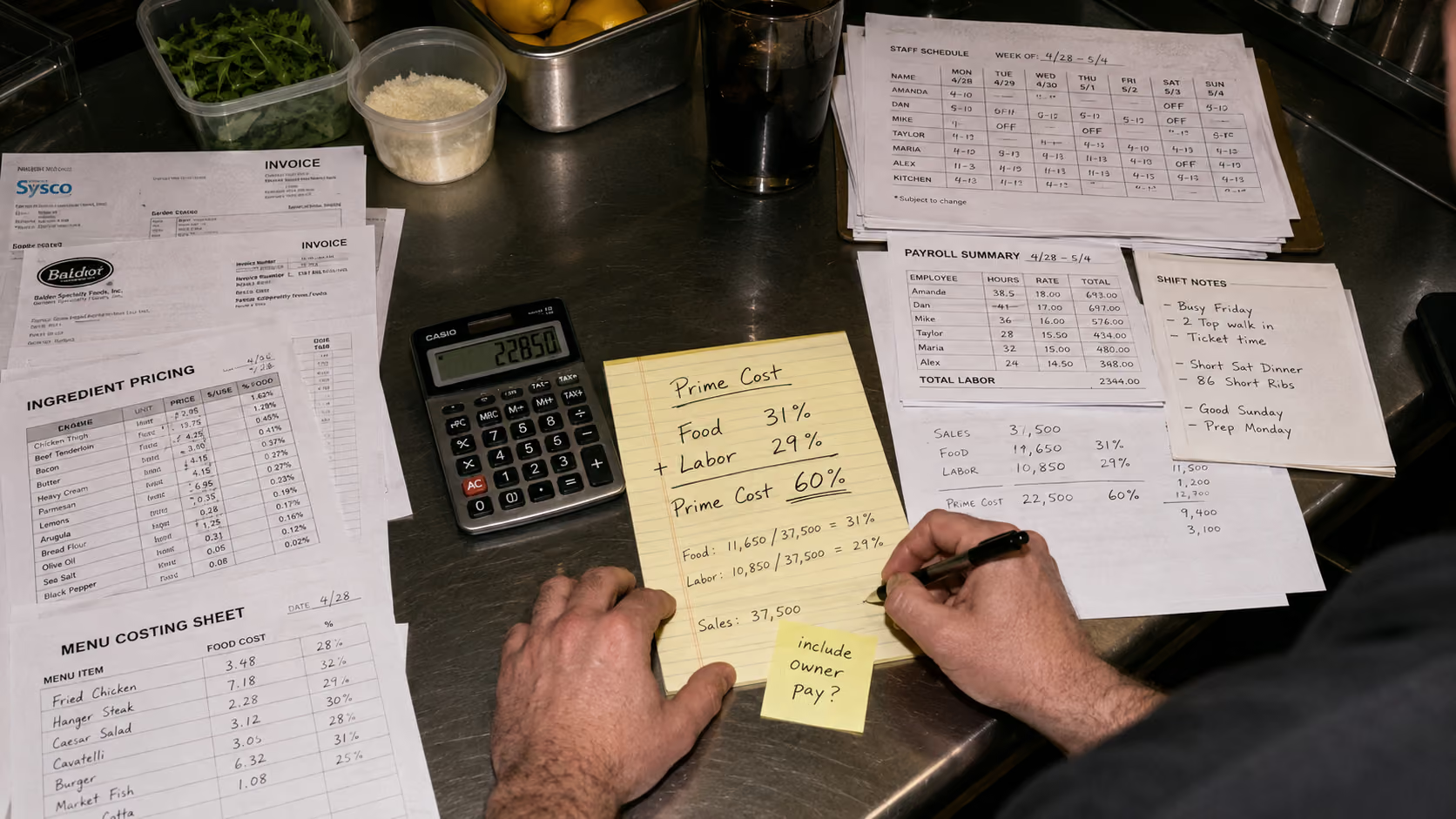
There is a single number that tells you more about your restaurant's health than anything else on your P&L, and most operators have never heard the term. Your accountant probably has, but nobody made it the headline, and that is a shame, because everything else you track rolls up into it.
It is called prime cost, and by the time I was 17 I was helping run 11 of my family's restaurants without anyone ever teaching it to me. We tracked food cost when suppliers annoyed us and payroll when it hurt, but we never put the two together, which is like checking each eye separately and never opening both at once.
The prime cost formula
Prime cost is your food cost percentage plus your labour cost percentage. That is the whole formula.
Prime cost % = Food cost % + Labour cost %
If your food cost is 32% and your labour cost is 31%, your prime cost is 63%. If you have not run those two inputs recently, my food cost guide walks through the first one in ten minutes, and labour is your total wage bill divided by total revenue.
Why does adding two numbers you already know matter so much? Because of what is fighting for the rest of the dollar.
Every dollar has four claimants
Think about a dollar coming into your till. Four things are fighting for it: food cost, labour cost, overhead, and profit.
Overhead is your rent, utilities, insurance and all the fixed stuff, and for most independent restaurants it runs somewhere between 20 and 30 percent of revenue. Here is the uncomfortable part: that slice is essentially locked, because your rent does not go down after a slow Tuesday. Your POS software and card processing sit in that slice too, and unlike rent they are negotiable. I priced out what Square actually costs if you want a benchmark to negotiate against.
So profit is what survives after the other three take their share. If your prime cost is 70%, you have somewhere between zero and ten percent left before anything goes wrong, and something always goes wrong. A broken fridge, a slow week, a supplier price rise, and that thin slice is gone.
That is why 60% is the target. At 60% prime cost with 25% overhead you are sitting at a 15% profit margin, which is a real business, one that can absorb a bad month, reinvest, and grow. Industry benchmarks back the same line: Restaurant365 puts healthy full-service operations at 60-65% with quick service closer to 55-60%, and Baker Tilly's restaurant practice treats anything sustained above 65% as a margin problem that needs intervention.
Every point above 60 comes straight out of your bottom line, not from somewhere else, so a restaurant at 66% is not "a bit high", it is handing over nearly half its potential profit.
The trap that hides ten points
Now for the part that breaks most operators' numbers, and I say this with love, because I have watched family members do it for years.
You are probably not paying yourself properly, and your labour cost looks clean because of it. If you replaced yourself tomorrow, a general manager would cost you $50,000 to $80,000 a year minimum, which is $4,000 to $6,000 a month that is not in your number right now. Add it back in and most owner-operated restaurants jump six to ten points overnight.
The restaurant you thought was running 30% labour is actually running 40%, and combined with a food cost drifting toward 40%, you are at 80% of revenue gone before rent gets paid. That is not a restaurant, that is an expensive job you bought yourself.
Run your labour cost with a real salary for you in it. That is the honest number, and the honest number is the only one worth managing.
Prime cost tells you where the problem lives
Here is why this beats staring at food and labour separately: when prime cost is too high, the two inputs point at completely different fixes, and you should not attack both at once.
If food is out of range, the work is purchasing, portioning and menu pricing, which I covered in the food cost guide. If labour is out of range, the work is scheduling against your actual cover pattern, cross-training so one person can hold two stations on quiet shifts, and being honest about how much management the building really needs. Put the two percentages next to each other and the guilty one is usually obvious within a minute.
Most of the time, the wrong move is the instinctive one: cutting floor staff on your busiest nights. Thin service on a Friday costs you regulars, and as I covered in the money formulas playbook, a regular is worth thousands over their life with you, so saving forty dollars on a shift to lose a three-thousand-dollar relationship is bad maths dressed up as discipline.
The labour you can remove without touching service
There is one chunk of labour that adds nothing to the guest sitting in front of you, and that is the time your team spends wrestling the phone.
Every minute a server spends taking a phone order is a minute they are not at a table, and on busy nights the phone loses anyway, ringing out while everyone is mid-service. So you are paying full service wages for a job that is half done, and the half that gets dropped was holding money.
At Baci Trattoria in Naples, Florida, the owner Frank was running five phone lines through his team before he handed the phones to Certus AI's phone agent. The AI has taken more than 1,000 orders and saved his staff over 130 hours that used to disappear into the phone, hours that went back into the dining room, and it recovered over $50,000 in revenue from calls that used to ring out. The full Baci case study has the detail.
Notice what that does to prime cost from both ends: labour hours drop without a single person leaving the floor, and recovered phone revenue grows the denominator, which pulls both percentages down together. Certus runs on flat monthly pricing, sets up the same day, and pushes orders straight into Toast, Square, Clover, Skytab, or Aloha NCR.
The verdict
- If you have never calculated prime cost: add this week's food cost percentage to this week's labour percentage tonight, including a real salary for yourself. If the answer starts with a seven, this is now your most urgent project.
- If you are between 60% and 65%: put food and labour side by side and fix only the one that is out of its lane, then re-run the number in four weeks.
- If you are at or under 60%: stop cutting and start growing, because at your margins every extra dollar of sales is worth more to you than another point of savings.
Full tables and a healthy prime cost are not the same thing, and only one of them shows up in your bank account. Add the two numbers.
Want the labour hours your phone is eating back? Book a demo with Certus AI. Twenty minutes, and you will know.

.svg)
.svg)
.svg)
.svg)