.svg)

.svg)


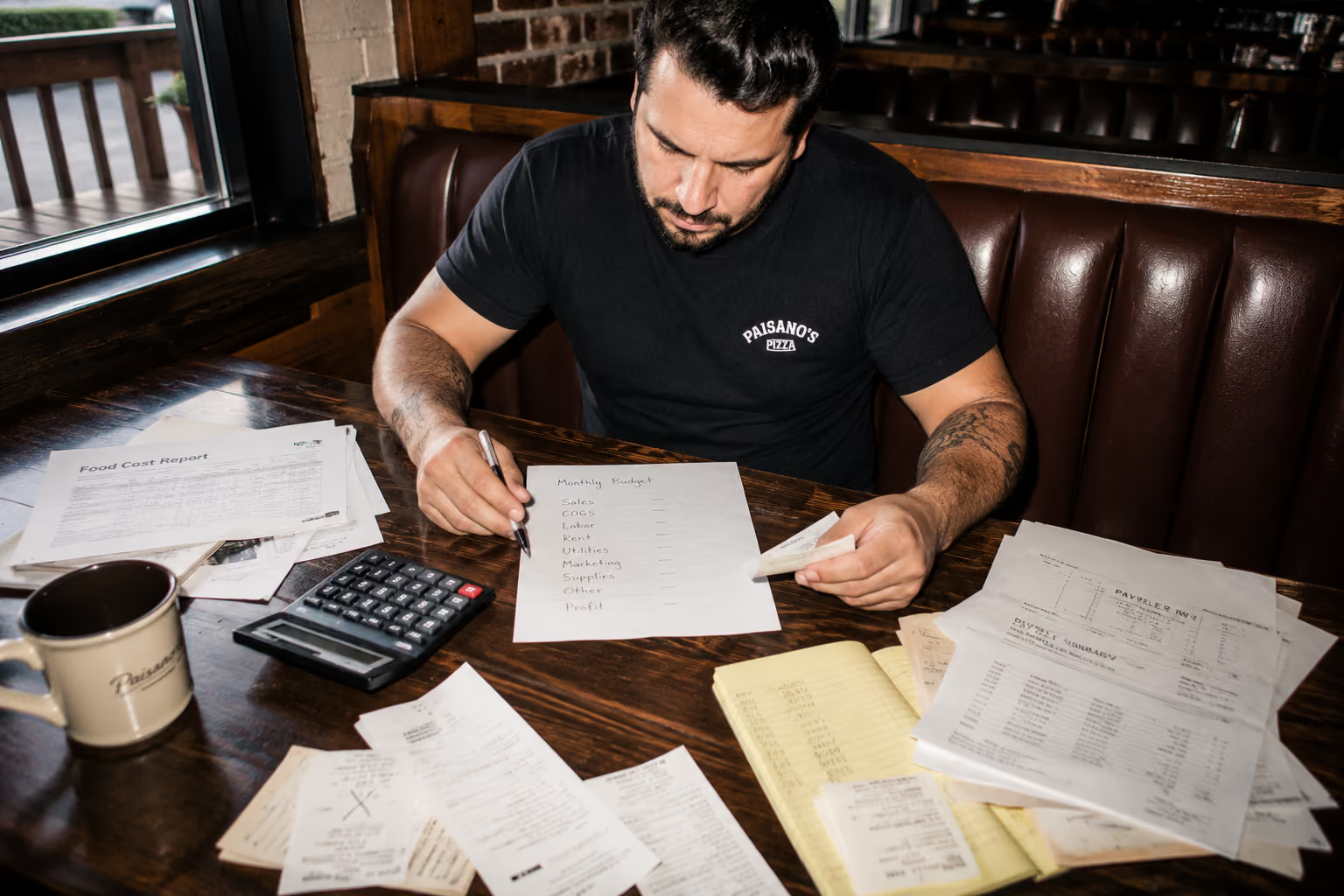
Staring at a bank balance on a Tuesday morning, trying to figure out if you'll make payroll on Friday is something very few get used to. Sales could good and dining rooms can be full, but the money always seems to disappear somewhere between the register and the bank account.
You aren't alone. Most operators run the same way: instinct, bank balance, and hope. A 2026 industry report found that 42% of independent operators said their businesses were not profitable in 2025, and Restaurants Canada reported in 2024 that 62% of restaurants were operating at a loss or just breaking even.
This article is about why that happens and the simple, one-page budget that actually works when you're running a restaurant. It’s the roadmap to taking control of your finances and building a truly profitable restaurant business.
Key takeaways:
- Stop running your restaurant on instinct; a simple budget is your roadmap to profit.
- Focus on a one-page weekly budget that tracks sales, prime cost, and profit.
- Review your budget for 20 minutes every Monday to make informed decisions.
- Don't overlook missed revenue from unanswered calls, a hidden budget killer that AI phone agents for restaurants can solve.
Why the budget feels like a four-letter word
A restaurant budget is a financial plan that sets targets for sales, costs, and profit, then tracks actual performance against those targets. Most operators avoid it because it feels like extra work, confronts uncomfortable truths, or becomes a document created once for the bank and never seen again. Restaurant coach David Scott Peters has been writing about this since 2003. And since then the reasons haven't changed.
You're already working 70 hours a week, covering shifts, dealing with vendors, and putting out fires. The idea of sitting down with spreadsheets feels impossible. But you're already making financial decisions every day, you're just making them blind. Every time you schedule staff or order inventory, you're spending money based on a guess. The 20 minutes you "don't have" for budgeting costs you hours of stress and thousands in mistakes.
Facing your financial situation
Opening your financials when you know things are tight can feel like a personal failure. Many owners are so invested that red numbers feel like proof you're not good enough. This is a psychological trap. The budget isn't the enemy. It's the tool that helps you fix the problem, just like how Dirty Bird stopped losing phone orders by identifying and plugging a key revenue leak.
The only budget was for the bank
Most operators have created exactly one budget: the 15-page monster their accountant built for a loan application. It was designed to impress a loan officer, not run a business. After the loan was approved, that document went into a drawer. That's not a budget, it's financial theater. A real budget is a living, breathing tool you use every week.
What a restaurant budget really is and how to use it
A real restaurant budget is a one-page plan that sets weekly targets for sales and costs, then tracks actual performance to guide immediate decisions. It's noto only a finance document, but it can be an operating tool that tells you whether you're on track to hit your profit goals and what to adjust if you're not. The best budgets I've seen fit on a single page because complexity kills execution.
Think of your restaurant budget as a GPS for your business. It tells you where you're trying to go (your profit target), where you are right now (actual sales and costs), and whether you need to adjust your course. You don't need to be an accountant to use it. You just need to know what you sold, what you spent on food and labor, and what's left.
Creating a solid restaurant budget is one of the best tips for modern restaurant management.
A one page budget is all you need
A one-page budget works because you can review it in the time it takes to drink your Monday morning coffee. You can print it, stick it on the wall, and reference it before making decisions. The restaurants that actually use their budgets keep them simple. The ones that don't use their budgets made them too complicated.
Which numbers does a restaurant need to track?
Your weekly budget needs to track three things: sales (revenue), prime cost (food and labor), and profit (what you keep). Everything else is either fixed (like rent) or too small to move the needle week to week. Prime cost is the big one. It's typically 55-65% of your sales, which means it's where you have the most room to improve or the most risk of bleeding money.
How to building your one-page restaurant budget, line by line
Creating a restaurant budget starts with setting a weekly sales target based on historical data, then allocating costs as percentages of that target. The goal is to plan for profit, not just hope for it. When setting sales targets, consider how technology can help you capture more revenue, especially if you're wondering if an AI phone agent can handle complex orders.
Set your weekly sales target
Start with last year's sales data. Pull your POS reports and calculate your average weekly sales. If you're new, use the data you have. Break it down by week, not month. Your cash flow, labor scheduling, and ordering all happen weekly. For our example, let's say historical data shows $25,000 in average weekly sales. That's your baseline. Adjust for seasonality, but start with what you actually do, not what you hope to do.
Control your prime cost: food and labor
Prime cost is your Cost of Goods Sold (food and beverage) plus all labor costs (wages, taxes, benefits). It's the single most important number in your budget because it's the largest expense you can control. Industry benchmarks suggest 55-60% is healthy for most concepts. For a $25,000 week, that means a prime cost target of $15,000 (60%). This is where an AI alternative to dedicated phone staff can have a huge impact on your labor line without sacrificing service.
Understand your fixed costs
Fixed costs are expenses that don't change with sales volume: rent, insurance, loan payments, licenses, and salaried management. These typically run 25-30% of sales. In our $25,000 example, that's $6,250 to $7,500 per week. You need to know these numbers, but you don't need to stare at them weekly. You can't change your rent on Monday morning, so focus your weekly review on what you can control.
How can restaurants budget for profit?
This is the most important shift in thinking. Don't budget for expenses and hope for profit. Decide your profit target first, then build your costs to fit. If you want to make 10% profit, that's $2,500 on a $25,000 week. That's not what's left over, that's what you plan to keep.
Here is a sample one-page budget:
If the math doesn't work, you adjust your costs or your sales target. You don't adjust your profit to zero and call it a plan.
How often should I review my restaurant budget?
A weekly budget review compares last week's actual sales and prime cost against your targets, identifies variances, and results in one specific action for the week ahead. This 20-minute Monday morning habit is what separates profitable restaurants from busy ones that wonder where the money went. Budgets fail when they're annual documents in a drawer. They work when they're weekly habits.
Last week's reality vs. your plan
Every Monday, pull three numbers: actual sales, actual food cost, and actual labor cost. Compare them to your budget. For example, if your sales were $23,500 (under target) and your labor cost was 34.5% (over target), you know exactly where your profit went. You're not guessing, you know the problem is labor.
One decision for the week ahead
The review should end with one decision. Not five. One thing you will do differently this week. If labor was high, your decision might be to cut two slow lunch shifts or review the schedule before posting it. Pick one, do it, and see if it worked next Monday. This prevents analysis paralysis by focusing on small, consistent adjustments.
Avoiding common budgeting mistakes
The biggest mistake is creating a budget and never looking at it again. Other common traps include budgeting monthly instead of weekly (too slow), tracking too many categories (losing focus), and not adjusting for seasonality. Your budget is a living tool. Review it quarterly and adjust your targets based on what you're learning.
What are "prime costs" and why are they so important?
Prime costs are the total of your food and beverage costs (Cost of Goods Sold) and your total labor costs. They are the most important numbers in your budget because they represent the largest and most controllable expenses in a restaurant, typically accounting for 55-65% of total sales. Managing prime cost effectively is the key to profitability.
The revenue line restaurants should budget for
Most restaurant budgets focus entirely on controlling costs, but there's a massive revenue line almost nobody tracks: missed phone calls. This is revenue you already paid to generate through marketing and rent. The customer called, but you were too busy to answer. That's not a missed call, that's a customer actively choosing your competitor.
How to get more revenue out of a ringing phone
During a dinner rush, the phone is the lowest priority. But research shows that 85% of callers who don't get an answer won't call back. You spent money on marketing to make the phone ring. When it goes unanswered, you just lit that marketing dollar on fire. This is a critical blind spot in most strategic AI phone answering for restaurants is not yet a common practice.
The average restaurant misses over 150 calls a month. If 60% are orders with a $35 average ticket, that's over $37,000 in lost annual revenue. For a restaurant doing $100,000 a month, that's a huge chunk of your potential profit walking out the door. A missed call isn't just one lost order, it's a customer who might have become a regular.
How can a restaurant automate phone orders with AI?
This is where AI actually pays off for independents. We built Certus AI to solve this problem. It's an AI agent that answers every call, takes orders, and syncs them directly into your POS (Toast, Square, Clover). It works 24/7, handles complex orders, and costs a fraction of a dedicated phone person. For example, Boardwalk Pizza captured $70,000 in orders and freed 195 hours of staff time by answering every call. That's real money that was already in their budget as potential sales, they just weren't capturing it.
Your budget is your restaurant business's GPS
A restaurant budget is a clarity tool. It shows you exactly where you are, where you're trying to go, and what needs to change to get there. The operators I know who run profitable restaurants all have one thing in common: they know their numbers. Not because they love spreadsheets, but because they got tired of being surprised by their bank balance. You don't need an MBA. You need one page, four numbers, and 20 minutes every Monday.
Certus AI is a Y Combinator-backed company dedicated to helping restaurants turn every phone call into revenue. The Certus AI Phone Agent for restaurants acts as your best employee, answering 24/7, taking complex orders directly into your POS, and ensuring you never miss an order again. It's the practical, profitable automation that independent restaurants need to thrive.
To get personal consulting and learn more, book a free demo call with our team.

.svg)
.svg)
.svg)
.svg)