.svg)

.svg)


Key takeaways
- Taco Bell now runs voice AI at more than 890 drive-thrus across 38 states. That is one of the biggest automation rollouts the quick-service world has seen.
- On July 23, SoundHound AI and Deliverect announced a partnership to push voice orders straight into kitchen systems. Deliverect connects to more than 80,000 restaurant locations and 550 point-of-sale systems.
- Almost all of this money is aimed at the drive-thru lane. Most independent restaurants do not have a drive-thru lane.
- The channel you are actually losing money on is the phone, and it is the one the chains automated first when they had no lane to fix.
Two weeks of headlines have been telling independent operators they are falling behind on AI. Almost every one of them describes a problem you do not have.
The first job I ever had was answering the phone in my parents' restaurant. I was nine. They started with one place and grew it to eleven, and every dinner rush looked identical. Packed dining room, everyone in the weeds, phone ringing off the wall. Somebody had to choose between the guest standing in front of them and the guest trying to spend money down the line, and the phone always lost.
So when I read that Taco Bell now runs voice AI at more than 890 drive-thrus, my first thought was not that we are behind. It was that a lot of money just went into fixing a problem I never had.
Let me explain what happened, and then what it actually means for you.
What actually got announced this month
Two things, four days apart.
First, Taco Bell confirmed its voice AI is now live at more than 890 drive-thru locations across 38 states, built with a company called Omilia. It has been running at hundreds of stores since 2023. This July it crossed into nearly a thousand.
Second, on July 23, SoundHound AI announced a partnership with Deliverect. Deliverect is the integration layer a lot of restaurants already use to move orders between apps and their till. It reaches over 80,000 restaurant locations, connects to more than 550 point-of-sale systems in 50-plus countries, and handles 100-plus languages. The deal lets a voice agent pull live menu data from Deliverect and drop the finished order into the kitchen automatically.
Don MacMillan, who runs partnerships in the US and Canada for Deliverect, said the quiet part out loud in the announcement: "Voice is the oldest ordering channel in the restaurant business, and until now it's been the least automated."
He is right. That sentence is the whole story, and almost everyone read it backwards.
Why every big rollout points at the drive-thru
Follow the money and it makes sense. A large chain measures itself on cars per hour. Shave eight seconds off an order across 890 stores and you have a number you can put in an earnings deck. Taco Bell's own reporting says transactions at voice-AI lanes run the same speed or faster than a person taking the order, and that those stores have seen better employee retention.
Now look at it from the vendor's side, because this is the part nobody says out loud. One chain contract delivers 890 locations from a single signature. Reaching 890 independents means 890 separate sales conversations with 890 owners who all want to see it work first. If you are building a voice AI company, you already know which of those two you are going to chase.
So the product gets built for the lane, and the case studies get written about the lane, and the trade press covers the lane. That is not a conspiracy, it is just how enterprise software gets funded. But it means the roadmap you have been reading about for two weeks was never written with your restaurant in mind.
Burger King has been piloting an assistant across roughly 500 restaurants. Wendy's runs its own system in hundreds of locations. White Castle has gone wide with it. The pattern repeats because the problem repeats: a lane, a speaker, a queue of cars.
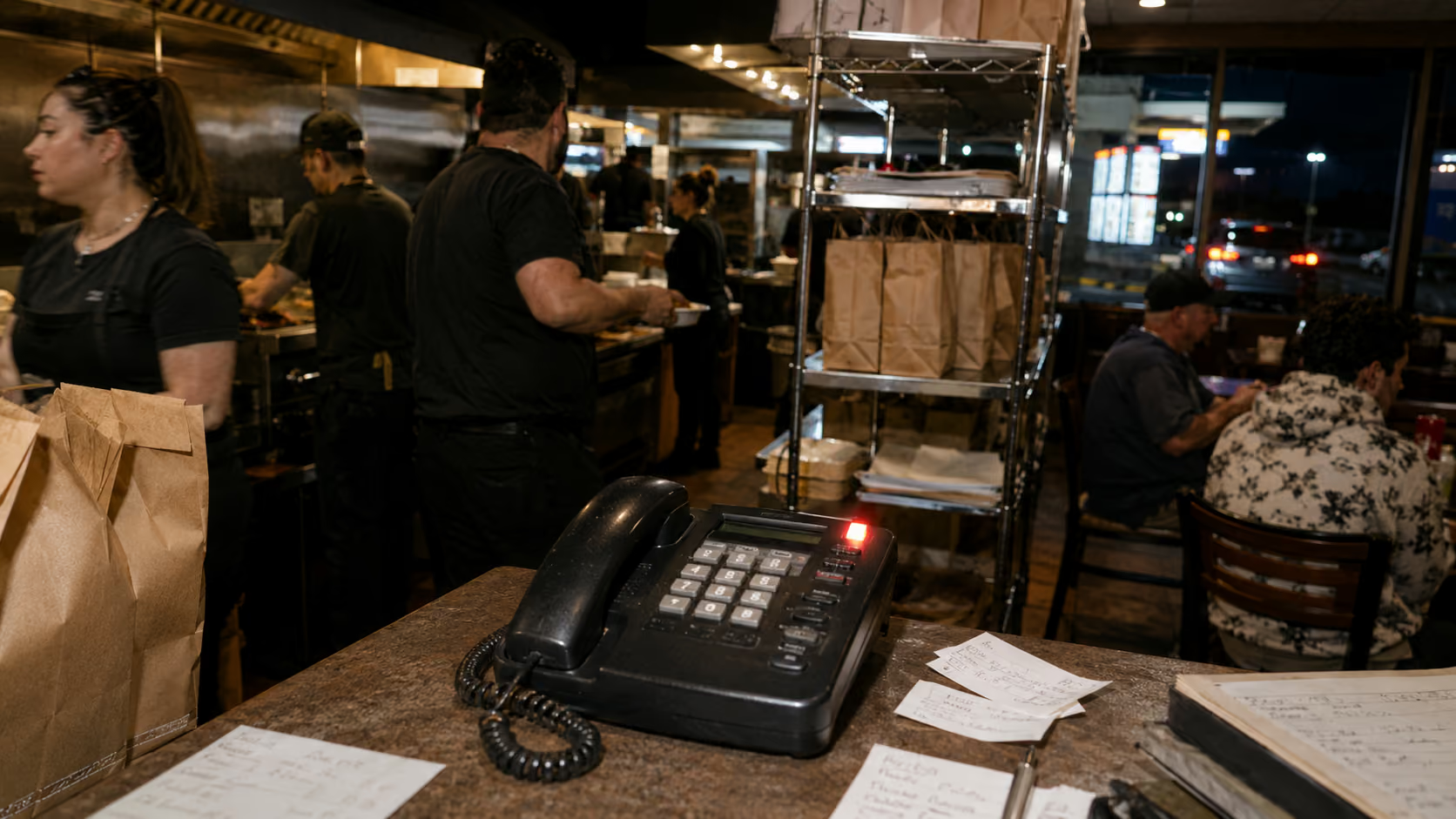
Now go stand in your own dining room and ask what your equivalent is. For most independents there is no lane. There is a phone on the wall that rings during the exact 90 minutes nobody on your team can pick it up.
The channel you are actually losing
Here is the part that annoys me about the coverage. Every article treats the drive-thru as the frontier and the phone as a leftover. For an independent it is the reverse.
Your phone carries the orders with the highest value in the building. Catering calls start on the phone. Big family takeout orders start on the phone. Someone asking whether you can do a table of 14 on Saturday starts on the phone. Those are not $9 tickets, and they almost never arrive through an app.
Boardwalk Pizza captured over $70,000 in orders that had been slipping away on unanswered calls, and freed up 195 hours of staff time doing it. Manhattan Deli and Grill added $30,000 a month. Those numbers did not come from making a line move faster. They came from picking up a phone that used to ring out.
I used to think the phone was just a cost of doing business, so I know how easy that assumption is to hold. We would let it ring during a rush and tell ourselves the good customers would call back. Some did. I have no idea how many did not, and that is exactly the problem: a missed call leaves no trace in your till. You cannot see the hole, so you never fix it.
What the Deliverect deal really signals
Ignore the two brand names for a second and look at the shape of the thing.
A voice platform plugged itself into an order-routing layer that already touches 80,000 locations and 550 tills. That is not a product launch, it is a distribution move. It means voice ordering is about to stop being a custom build for chains with an engineering team, and start being something that arrives through infrastructure you may already be paying for.
The window where "we have voice AI and our competitor doesn't" is a real advantage is closing. Not this year, probably not next. But it is closing, and the operators who set this up while it is still unusual will have a year or two of collecting orders their neighbours are still dropping.
What I would do this month
Four things, and none of them require a budget meeting.
Count what you are missing. Call your own restaurant at 7pm on a Friday from a number your staff will not recognise. Then do it again on Saturday. If it rings out or lands in voicemail, you have your answer, and it costs you nothing to find out.
Work out what one missed call is worth. Take your average takeout ticket and multiply it by the calls you just watched go unanswered. Then multiply by 30. Most operators I show this to go quiet for a second.
Check whether your till can even accept a phone order automatically. Certus AI works with all major POS systems including Toast, Square, Clover, Skytab, and Aloha NCR, so orders land in the kitchen the same way a server would enter them. If a system cannot do that, you are just moving the typing to someone else.
Cover Spanish properly. Certus answers in English and Spanish and switches automatically based on the caller. In a lot of neighbourhoods that alone is the difference between taking an order and losing one.
We charge flat monthly pricing, set up the same day, and back it with a 30-day money-back guarantee. Our Trustpilot rating is 4.5 stars. If you want the longer comparison of what is out there, I have written up the best SoundHound alternatives for restaurants and an honest breakdown of Loman AI.
The bit nobody in the trade press will say
The chains are not smarter than you. They are better instrumented.
They found their biggest leak because they count cars, and a slow lane shows up in a report every single morning until somebody fixes it. Your biggest leak shows up nowhere, because a phone that rings out generates no data at all. No ticket, no timestamp, no line item, nothing. You cannot manage a number that was never recorded.
That is the whole distance between your restaurant and an 890-store rollout, and it is a measurement gap rather than a money one. Two phone calls this Friday will tell you how wide yours is. Nobody in the trade press will write a word about it when you close it, and your bank account will not care.
About the author
I'm Gurveer Singh, co-founder and CEO of Certus AI. I grew up in my family's restaurants and was helping manage 11 of them by 17, from takeaway counters to a brewery. I started Certus because the phone was the one part of the operation nobody had fixed, and it was quietly costing us more than anything on the menu.
References
- Deliverect and SoundHound AI partnership announcement, July 23, 2026 - stocktitan.net
- "Taco Bell's drive-thru voice AI expands to nearly 900 restaurants," Nation's Restaurant News, July 2026 - nrn.com
- "Taco Bell Now Has Drive-Thru AI Ordering in About 900 Locations," QSR Magazine, July 2026 - qsrmagazine.com
- "Taco Bell Expands Drive-Thru Voice AI to Nearly 900 Restaurants Across the U.S.," Restaurant Technology News, July 2026 - restauranttechnologynews.com

.svg)
.svg)
.svg)
.svg)