.svg)

.svg)


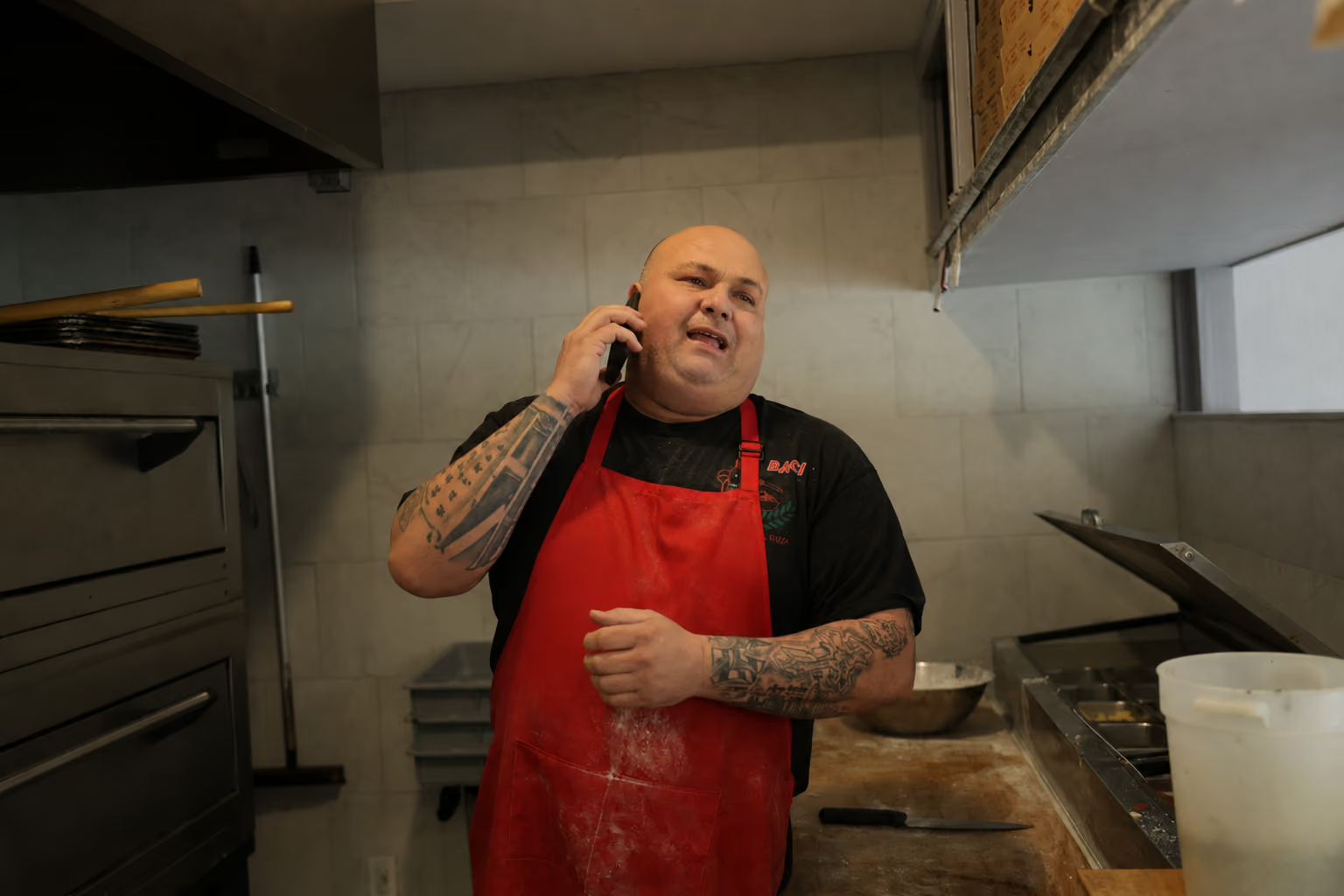
Here is a bill I want you to picture: $750 a month, for phones. That is what a busy trattoria in Naples, Florida was paying for five traditional phone lines - $150 per line, every month. Five lines was what the phone company said it would take for callers to stop hitting a busy signal. And on Friday nights the calls still rang out. Because a phone line does not answer a phone. A person answers a phone, and every person in that building was carrying plates.
That restaurant is Baci Trattoria, and I will come back to what happened to those five lines. First, the prices.
What VoIP is, and what it costs in 2026
VoIP stands for Voice over Internet Protocol. In plain English: your phone calls travel over your internet connection instead of an old-fashioned phone line. You buy it as a monthly subscription, priced per user - a "user" means each person or handset on the account. A small restaurant typically needs two or three.
Here are the real published prices right now:
| Provider | Entry price | The catch |
|---|---|---|
| Zoom Phone | from $10/user/month | At that price you also pay for every minute of every outbound call. A restaurant that calls customers back a lot will spend past the flat-rate plan quickly |
| Nextiva | $15/user/month | That price requires annual billing. Pay month to month and it becomes $23 |
| Ooma Office | $19.95/user/month | The steady, boring option, and boring is fine |
| RingCentral | $20-35/user/month | Also annual pricing. Month to month runs $30-45 |
So a modern setup for a small restaurant costs roughly $30-70 a month. Next to that $750 traditional-line bill, it looks like a miracle. And honestly, as a way to pay less for phone service, it is a good deal. Take it.
But look closely at what those subscriptions include. Call routing. Hold music. Voicemail transcription. An auto attendant - that is the recorded menu that picks up first and says "press one for hours, press two for directions." Every feature on the list manages callers who are waiting. Nothing on the list answers the call. Answering is still done by your staff, in the middle of dinner service, or by nobody.
The question no phone company asks
Nobody selling phone service has ever asked a restaurant the only question that matters: who is going to pick up?
They ask how many lines you want. How many handsets. Which features. These products were designed for offices, where a receptionist sits by the phone all day. A restaurant is the opposite of that. The moment your phone rings hardest is the exact moment every person who could answer it has their hands full.
I ran 11 of my family's restaurants growing up, and we fell for every version of the upsell. A second line for the lunch rush. A third line "for catering." Each one felt like progress. Each one just meant more callers could ring into a building where nobody was free to talk.
How many phone lines does a restaurant actually need?
Here is what a phone line really buys: the ability for one more call to ring at the same time. That is all. It does not buy the answering.
And restaurant calls do not spread themselves evenly through the day. They pile into the same ninety minutes as your busiest service. That is how a restaurant with five lines still misses calls, and it is why research reported by Restaurant Dive found that 50% of calls to restaurants go unanswered. Half. No matter how many lines.
So the honest answer: one or two lines, plus something that actually answers them. Any line beyond that is a monthly fee for a problem the line cannot fix. If you keep extra lines because of one nightmare Mother's Day three years ago, the phone company has been collecting on that memory ever since.
The full math, three ways
Put the whole picture on one page. A typical independent restaurant, plenty of phone orders, $40 average order:
- Traditional phone lines, Frank's version: $750 a month for five lines, and still six or seven missed calls a night. The most expensive way ever invented to buy the ability to miss calls.
- VoIP: around $50 a month for two users. The cheapest bill of the three - but at dinner rush, the recorded menu is still routing callers to a human who cannot come to the phone. The missed calls survive the upgrade untouched. And missed calls are the real money. Run it yourself: calls per day, times the share that ring out, times your average order, times 365 days. For a typical independent - say 25 calls a day, a quarter missed during service, $40 orders - that is $87,600 a year in orders that never reached you.
- One or two lines, plus an AI that answers: this is what we built Certus AI to do. It picks up every call instantly - every call at once if it has to - speaks English and Spanish, takes the complete order with sizes and modifications, and sends the ticket straight into your POS system, whether that is Toast, Square, Clover, Skytab, or Aloha NCR. Flat monthly pricing, meaning the busy Friday costs the same as a quiet Tuesday. The number of lines stops mattering, because no caller ever waits for a human.
The point is not that VoIP is bad. VoIP is fine. The point is that your phone bill was never the leak. Saving $700 on phone service feels great until you set it next to the $87,600 the phone service was never going to catch.
What happened at Baci
Frank, the owner of Baci Trattoria, had taken the traditional route to its logical end: five lines, $750 a month, and still losing calls every night - some of them $200 catering orders. The lines were there. The answering was not.
Then he put Certus on the phones. Since then the AI has taken more than 1,000 orders, recovered over $50,000 in revenue from calls that used to ring out, and given his staff back over 130 hours they used to spend tied to the phone. The full Baci case study has the details, and its title gives away the ending: five phone lines became one AI.
What to actually do, in order
- Count before you buy anything. For one week, keep a tally sheet by the till: calls you heard ring, calls someone answered. If the two numbers match, buy the cheapest VoIP plan in the table and stop reading. You are the exception, and I am happy for you.
- Cancel the just-in-case lines. Every extra line is a monthly fee for insurance that cannot pay out - a line has never once answered itself. Cancel and watch nothing bad happen.
- Get both quotes on the same page. The VoIP quote, the AI quote, and your missed-call tally from step one, side by side. You will not need a salesperson to explain the answer.
Phone companies sell the ability to receive calls, because that is what they have always sold. Your customers are not calling to be received. They are calling to order dinner. Buy the thing that takes the order.
Want to hear what one line plus an AI sounds like on your own menu? Book a demo. Twenty minutes, and you will know.
References
- GetVoIP, "RingCentral vs Nextiva: Head-to-Head Comparison (2026)" - getvoip.com
- 2026 business VoIP pricing roundups (Zoom Phone, Ooma Office) - technologyadvice.com
- Restaurant Dive, "DoorDash adds automated AI phone ordering" - restaurantdive.com
- Certus AI, Baci Trattoria case study - certus-ai.com

.svg)
.svg)
.svg)
.svg)