.svg)
.svg)

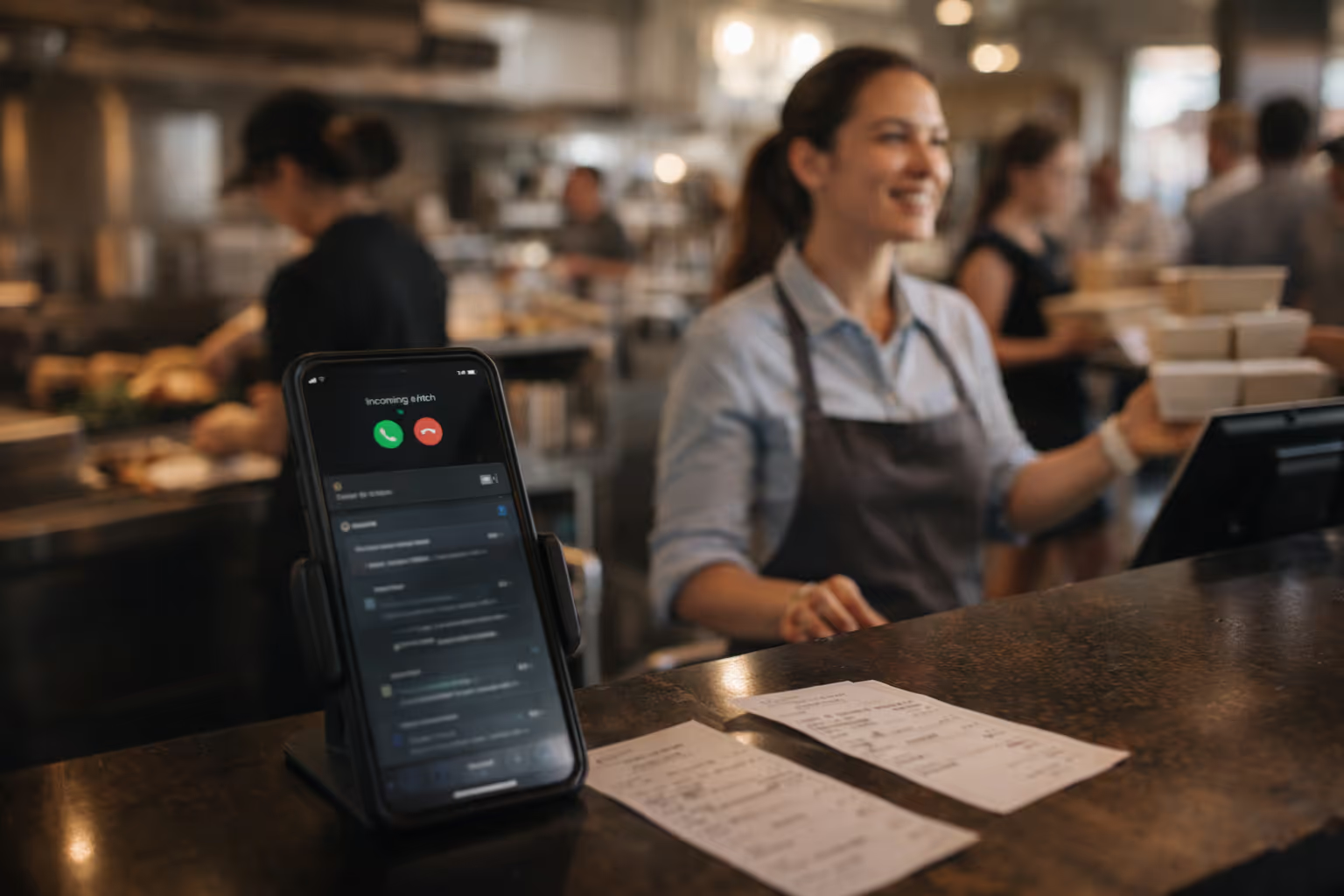
You need an AI phone agent to stop losing money on missed calls. Loman AI keeps coming up in your research. But before you commit to a $299 monthly subscription, you should know what else is available.
Certus AI offers capabilities that Loman AI simply can't match. The difference shows up in features that directly impact your bottom line: smarter integration, better reliability, and technology built specifically for restaurant complexity.
Here's what actually matters when comparing these two platforms.
What restaurant voice AI needs to get right
Any AI ordering system should handle the basics. Answer calls instantly. Take orders without errors. Book reservations. Process payments. Integrate with your POS.
Research shows restaurants lose about $27,000 a year from missed orders, with 43% of calls going unanswered.
Both Certus AI and Loman AI claim these capabilities. The real question is execution. How well do they handle complex orders during Friday dinner rush? What happens when the POS connection drops? Can they upsell naturally without sounding robotic?
This is where differences become clear.
Automated Order processing and payment handling
Loman AI processes orders during calls and syncs with POS systems, including Square, Toast, Clover, and Revel. Their Standard plan at $299 monthly covers up to 500 minutes for one location.
The system takes orders, repeats them back, and sends tickets to your kitchen display. Payment processing happens through your existing gateway.
Certus AI processes orders the same way, but adds critical capabilities Loman lacks, such as:
Failsafe backup ordering
When POS integrations fail, most AI systems just stop working. Orders get lost. Revenue disappears. Certus AI includes a Failsafe feature that automatically calls your restaurant and manually places the order with staff if the digital connection drops.
This matters more than it sounds. POS systems crash. The Internet goes down. Third-party APIs have outages. When your ordering system fails during Saturday dinner rush, every minute of downtime costs hundreds in lost sales.
Loman AI doesn't offer backup ordering. If the integration fails, orders fail.
Lifetime conversational context
Certus AI’s voicebot remembers customers across calls. When someone who ordered last week calls back, the system recognizes them by phone number and voice. It knows their past orders, dietary preferences, and usual modifications.
This creates genuinely personalized service. "Hey John, want your usual pepperoni pizza with extra cheese?" sounds human because the AI actually remembers John's order history.
Loman AI processes each call independently. There's no memory between interactions. Every customer is treated like a first-time caller.
That said, let’s look at the other features where these two platforms differ and how they compare in real restaurant use.
Voice-AI integration depth and reliability
Loman AI integrates with major POS systems. Their setup process promises deployment in under 24 hours. They offer white-glove onboarding and claim seamless connection to Toast, Square, Clover, and Revel.
Certus AI's onboarding only takes 45 minutes. It integrates with 45+ POS platforms and delivery systems. What matters more is how well those integrations work.
Most AI phone systems integrate with standard POS. When those APIs work, orders flow smoothly. When they don't, the whole system breaks.
Certus AI handles integration failures gracefully through Failsafe. It also provides deeper data sync across platforms. Order history, customer preferences, and payment details stay synchronized across your entire tech stack.
Certus AI typically goes live within an hour, with most time spent on menu configuration rather than technical setup.
Upselling and revenue optimization
Loman AI includes upselling capabilities. The system can suggest add-ons during orders and track which recommendations convert. Restaurant owners adjust which items get promoted through the dashboard.
Certus AI's upselling is more sophisticated. The AI learns which suggestions work based on order context, customer history, and real-time conversion data.
A customer ordering two large pizzas gets different recommendations than someone ordering a single personal pie. Someone who always declines dessert stops getting dessert offers. High-value customers receive premium add-on suggestions.
This intelligent upselling increases average order values by 15-20% for Certus users. The AI optimizes recommendations automatically without requiring constant manual adjustment.
Both platforms claim revenue increases from capturing missed calls. Certus AI users report recovering six figures annually. One pizza restaurant went from missing 60 calls daily to capturing every order, generating $400,000 in additional annual revenue.
We’ve also compared Slang AI’s alternatives in detail, including the limitations restaurant owners run into after deployment.
Voice AI with Multi-language support and accent handling
Loman AI offers multi-language support with natural conversation across different languages. The platform handles various accents and regional speech patterns.
Certus AI supports English, Spanish, French, and additional languages with automatic detection. The system switches languages mid-conversation when it detects the customer's preference.
More importantly, Certus is specifically trained on South Asian, East Asian, and Caribbean accents. Restaurant owners with diverse customer bases report significantly better order accuracy because the AI actually understands different pronunciation patterns.
This isn't just marketing. How restaurants use AI to automate orders demonstrates that accent recognition directly impacts order accuracy and customer satisfaction.
Pricing and value comparison
Loman's Standard plan covers single-location restaurants with moderate call volume. Premium adds voice cloning and multi-location support. Enterprise requires direct contact for custom pricing.
Certus AI pricing is customized based on your specific operation. This allows for more flexible arrangements that match actual usage rather than forcing you into predetermined tiers.
For restaurants with variable call volume, tiered minute limits can become expensive quickly. A busy weekend could burn through your monthly allocation in days, triggering overage charges or requiring immediate plan upgrades.
Certus AI offers unlimited call handling without minute caps. You pay for the service, not per-call fees.
What restaurant owners should evaluate
Before committing to any AI ordering system, test these specific scenarios:
1. Complex order handling
Place a test order with multiple modifiers: “Large pepperoni pizza, light sauce, extra cheese on half, well done, add mushrooms and black olives only on the half without extra cheese, plus a side of ranch.”
This is a practical way to see whether an AI phone agent for restaurants can handle complex orders, repeat them clearly, and send a correctly structured ticket to the kitchen display without errors.
2. Peak volume stress testing
If possible, simulate multiple simultaneous calls. Do all calls get answered? Is there any degradation in conversation quality or order accuracy?
3. Integration failure response
Ask what happens when the POS connection drops. Does the system have backup processes? Will orders still reach your kitchen?
4. Customer recognition
For returning customers, does the system remember past orders and preferences? Can it provide personalized service?
5. Upselling intelligence
How does the AI handle upselling? Are suggestions contextually appropriate? Does the system learn which recommendations work?
These practical tests reveal real performance better than marketing materials or feature lists.
Understanding how to implement voice AI in restaurants helps frame realistic expectations for deployment timelines and operational impact.
The best AI ordering system for serious restaurant operators
Loman AI provides basic AI phone functionality at a clear price point. For very small operations with minimal call volume and simple menus, it might be sufficient.
For restaurants serious about maximizing revenue, protecting against downtime, and creating exceptional customer experiences, Certus AI offers capabilities that Loman simply can't match.
The difference isn't just features. It's fundamental architecture. Certus is built for reliability and intelligence from the ground up. Failsafe isn't an add-on; it's core infrastructure. Conversational memory isn't a future roadmap item; it's working in production today.
When you're choosing voice AI for restaurants, you're making a bet on which platform will help you compete effectively as voice AI becomes an industry standard.
The restaurants pulling ahead in 2026 are those investing in technology that actually delivers results, not just answers phones.
Ready to see the difference Certus AI makes for restaurants that take phone revenue seriously? Book a free demo and experience the capabilities that Loman AI can't provide.




.svg)